
Sentiment Analysis for Social Media Crises
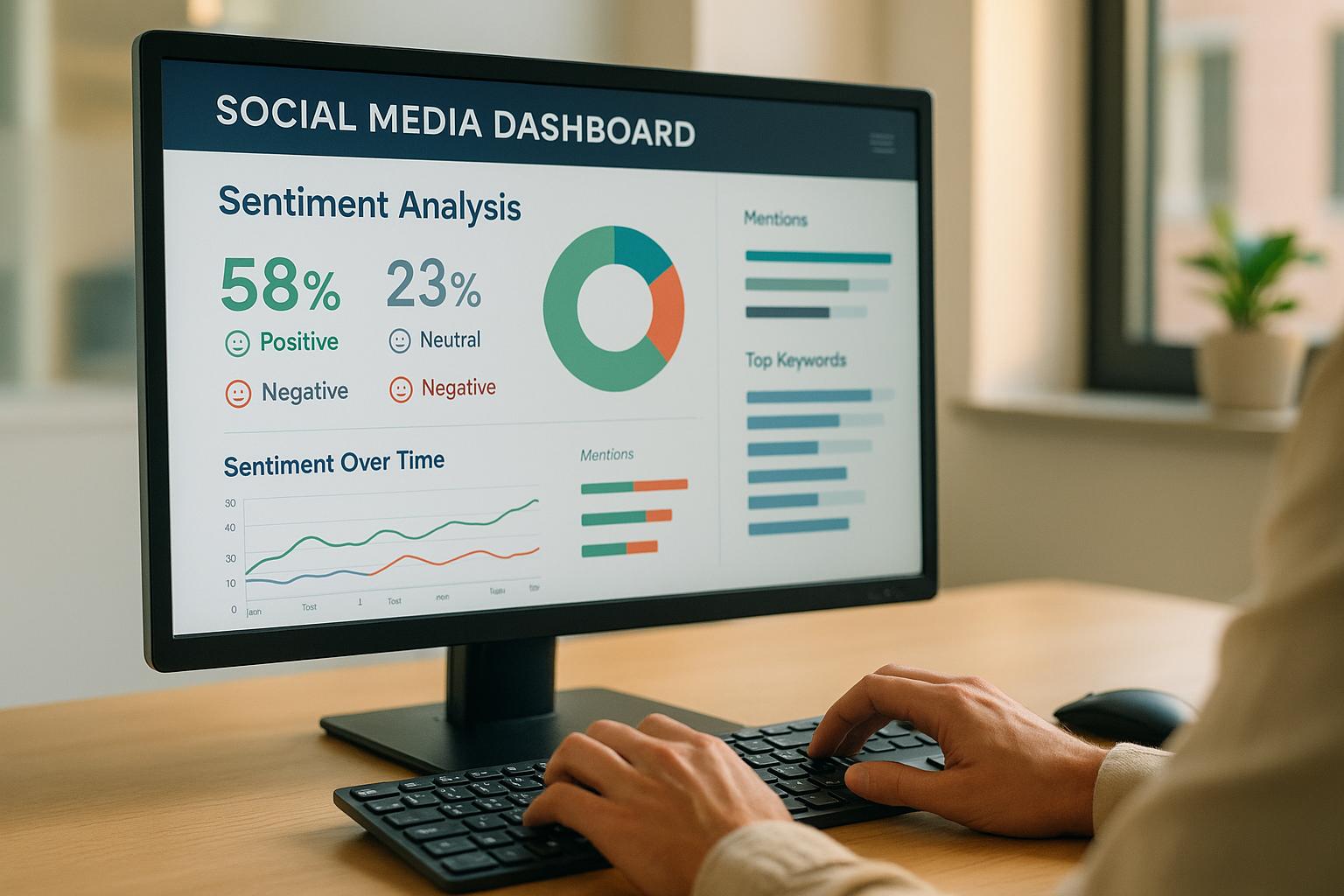
Social media crises can escalate fast, with 28% going global within an hour. Businesses face reputational and financial risks when negative sentiment spirals out of control. Sentiment analysis, powered by AI, helps detect and manage these crises by monitoring public opinion in real time.
Key takeaways:
- What is it? Sentiment analysis uses AI to interpret emotions in online content, categorizing it as positive, negative, or neutral.
- Why it matters: It enables early detection of issues, real-time monitoring, and data-backed crisis responses, minimizing damage.
- How it works: By analyzing words, emojis, and hashtags, AI tools identify shifts in sentiment and provide actionable insights.
- Limitations: Sarcasm and nuanced language can confuse automated systems, requiring human oversight.
Examples: Adidas quickly ended its Kanye West partnership in 2022 after tracking negative sentiment. In contrast, United Airlines’ delayed response in 2017 led to a $1.4 billion loss.
Sentiment analysis is a must-have tool for businesses navigating today’s fast-moving digital landscape. Combining AI insights with human judgment ensures effective crisis management.
How To Effectively Track Public Sentiment In Crisis Communication? - Communications Jobs
How Sentiment Analysis Works
Sentiment analysis uses AI to interpret online emotions, especially during crises. Building on the foundation of crisis management, understanding how this technology operates can lead to quicker, more informed decisions.
Sentiment Analysis Technology Basics
The core of sentiment analysis lies in Artificial Intelligence (AI), Natural Language Processing (NLP), and machine learning [1]. Together, these technologies analyze and decode human emotions expressed in text.
AI models are trained on massive social media datasets, enabling them to spot patterns in how people express positive, negative, or neutral feelings. They pick up on both obvious words like "hate" or "love" and more subtle expressions.
NLP breaks down text into its components, examining word choice, structure, and context. For instance, in the phrase, "This customer service experience was absolutely incredible", NLP identifies "incredible" as a positive sentiment tied to the context of customer service.
Machine learning further sharpens this process by learning from new data over time, improving accuracy with each input.
A real-world example? Tesla has relied on AI-driven sentiment analysis to manage public perception during product recalls. By identifying negative sentiment early, the company could adjust its messaging quickly [4].
This technology doesn’t stop at text. It also processes emojis, hashtags, and engagement patterns. For example, a post with crying emojis paired with negative text indicates dissatisfaction, while heart emojis typically signal positive reactions [1].
How Sentiment Gets Categorized
Sentiment analysis systems classify content into three main categories: positive, negative, or neutral [1]. Words like "fantastic", "amazing", and "excellent" are flagged as positive, while terms such as "terrible", "awful", and "disappointed" are marked as negative.
But it’s not just about individual words. These systems also analyze context. For example, the phrase "not bad" might include a negative word, but its meaning is mildly positive or neutral. Hashtags play a similar role; tags like #fail or #boycott clearly indicate negative sentiment, while #love or #amazing suggest positive feelings. In times of crisis, hashtags often become focal points for public sentiment.
Sentiment trends are tracked over time using scores ranging from -1 (very negative) to +1 (very positive), with 0 being neutral. Monitoring shifts in these scores can help detect potential crises. For example, if a brand typically sees 70% positive mentions but suddenly experiences 50% negative feedback, the system will flag this as a concern [1].
Yelp uses sentiment analysis to address customer complaints in real-time, helping to improve user satisfaction and prevent minor issues from escalating into larger problems [4].
| Traditional Analysis | AI-Powered Sentiment Analysis |
|---|---|
| Manual review of individual posts | Automated processing of thousands of posts per second |
| Subjective human interpretation | Consistent, data-driven classification |
| Limited to small sample sizes | Comprehensive analysis across all mentions |
| Reactive approach | Proactive trend detection |
Automated Sentiment Analysis Limitations
Despite its advancements, sentiment analysis isn’t perfect and still requires human oversight.
One major challenge is sarcasm detection [1]. For example, a tweet saying, "Great job on that product launch!" after a publicized failure might mistakenly be read as positive when it’s clearly sarcastic.
Contextual nuances also complicate things. Words can have different meanings based on context. A post saying, "This is sick!" could express either disgust or admiration, depending on the speaker’s intent. Similarly, ambiguous expressions like "Well, that happened" or "Interesting choice" can confuse automated systems. Cultural differences and evolving language trends add even more complexity.
These limitations become especially risky during crises, where misreading public sentiment can result in poorly executed responses. This is why human oversight is critical. By combining the speed of automated analysis with human expertise, organizations can better interpret complex situations and respond effectively [1].
Take Starbucks, for instance. In 2018, the company faced backlash after two Black men were wrongfully arrested at one of its stores. Using sentiment analysis, Starbucks monitored public reactions, issued a swift apology, and closed 8,000 stores for bias training. Continued sentiment tracking helped guide their actions and minimized long-term damage to their brand [1].
These examples highlight why blending technology with human judgment is key to navigating crises successfully.
Benefits of Using Sentiment Analysis During Crises
When a social media crisis hits, sentiment analysis can be a game-changer. This tool offers three major advantages that can help you navigate challenging situations and protect your brand's reputation.
Early Detection of Negative Sentiment Trends
Think of sentiment analysis as your crisis radar. Instead of waiting for a flood of complaints or issues to spiral out of control, AI-powered tools can detect shifts in sentiment as they happen. For example, if positive mentions drop from 70%, these tools can send immediate alerts, giving you a heads-up before things escalate.
But it’s not just about counting negative posts. Sentiment analysis identifies patterns and trends, helping you pinpoint when and where intervention is needed. This proactive approach ensures you’re not caught off guard and allows for continuous monitoring.
Real-Time Crisis Monitoring
Once a crisis is underway, sentiment analysis acts like a real-time barometer for public opinion. AI tools can process thousands of social media posts per second [4], giving you instant feedback on how your response is landing. If negative sentiment continues to grow, you can quickly refine your strategy.
These tools also reveal platform-specific trends. For instance, you might find that negative feedback is concentrated on one social network while others remain more neutral or positive. This insight lets you adjust your messaging to address concerns where they’re most pressing, keeping your response agile and effective.
Data-Driven Crisis Management
Sentiment analysis turns crisis management into a more strategic process. By analyzing public sentiment data, you can make informed decisions rather than relying on guesswork. For example, if the analysis shows a surge in negative sentiment on a specific platform, your team can focus its efforts there.
Beyond prioritizing responses, these insights help fine-tune your messaging by identifying the root causes of negative reactions. Instead of just addressing surface-level complaints, you can tackle the underlying issues driving the backlash.
AI-powered tools boast accuracy rates of 90% or higher [4], far outpacing manual methods. This precision ensures your team has reliable data to guide their actions.
| Traditional Crisis Management | Sentiment Analysis-Driven |
|---|---|
| Reactive responses with limited feedback | Proactive decisions backed by comprehensive data |
| One-size-fits-all messaging | Tailored communication based on platform-specific insights |
| Delayed understanding of public sentiment | Real-time tracking and strategy adjustments |
| Resource allocation based on assumptions | Focused efforts on high-impact areas |
Perhaps the most valuable aspect of sentiment analysis is its ability to measure the effectiveness of your crisis response. You can track how sentiment improves over time, evaluate which strategies work best, and use these insights to strengthen your team’s preparedness for future challenges.
Pressmaster.ai integrates sentiment analysis with content creation and distribution, ensuring your messaging stays consistent while monitoring public reactions. This dual capability makes it an essential tool for PR teams handling complex crisis communications across multiple platforms [1][3].
Steps to Implement Sentiment Analysis for Crisis Management
Using sentiment analysis for crisis management requires a structured approach. It’s all about setting clear benchmarks, choosing the right tools, and weaving these insights into your existing crisis response strategies.
Setting Up Baseline Sentiment and Alerts
Before you can identify a crisis, you need to know what "normal" looks like for your brand. Establishing a baseline sentiment helps you spot when public perception veers away from typical patterns and into crisis territory. Without this foundation, it’s tough to differentiate between routine fluctuations and actual threats [1][4].
Start by tracking your brand mentions across major platforms during a calm period. This includes monitoring mentions of your brand name, common misspellings, product names, key personnel, and campaign hashtags.
Your baseline should include metrics like average sentiment scores, daily mention volumes, and typical engagement rates across platforms. Once you’ve got these benchmarks, set up automated alerts for significant changes in sentiment. These alerts should trigger when metrics deviate from the norm. Make sure your system also tracks industry-specific terms and crisis-related keywords - like "outage", "problem", "lawsuit", "boycott", or "scandal" - and uses geo-fenced tracking to catch localized issues.
With your baseline and alerts in place, the next step is finding the right tools to analyze sentiment effectively.
Choosing the Right Tools for Sentiment Analysis
Picking the right sentiment analysis tools is key to managing crises effectively. The best platforms combine real-time monitoring across multiple channels with AI-powered analysis capable of processing thousands of posts per second, all while maintaining high accuracy [4].
Look for tools that offer automated sentiment classification (positive, negative, neutral), trend analysis, and anomaly detection. Multi-platform coverage is a must in today’s fragmented social media landscape. Opt for tools that provide real-time monitoring across platforms and integrate seamlessly with your crisis management systems.
For example, Pressmaster.ai combines trend analysis and real-time monitoring with automated content creation and distribution. During a crisis, this allows teams to quickly detect spikes in negative sentiment, craft appropriate responses, and distribute them across multiple platforms - all from one dashboard.
Customizable dashboards and reporting features are also crucial, ensuring that team members can access the insights most relevant to their roles. And don’t forget scalability - a tool that works well under normal conditions should also handle the increased data flow during a crisis.
Adding Sentiment Insights to Crisis Plans
Once you’ve chosen the right tools, the next step is to integrate their insights into your crisis management protocols. Real-time sentiment dashboards can guide decision-making, replacing guesswork with data-driven actions [1][2].
Start by defining escalation procedures tied to sentiment thresholds. For example, if negative sentiment surpasses your baseline, you might intensify monitoring or activate your crisis response team.
Assign specific roles to team members for monitoring and interpreting sentiment data. This could include a social media manager for real-time updates, a communications director for platform-specific trends, and a data analyst to identify broader patterns. Clear role assignments ensure no critical insights slip through the cracks.
Use sentiment data to prioritize where and how you respond. For instance, if negative sentiment is concentrated on Twitter while other platforms remain neutral, focus your efforts on Twitter. Tailor your messaging to address the specific concerns revealed by the analysis - if users are worried about data security, make that the focus of your communication.
Finally, create feedback loops to measure how your responses impact sentiment. Track changes in sentiment scores after each action or message. Document these patterns and outcomes to refine your future crisis plans. This ensures your team is better prepared for whatever challenges come next.
Incorporating sentiment analysis into your crisis strategy shifts your approach from reactive to proactive. With 28% of social media crises going global within an hour [1], having a data-driven system in place can mean the difference between containing an issue and watching it escalate.
Real-World Applications and Key Takeaways
Case Studies of Sentiment Analysis in Action
Real-world examples highlight how sentiment analysis can shape crisis management and decision-making. These case studies illustrate how companies have navigated public backlash by leveraging sentiment tracking.
Take the 2017 United Airlines incident, where a passenger was forcibly removed from a flight. Real-time sentiment tracking exposed a massive spike in negative reactions almost immediately. However, the company’s delayed response allowed the situation to spiral, leading to a staggering $1.4 billion loss in market value [1].
In contrast, Adidas handled the 2022 Kanye West controversy with remarkable speed. When negative mentions surged after his inflammatory remarks, sentiment analysis tools flagged the issue within hours. This swift detection enabled Adidas to terminate their partnership quickly, limiting potential harm to their brand [1].
These cases highlight how critical it is to act on reliable sentiment data promptly. Up next, we’ll dive into the metrics that help measure and refine these responses.
Key Metrics and Outcomes
To effectively manage crises, organizations rely on specific metrics that translate sentiment analysis into actionable insights. These metrics help gauge the severity of a crisis and the success of the response.
One of the most important factors is response time. Research shows that 28% of social media crises can go global within just one hour [1]. Companies using AI-driven sentiment analysis tools report significantly faster response times compared to traditional methods. These tools can process thousands of posts per second with an impressive 90% accuracy rate [4].
Another critical measure is sentiment recovery time - the period it takes for public sentiment to return to normal. The speed and quality of a company’s response heavily influence this metric. Negative posts often generate more engagement than positive ones, amplifying the impact of a crisis.
Here’s a quick breakdown of key metrics:
| Metric Category | Key Measurements | Crisis Impact |
|---|---|---|
| Volume | Daily mention count, spike magnitude | Reveals the scale and reach of the crisis |
| Velocity | Rate of sentiment change, spread across platforms | Highlights urgency and the need for containment |
| Recovery | Time to baseline, sustained improvement | Reflects how effective the response is |
The financial implications of response speed are clear. United Airlines suffered enormous losses due to a delayed reaction, while companies like Tesla have demonstrated the value of AI sentiment analysis during product recalls. Tesla uses these insights to track public perception and fine-tune messaging, ensuring proactive crisis management [4].
Conclusion and Final Thoughts
As we’ve seen, real-time sentiment analysis is transforming crisis management from a reactive process to a proactive one. AI tools capable of analyzing massive amounts of social media data allow companies to identify potential issues early and respond with precision.
Platforms like Pressmaster.ai take this a step further by integrating sentiment analysis with crisis communication tools. Features like trend detection and AI-generated content ensure consistent and timely messaging across all channels. This seamless integration gives organizations a critical edge when every second counts.
For example, Yelp uses sentiment analysis to address customer complaints in real time. This not only improves user experience but also prevents negative sentiment from escalating [4]. Incorporating sentiment analysis into broader public relations strategies is quickly becoming the norm.
Ultimately, successful crisis management requires a balance between AI-driven insights and human expertise. While technology excels at processing data at lightning speed, human judgment is essential for understanding context and nuances. Companies that invest in robust sentiment analysis tools today will be better equipped to protect their reputation and maintain trust in an ever-evolving social media landscape.
FAQs
How can sentiment analysis help manage and control social media crises?
Sentiment analysis is a key tool for spotting and managing potential social media crises before they escalate. By examining the tone and emotions in online conversations, it helps organizations pick up on negative trends, identify unhappy customers, and flag potential PR problems early.
With this insight, teams can act quickly, craft the right responses, ease tensions, and work to restore trust. Tools like Pressmaster.ai make this process smoother by offering real-time monitoring and supporting effective crisis management efforts.
What challenges does AI-powered sentiment analysis face, and how can businesses address them?
AI-driven sentiment analysis often falters when it comes to grasping subtleties like sarcasm, slang, or regional expressions, which can lead to misinterpretations. For instance, a sarcastic remark might be taken at face value as positive, throwing off the entire analysis.
To tackle these issues, companies can pair AI tools with human judgment to cross-check results and fine-tune interpretations. Regularly updating the AI with fresh, relevant data - like industry jargon or local language nuances - can also sharpen its accuracy. This blend of technology and human insight ensures businesses get the most out of sentiment analysis, especially during social media crises.
Why is it essential to combine AI-driven sentiment analysis with human judgment during a social media crisis?
Using AI-driven sentiment analysis alongside human judgment creates a well-rounded approach to handling social media crises. AI shines in its ability to sift through mountains of data at lightning speed, spotting trends, detecting emotions, and flagging potential red flags. However, it often struggles with understanding subtle nuances like sarcasm, cultural context, or layered meanings.
This is where human expertise comes in. People bring the ability to interpret complex situations, make ethical calls, and craft responses that resonate with the specific tone and needs of the moment. By blending AI's efficiency with human insight, brands can respond to sensitive situations more accurately and empathetically. This partnership helps safeguard your brand's reputation while maintaining the trust of your audience.
Related Blog Posts





Sign Up for our Pressmaster Newsletter
Sign up for our Pressmaster.ai newsletter to get instant alerts on trending topics, ensuring you stay ahead in your field with the latest insights and updates.







7 Viral Patterns That Drove 10,643% Growth
Turn natural conversations into content gold, make every insight count, and drive real conversations.

Please fill out the form to get our Viral Cheat Sheet


How to Become a Thought Leader in 6 Easy Steps
Increase your visibility, establish authority, and conquer your market with minimal effort.

Please fill out the form to get our PDF Checklist
