
AI Content Strategy That Blends Data Driven Insights With Human Emotion

Balancing data and emotion is the key to creating effective PR content. Data ensures precision, helping you target the right audience and predict trends. Emotion, on the other hand, builds trust and connection, making your message memorable. By combining the two, you can craft stories that resonate deeply while achieving measurable results.
AI tools make this process easier by handling data-heavy tasks like audience segmentation, trend analysis, and sentiment tracking. For example, platforms like Pressmaster.ai analyze vast datasets to uncover audience behavior and emotional patterns, freeing up your team to focus on storytelling. The result? Content that’s both strategic and relatable.
Here’s how to make it work:
- Use data to identify trends, segment audiences, and track performance.
- Incorporate emotion to create stories that inspire and connect.
- Leverage AI tools for efficiency but ensure human oversight to maintain authenticity.
This approach allows PR teams to create campaigns that perform well analytically while leaving a lasting emotional impact.
The Future of Content & How AI Transforms Storytelling
Why Data Matters in PR Content
Data transforms PR from a guessing game into a precise, targeted strategy, ensuring you reach the right audience at the right time for maximum impact.
Today’s PR teams use data to segment audiences with pinpoint accuracy. Instead of sending generic messages to everyone, you can focus on specific groups based on their online behavior, interests, and even sentiment. For example, a tech startup might craft messages for early adopters keen on cutting-edge products, while a healthcare company could address patients discussing particular concerns online. This targeted approach leads to better engagement, stronger trust, and measurable results.
Data also enables PR teams to predict trends before they hit the mainstream. With AI tools scanning millions of online conversations, you can identify emerging topics weeks ahead of their peak, positioning your brand as a leader in the conversation rather than a latecomer.
Tracking performance metrics completes the cycle. By monitoring data like referral traffic, engagement rates, and conversions, you can measure what resonates with your audience and refine your strategy accordingly. For instance, data-driven content strategies have been shown to increase organic impressions by up to 4,100% in just 90 days [1].
This shift from intuition-driven PR to data-backed strategies has completely changed the game. By combining the creativity of human storytelling with the precision of data insights, PR professionals can ensure their most compelling ideas reach the right audience.
Types of Data Used in PR
PR relies on several types of data to guide content creation and distribution:
- Audience behavior patterns: Understanding how your audience interacts with your brand across digital platforms is crucial. Metrics like website clicks, email open rates, and social media engagement help identify preferences and the best times to publish content.
- Trend and topic analysis: AI tools can analyze search trends, hashtag activity, and online mentions to identify emerging themes. For instance, AI might detect a growing interest in inclusivity topics, giving you the opportunity to create timely, relevant content.
- Sentiment and emotion tracking: Advanced tools like Google Cloud Natural Language and AWS Comprehend go beyond basic sentiment analysis, detecting emotions such as joy, anger, or frustration in customer feedback and media coverage [3]. This helps PR teams adjust their messaging on the fly.
- Performance metrics: These measure the impact of your PR efforts. Metrics like reach and impressions show exposure, while engagement rates (likes, shares, comments) reveal what resonates with your audience. Conversion data - like sign-ups or demo requests - connects PR efforts to tangible business results. For example, IBM reported a 25% increase in employee satisfaction and a 15% rise in engagement after using AI-based sentiment analysis to refine internal communications [6].
Benefits of Using Data in PR
Data-driven strategies allow PR professionals to target their audiences with greater precision. Instead of casting a wide net, you can create personalized content that addresses specific interests and pain points, leading to higher engagement and better conversion rates [2][7].
Spotting trends early is another advantage. By analyzing historical and real-time data, AI can detect shifts in public conversation weeks before they peak. Acting on these insights gives your brand a competitive edge, allowing you to shape the narrative while others are still catching up [2][3][5].
Data also supports continuous improvement. By analyzing which story angles, formats, and tones perform best, you can double down on successful strategies and eliminate those that don’t work. Companies that consistently refine their PR efforts see a 20–30% improvement in campaign performance, with AI tools further boosting ROI [7].
Finally, data bridges the gap between PR activities and business outcomes. Tracking metrics like website traffic, branded search volume, and lead generation shows how PR efforts directly contribute to revenue. This shifts the focus from vanity metrics to meaningful indicators like customer acquisition costs and lifetime value.
Common Data Mistakes to Avoid
While data is a powerful tool, it’s not foolproof. One common mistake is relying too heavily on AI without human oversight. Automation can lead to generic, impersonal messaging that fails to connect emotionally. Use AI for insights like trend analysis and audience segmentation, but rely on human creativity to craft authentic, engaging stories [2][4].
Another pitfall is focusing on vanity metrics. High follower counts or impression numbers might look impressive, but they don’t always translate to meaningful results. Instead, prioritize metrics that reflect real engagement, like click-through rates, time spent on site, or demo requests.
Data quality and context are also critical. Misinterpreted data - like inflated engagement from bots or seasonal spikes in sentiment - can lead to flawed strategies. Always validate your sources, clean your datasets, and consider external factors when analyzing results.
Finally, be cautious of reinforcing biases in your data. If past campaigns targeted a specific demographic, AI might continue to suggest the same audience, potentially overlooking new opportunities. Balance quantitative data with qualitative feedback from customers, journalists, and team members to ensure a well-rounded approach.
Why Emotion Matters in PR Campaigns
Data can tell you what your audience is doing, but emotion helps you understand why they’re doing it. While metrics can highlight trending topics and predict behavior, it’s emotional connection that builds the trust and loyalty needed to turn casual followers into dedicated supporters. Numbers might show how far your message is reaching, but they won’t reveal whether your audience feels inspired, understood, or motivated.
This distinction is critical. Data-driven strategies are excellent at pinpointing the right audience and timing, but without an emotional hook, your message risks blending into the noise of an oversaturated feed. Emotional storytelling, on the other hand, taps into universal human reactions like empathy, joy, and empowerment - feelings that leave a lasting impression. When organizations combine data insights with emotional resonance, they see noticeable boosts in satisfaction and engagement.
The best PR campaigns don’t force a choice between data and emotion - they harness both. Data uncovers opportunities and measures success, while emotion provides the human element that makes content memorable and shareable.
How Emotional Stories Work in PR
Emotional stories resonate because they align with how people naturally process information. We may forget the specifics of a message, but we remember how it made us feel. Stories that evoke empathy, challenge assumptions, or inspire action create stronger connections in the brain, leading to 20–30% higher recall rates compared to purely factual content[2].
Take, for example, the "Assume That I Can" campaign for World Down Syndrome Day. Instead of leaning solely on statistics about inclusion, the campaign sparked global conversations by challenging assumptions through joyful and empowering storytelling[2]. It worked because it made people feel something genuine - a connection that no amount of trend analysis could replicate. This demonstrates how emotional storytelling complements data to create a more impactful message.
How to Balance Data and Emotion
To make the most of emotional storytelling, it’s essential to integrate it with data-driven strategies. This balance starts with a workflow that allows data and emotion to enhance each other. Begin by using AI tools to identify patterns, track trends, and segment audiences based on their behavior. These insights help determine what topics resonate most and when your audience is most likely to engage. From there, apply human emotional analysis to decide how to craft stories that build meaningful connections.
For example, AI sentiment analysis tools like Google Cloud Natural Language or AWS Comprehend can categorize customer feedback into emotions such as joy, frustration, or anger[3]. While these tools provide a solid foundation, human interpretation is critical for understanding why customers feel a certain way and what personal experiences might shape their reactions. This human touch prevents your messaging from feeling generic or disconnected[2].
In practice, you might use AI to identify a rising interest in sustainability within your audience. Then, through interviews or voice notes, your team can uncover real stories that illustrate why sustainability matters to your brand. This approach combines AI’s efficiency in processing data with the emotional depth only human storytelling can provide.
Quality control is key throughout this process. AI-generated content should always go through human review to ensure it aligns with your brand, feels authentic, and resonates emotionally. Testing the content - whether through focus groups or A/B testing - can confirm that it evokes the desired emotional response. This ensures you’re not just chasing engagement metrics but building the kind of connections that turn one-time readers into loyal advocates[4]. By blending data and emotion thoughtfully, you can create campaigns that truly stand out.
How to Build an AI-Powered PR Workflow That Keeps the Human Touch

Manual vs AI-Powered PR Workflows: Time, Insights and Precision Comparison
Creating an AI-powered PR workflow isn’t about replacing people - it’s about letting machines handle repetitive tasks so communicators can focus on what matters: crafting meaningful stories. A well-designed workflow combines the efficiency of AI with the emotional intelligence of humans, moving through five key stages: research, planning, content creation, distribution, and measurement. AI takes care of the heavy lifting, while human oversight ensures the results align with brand values and feel authentic.
The PR Content Process: From Data to Emotion
AI shines brightest during the research phase. Instead of manually combing through news feeds or social media, tools can process vast amounts of data in hours, identifying trends in audience behavior, media coverage, and sentiment. For instance, sentiment analysis tools can quickly categorize feedback by emotion, offering a clear starting point. From there, humans step in to interpret the "why" behind these emotions, adding depth by considering cultural or personal nuances.
In planning, AI can predict which topics will resonate most, group audience segments, and suggest content pillars based on past successes. Tools like an AI Strategizer can even draft campaign frameworks by analyzing business goals, audience profiles, and emotional targets. However, experienced PR professionals must still review these suggestions to ensure they align with the brand’s voice and audience expectations. This back-and-forth ensures strategies are both data-informed and deeply human.
When it comes to content creation, the collaboration between AI and humans truly stands out. AI drafting tools can generate initial versions of press releases, op-eds, and social posts based on concise briefs. Human editors then refine these drafts, weaving in real stories and adjusting the tone to resonate emotionally. Some tools even flag phrases likely to evoke strong reactions, helping writers fine-tune language before publishing.
For distribution, AI tools analyze past outreach data to recommend journalists and outlets that align with specific emotional tones. They can even suggest personalized pitch angles based on a journalist’s past work. However, building relationships still requires a personal touch. PR professionals should customize these AI-generated pitches, referencing recent articles or shared interests to maintain genuine connections. While AI can schedule outreach for optimal response rates, human judgment is vital for sensitive topics or crisis communications.
The final stage - measurement - closes the loop. AI tools track metrics like reach, engagement, and sentiment, linking them to specific messages or formats. Sentiment analysis can break down audience reactions into categories like trust, joy, or frustration, revealing what worked and what missed the mark. By comparing data-driven insights with human analysis, PR teams can refine their storytelling, creating a feedback loop that improves results over time.
How Pressmaster.ai Simplifies PR Workflows
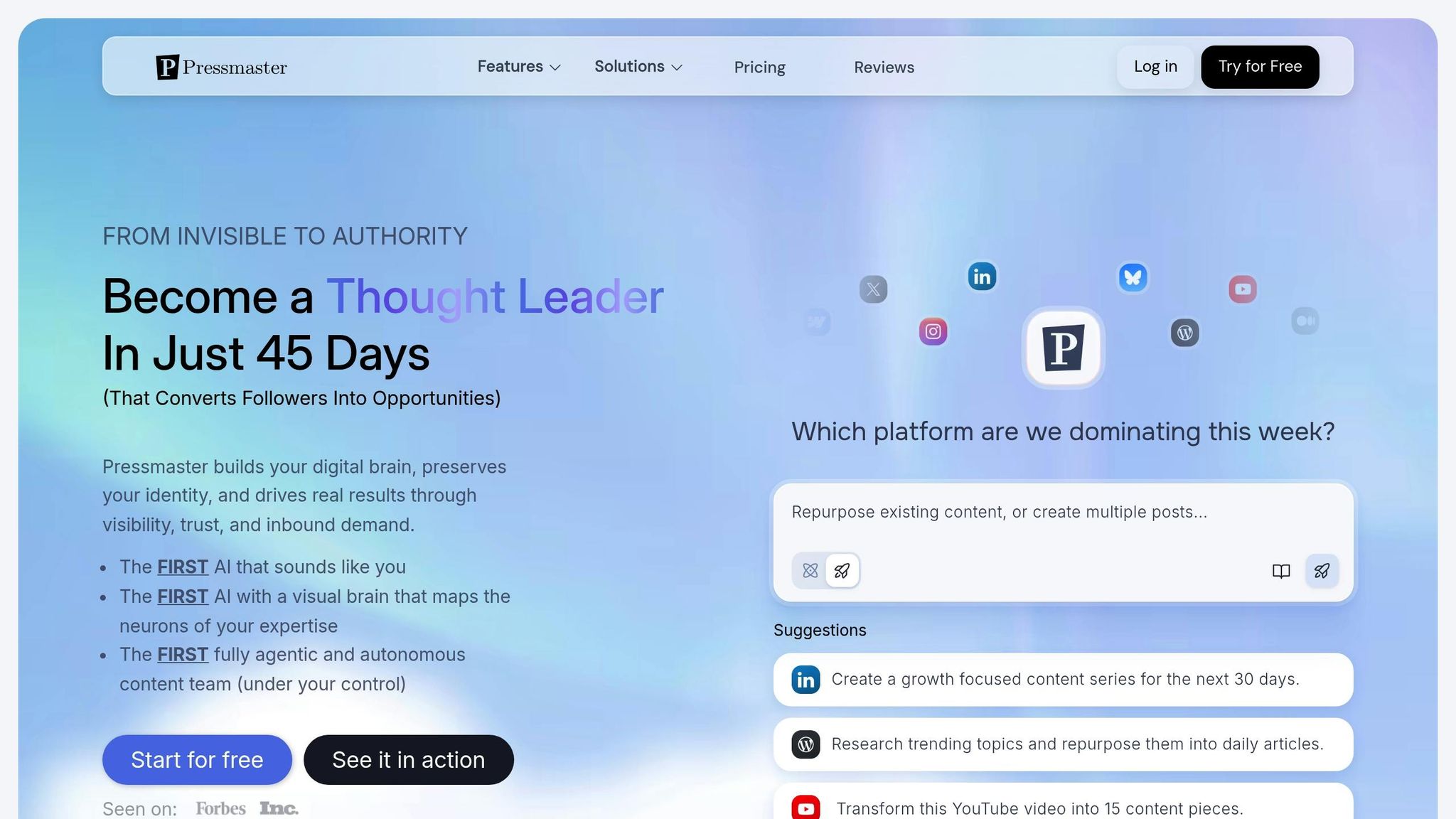
Pressmaster.ai is designed to handle the data-heavy aspects of PR while leaving room for human creativity. Its Trendmaster feature scans over 500,000 sources daily, identifying emerging topics weeks before they peak. Instead of spending hours monitoring Google Alerts or social feeds, PR teams receive curated trend alerts tailored to their audience. This allows them to focus on deciding which trends align with their brand and how to frame them emotionally.
The AI Strategizer builds on this by creating content plans rooted in proven frameworks and audience insights. By inputting business goals, target personas, and emotional objectives, teams receive draft campaign structures - complete with content pillars, story arcs, and schedules - that they can refine as needed. This approach eliminates the stress of starting from scratch while ensuring the final plan reflects the brand’s unique voice.
For content creation, Pressmaster.ai uses an AI Interview feature that mimics a journalist’s approach, drawing out personal stories and insights. Instead of producing generic text, it organizes the interviewee’s words into polished drafts. As Todd Sivers, a SaaS and AI tester, explained:
"It doesn't write so much as it reorganizes my own words for me. I love the experience of the interview it does to pull information from me."
This method keeps the content authentic and emotionally engaging.
The AI Twin feature takes it a step further by building a digital model of a user’s style, ensuring every piece of content - whether a blog post or a press release - matches their voice. Paired with the platform’s Social Suite, which transforms a single article into over 15 optimized posts, teams can maintain a consistent emotional tone across channels without extra effort.
For distribution, Pressmaster.ai integrates with over 1,500 apps like LinkedIn and Webflow, enabling teams to publish and track content from one hub. Its Analytics dashboard consolidates performance metrics, helping PR professionals understand not just what worked but why it resonated. This streamlined approach can save teams over 40 hours a month, allowing them to focus on strategy and storytelling.
Manual vs. AI-Powered PR Workflows
The contrast between traditional and AI-powered PR workflows is striking, especially in terms of time, insights, and precision. Research that once took days - scanning articles, monitoring feeds, and compiling data - can now be completed in hours using AI tools. These tools don’t just save time; they uncover emotional patterns and trends that would be nearly impossible to spot manually.
Planning and content creation also benefit. While manual processes rely on intuition and experience, which can produce compelling stories, they may overlook data-driven opportunities. AI tools highlight emotional content types that historically drive higher engagement, giving human storytellers a solid foundation to refine. Distribution, traditionally reliant on broad outreach, becomes more focused with AI-generated, personalized pitches.
This blended workflow combines the best of both worlds: the efficiency of AI and the emotional depth of human creativity.
| Aspect | Manual PR Workflow | AI-Powered PR Workflow |
|---|---|---|
| Time Spent | Days of manual data processing | Hours or less through automated analysis |
| Depth of Insights | Limited by human capacity | Broad analysis across large datasets |
| Emotional Quality | Authentic but inconsistent | Enhanced with data-backed insights and human validation |
| Distribution Precision | Generic outreach | Targeted pitches with emotional relevance |
How to Keep AI-Generated PR Content Ethical and Trustworthy
As we explore the intersection of data and emotion in AI-generated PR content, it's crucial to prioritize ethical practices to maintain trust. AI's speed and efficiency are impressive, but they must never compromise integrity. When content feels manipulative, inaccurate, or detached from human values, audiences lose trust - and rebuilding that trust can take years. To ensure AI-generated PR content aligns with ethical standards, transparency, human oversight, and rigorous error-checking are non-negotiable. These principles help create messages that are both genuine and aligned with your brand's identity.
Ethics in AI Content Creation
Transparency is the cornerstone of ethical AI use. When AI contributes to press releases, social media posts, or campaign materials, disclosing its involvement builds trust. For example, a simple note like, "This content was drafted with AI assistance and reviewed by our communications team," can reassure audiences, especially for sensitive topics. The U.S. Federal Trade Commission has already cautioned businesses against using AI in deceptive ways, such as undisclosed AI-generated reviews or manipulative personalization.
Privacy and consent are equally critical. Many AI tools analyze customer data to identify preferences or emotional triggers. Always comply with privacy laws like the California Consumer Privacy Act (CCPA) and avoid using confidential customer data without proper approval. Ensure AI insights are used to promote empathy and support rather than exploiting fear or urgency. Research shows that 74% of consumers trust brands more after experiencing transparent, emotionally positive content. Conversely, undisclosed AI use can increase negative sentiment by up to 20%, according to feedback analysis. Ethical PR campaigns focus on clarity and support, fostering loyalty over manipulation.
Human oversight is indispensable. While AI can identify patterns and generate drafts, it often struggles with nuances like sarcasm, cultural subtleties, or context. Bias in training data or "hallucinations" (plausible but incorrect information) can lead to missteps. A human-in-the-loop approach ensures every message, tone, and claim is carefully reviewed before publication, combining AI's efficiency with human judgment.
How to Maintain Consistent Brand Voice
Ethical practices are only part of the equation - your brand voice must also remain consistent across all AI-assisted content. Scaling content with AI doesn't mean sacrificing your brand's distinct personality. Start by creating a detailed brand voice guide that includes tone descriptors (e.g., "friendly yet professional"), approved phrases, and clear guidelines. This guide becomes the foundation for training AI to produce content that genuinely reflects your brand.
Platforms like Pressmaster.ai offer tools to help maintain your brand's identity. For instance, its AI Twin feature learns from past content - articles, transcripts, and feedback - to mimic your phrasing, tone, and intent. Over time, as you provide more input, the system refines its ability to align with your unique style. Another feature, the AI Interview, uses journalist-style questions to capture your perspective and organize it into polished drafts, ensuring content feels authentic and rooted in your voice.
AI can also streamline consistency across channels. Tools like Pressmaster.ai's Social Suite can transform a single article into multiple platform-optimized posts while maintaining a cohesive tone. However, human editors should always review the final output to catch any subtle deviations from your brand's personality. Regular audits of AI-generated content help prevent "voice drift", ensuring that all communications - from press releases to tweets - remain unmistakably yours.
Quality Control Systems for Accuracy
Accuracy is paramount in AI-generated content. AI models can sometimes produce details that sound credible but are incorrect - a phenomenon known as "hallucination." To prevent this, PR teams should implement a multi-step verification process. Start by using AI tools to cross-check information against original sources, then follow up with manual fact-checking of all data points, names, dates, and quotes.
Plagiarism detection is another essential step. Since AI learns from vast datasets, there's a risk of unintentionally replicating phrases or structures from its training material. Running content through plagiarism detection tools like Turnitin or Grammarly ensures originality and avoids legal issues. Authentic storytelling resonates more with audiences than recycled narratives, so combining plagiarism checks with unique insights - such as those gathered through tools like Pressmaster.ai - can set your content apart.
A tiered quality control system ties these measures together. Begin with AI tools to flag potential inaccuracies or emotional missteps, then layer in human review to ensure ethical considerations and contextual accuracy. For example, AWS Comprehend can analyze the emotional tone of drafts, but a human editor should confirm its alignment with your brand values and audience expectations. Regular audits and A/B testing further enhance reliability, striking a balance between AI efficiency and human empathy. Keeping a source log documenting tools, prompts, and references used for each piece of content adds traceability and simplifies corrections when needed.
| Aspect | Risky Practice | Ethical AI-Assisted Practice |
|---|---|---|
| Transparency | Publishing AI-written content without disclosure | Clearly stating AI involvement and ensuring human review |
| Emotion Use | Exploiting fear or urgency identified by AI | Using insights to craft empathetic, supportive messages |
| Brand Voice | Using generic AI defaults for tone | Training AI with brand-specific guidelines |
| Accuracy | Relying on AI-generated facts without checks | Verifying all claims and running plagiarism checks |
Conclusion
The best PR content doesn’t force a choice between data and emotion - it skillfully combines the two. Data uncovers trends in your industry, shedding light on media coverage patterns, social conversations, and audience behavior. Emotion fuels connection, transforming raw statistics into stories that people care about. By pairing AI’s ability to process vast amounts of information with the human touch of empathy and storytelling, PR teams can craft campaigns that are both effective and meaningful.
AI should be your ally, not your replacement. Relying too much on automation can result in content that feels impersonal, while leaning solely on intuition can slow you down and lead to inconsistencies. The key lies in balance: AI takes care of scale and speed - analyzing sentiment data, identifying trends before they peak, and drafting initial ideas - while human creativity and judgment refine the message to ensure it resonates and aligns with ethical standards. Together, this partnership transforms PR into a powerful mix of precision and storytelling.
With these tools in hand, your next campaign can strike the perfect balance between accuracy and emotion. Platforms like Pressmaster.ai simplify the process by learning your tone, capturing your unique perspective, and identifying trending, emotionally engaging themes - saving teams over 40 hours each month.
Start by integrating critical data sources to run sentiment analysis, then use those insights to shape compelling story ideas. Monitor engagement and audience sentiment to refine your approach, scaling your efforts as confidence builds. This combination of advanced AI and human insight ensures your campaigns remain impactful and genuine.
The future of PR belongs to teams that can work with data-driven insights and human empathy simultaneously. Tools like Pressmaster.ai bring the speed, pattern recognition, and forecasting capabilities that modern PR demands, while human professionals contribute the cultural awareness, ethical considerations, and real-world experience that no algorithm can replicate. When you merge these strengths, you create content that not only performs well analytically but also resonates deeply - turning attention into credibility and followers into real business opportunities.
FAQs
How do AI tools help create emotionally engaging PR content?
AI tools are transforming how PR content connects with audiences by diving deep into audience sentiment, spotting trends, and fine-tuning messages to tap into emotional cues. By blending these data-driven insights with the art of human storytelling, brands can create messages that genuinely strike a chord with their audience.
This strategy strengthens trust, nurtures stronger connections, and encourages meaningful interactions, making content not just engaging but also effective in achieving its goals.
What are the common mistakes when balancing data and emotion in PR strategies?
Relying too much on data without weaving in genuine emotion can leave your content feeling cold or impersonal. Misreading data without factoring in your audience’s unique context can also lead to messages that fall flat or fail to connect on an emotional level. And let’s not forget the importance of understanding cultural nuances - overlooking these can unintentionally alienate or upset certain groups. The secret lies in finding the sweet spot between data-driven insights and authentic human connection to craft PR strategies that truly resonate.
How does Pressmaster.ai make PR workflows more efficient?
Pressmaster.ai reshapes PR workflows by leveraging AI to tackle time-consuming tasks such as content research, trend analysis, and drafting. This means less manual work, quicker turnarounds, and more consistent outcomes.
By analyzing audience data and predicting trends, it equips PR teams to plan and strategize more efficiently. Plus, its collaboration tools and simplified publishing process free up professionals to focus on creating campaigns that truly connect on an emotional level.
Related Blog Posts








Sign Up for our Pressmaster Newsletter
Sign up for our Pressmaster.ai newsletter to get instant alerts on trending topics, ensuring you stay ahead in your field with the latest insights and updates.


.avif)
.png)

.avif)


7 Viral Patterns That Drove 10,643% Growth
Turn natural conversations into content gold, make every insight count, and drive real conversations.

Please fill out the form to get our Viral Cheat Sheet


How to Become a Thought Leader in 6 Easy Steps
Increase your visibility, establish authority, and conquer your market with minimal effort.

Please fill out the form to get our PDF Checklist
