
AI Content Strategy Frameworks That Help You Plan a Month of Posts in Minutes
AI tools are transforming how businesses plan content, cutting what used to take days into just minutes. With frameworks like Trend-Driven, Conversation-to-Campaign, and Pillar-to-Post, you can quickly create content calendars tailored to your goals, audience, and key dates. These tools handle research, idea generation, and scheduling while boosting performance through data-driven insights. For example:
- Trend-Driven Framework: Tracks emerging topics to create timely content.
- Conversation-to-Campaign Framework: Turns expert discussions into multi-platform content.
- Pillar-to-Post Framework: Repurposes long-form assets into multiple posts.
AI doesn’t replace creativity but simplifies repetitive tasks, allowing teams to focus on messaging and strategy. Tools like Pressmaster.ai integrate these frameworks, saving hours of work and improving results, such as increasing organic impressions by up to 4,100% in 90 days. Whether you’re planning for holidays, seasonal trends, or evergreen topics, AI frameworks help you stay consistent and efficient.
i automated my entire content strategy with ai
Building a Monthly Content Plan That Works
A monthly content plan acts as your roadmap, connecting your content efforts to your business goals. To lay the groundwork, you need clear PR objectives, a strong understanding of your audience, and insight into engagement patterns within the U.S. market. Companies with well-documented content strategies consistently outperform those that post on a whim. Yet, according to Gartner, by the end of 2025, only 15% of businesses will use AI strategically, while the rest will simply add tools without a clear framework [4]. By setting up these foundational steps, you ensure that every piece of content generated by AI aligns with your overall strategy.
Define Your PR and Messaging Goals
Start by setting one or two PR goals for the month, such as increasing brand awareness by 20%, gaining 10% more LinkedIn followers, or securing 200 demo sign-ups. Then, align these goals with specific, measurable content objectives. For example, if your aim is to establish thought leadership in U.S. fintech, you might target four in-depth articles, 50,000 LinkedIn impressions, and three backlinks from industry leaders.
Next, outline 3–5 key content themes that support your goals. A typical breakdown might include:
- 40% product education
- 30% thought leadership
- 20% customer stories and testimonials
- 10% company culture
Structure these themes in a way that AI tools can interpret. For instance:
"Audience: U.S. B2B tech CMOs; Goal: build thought leadership; Message: our platform reduces PR reporting time by 50%; Call-to-action: download our case study."
When you feed this structure into your AI tool, it will generate calendar suggestions that align with your strategy, avoiding generic or irrelevant content.
Choose Your Audience Segments and Channels
Understanding your audience is critical. Define specific demographics, firmographics, and behavioral traits, such as job roles (e.g., U.S. PR manager vs. CMO), company size, industry, and region. Use AI or CRM tools to analyze patterns. For instance, mid-market SaaS marketers in the U.S. might prefer LinkedIn carousels about measurement strategies, while small-business owners might engage more with Instagram Reels offering practical tips.
Develop 3–5 detailed personas, each with clear pain points and preferred channels. This will guide your choice of content formats and platforms. For U.S. B2B and professional audiences, LinkedIn often serves as the go-to platform for thought leadership and product education, with an ideal posting cadence of 3–5 times per week. Instagram, on the other hand, works well for showcasing your brand’s personality and lighter educational content, with 3–7 posts per week plus Stories. Your blog can act as a central hub for evergreen, in-depth content, with 4–8 long-form articles per month.
A practical monthly plan might look like this:
- LinkedIn: 12–20 posts
- Instagram: 12–25 posts
- Blog: 4–8 articles
Use AI analytics to track performance and allocate resources to the platforms delivering the best results in terms of reach, engagement, and conversions.
Plan Around US Holidays and Seasonal Trends
Once your goals and audience insights are in place, align your content with U.S.-specific holidays and seasonal trends. Posts tied to events like Memorial Day, back-to-school season, or Q4 budget planning naturally resonate more than isolated updates. Use a U.S. holiday calendar to pinpoint key dates, such as Memorial Day, Independence Day, and Labor Day, along with observances like Black History Month or Pride Month.
Pick 2–4 key dates for the month and craft posts that connect these events to your brand. For example, on Labor Day, you could highlight your employees or discuss the future of work in your industry. Use these dates as anchors in your calendar, and build supporting content around them to sustain the theme.
Beyond holidays, seasonal patterns and industry cycles also influence audience behavior. For instance:
- Q1: Focus on planning and goal-setting
- Q2: Highlight execution and events
- Q3: Address budgeting and strategy
- Q4: Emphasize year-end reviews and forecasts
Even weather-related trends, like back-to-school excitement in late summer or holiday shopping in the fall, can shape your content. AI tools can analyze search trends and social conversations to identify rising topics. For example, every January, U.S. marketers often discuss measurement frameworks. Use insights like these to define 1–2 major themes for the month, such as "budget-proof PR strategies" in Q3, and create content that answers your audience’s questions before they even ask.
A well-rounded plan might allocate 60–70% of content to ongoing topics like tips, thought leadership, and FAQs, while dedicating 30–40% to campaigns tied to product launches, conferences, or key dates. AI can handle the baseline content - repurposing top-performing pieces into new formats - so your team can focus on high-impact campaigns. At the end of the month, review analytics to see what worked and refine your strategy for the next cycle.
3 AI Frameworks for Planning a Month of Posts

Trend-Driven vs Evergreen Content Planning Strategy Comparison
Once you've set clear goals, understood your audience, and aligned your calendar with U.S. events and trends, the next step is choosing a framework to streamline your content planning. A good framework not only saves time but ensures your posts align with your strategy and connect with your audience. Below, we break down three AI-powered frameworks that can help you build a robust content calendar for the entire month.
Trend-Driven Calendar Framework
The Trend-Driven Calendar leverages AI to track emerging topics across news outlets, social platforms, Reddit, and industry forums. By identifying trends 6–8 weeks before they hit the mainstream, this framework gives you a head start on creating timely, relevant content. Tools like Pressmaster.ai's Trendmaster analyze over 500,000 sources daily, scoring trends based on their relevance to your brand and U.S. audience, and mapping content ideas directly onto your calendar.
For example, if you're a B2B SaaS company targeting U.S. marketers, Trendmaster might flag rising interest in "budget-proof PR strategies" during early Q3 - just as finance teams begin preparing for annual planning. The AI generates draft headlines, post copy, and image prompts tied to the trend, seamlessly integrating them into your calendar alongside evergreen content. This approach can save over 40 hours of manual research each month and drive organic impressions up by as much as 4,100% within 90 days. [1]
"Prior to using Pressmaster.ai, I would read a lot of Google Alerts (every night), make a lot of notes about content I would create... Now with my custom set up, the trends tool does the heavy lifting for me." – Anja McKinley, Pressmaster.ai User [1]
However, trend-driven planning has its challenges. Posts tied to real-time topics can generate significant engagement but may require quick approvals and carry risks if linked to sensitive issues. On the other hand, evergreen content - like how-to guides or FAQs - offers steady traffic over time but lacks the viral spikes of trend-driven posts. Many teams use a hybrid strategy, dedicating 25–40% of their calendar to trend-based posts while focusing the rest on evergreen content. [4]
| Aspect | Trend-Driven Planning | Evergreen Content |
|---|---|---|
| Content Lifespan | Days to weeks | Months to years |
| Planning Horizon | Short-term (real-time) | Medium to long-term |
| Risk Level | Higher (sensitive topics) | Lower (stable topics) |
| Engagement Pattern | Spikes in shares and impressions | Steady traffic and leads |
| Production Speed | Fast (AI-generated) | Moderate (requires depth) |
| Best Use Case | Capturing viral moments, events | Building authority and SEO |
While trend-driven strategies capitalize on timely opportunities, the next framework focuses on turning in-depth conversations into comprehensive campaigns.
Conversation-to-Campaign Framework
The Conversation-to-Campaign Framework transforms a single expert discussion into a full suite of content. This method is particularly effective for B2B brands and professional services firms where expertise is key. Here’s how it works: A PR or marketing lead records a 30–60 minute conversation with a subject-matter expert - via Zoom, a podcast, or even a voice note - and uploads the audio to an AI tool. The AI transcribes the discussion, highlights key themes and quotes, and organizes the content into pillars like trends, customer challenges, or product insights. [3]
From just one conversation, tools like Pressmaster.ai can create a variety of assets: 1–2 long-form blog posts, 8–15 social media posts tailored to different platforms, a FAQ document, and even internal talking points or media pitches. For instance, a 45-minute discussion on emerging threats could result in a 1,500-word blog post, a LinkedIn carousel, an email briefing, 10 short-form posts, and a sales FAQ - all spread across four weeks during optimal U.S. working hours.
"I love the AI interview process! ... Pressmaster solved that for me by learning my voice and asking me great questions to write articles and social posts." – Hai Pham, Thought Leadership Turbocharger [1]
This framework is a game-changer for creating authentic, narrative-driven content without starting from scratch. By using a conversational approach, you extract expert insights while maintaining your brand’s voice. In just one hour of conversation, you can generate a month’s worth of content that feels personal and strategy-aligned.
Pillar-to-Post Framework
The Pillar-to-Post Framework starts with 3–5 strategic content pillars - such as thought leadership, customer stories, product education, and company culture - that tie directly to your business goals. [2] Each pillar is broken down into topic clusters and subtopics that align with different stages of the buyer journey (awareness, consideration, decision). Teams typically create 1–2 major pillar assets each month, like a long-form guide, webinar, or report, and then use AI to repurpose them into multiple pieces of content for various channels.
For instance, a single YouTube video or podcast episode can be transformed into 15+ platform-specific assets: LinkedIn posts, Twitter threads, Instagram captions, email snippets, and short video scripts. [1] Pressmaster.ai's Social Suite automates this process by analyzing long-form content, identifying key sections, and generating channel-ready snippets tailored to character limits and platform preferences. [2]
This framework is perfect for teams looking to maximize the return on high-value content. By repurposing a single asset into 5–10 targeted posts, you ensure consistent messaging across platforms while saving time. Performance data from previous months helps the AI refine future content, prioritizing formats and topics that resonate most with your audience - whether it’s U.S. customer stories on LinkedIn or data-driven visuals in social threads.
How to Use Pressmaster.ai for Monthly Content Planning
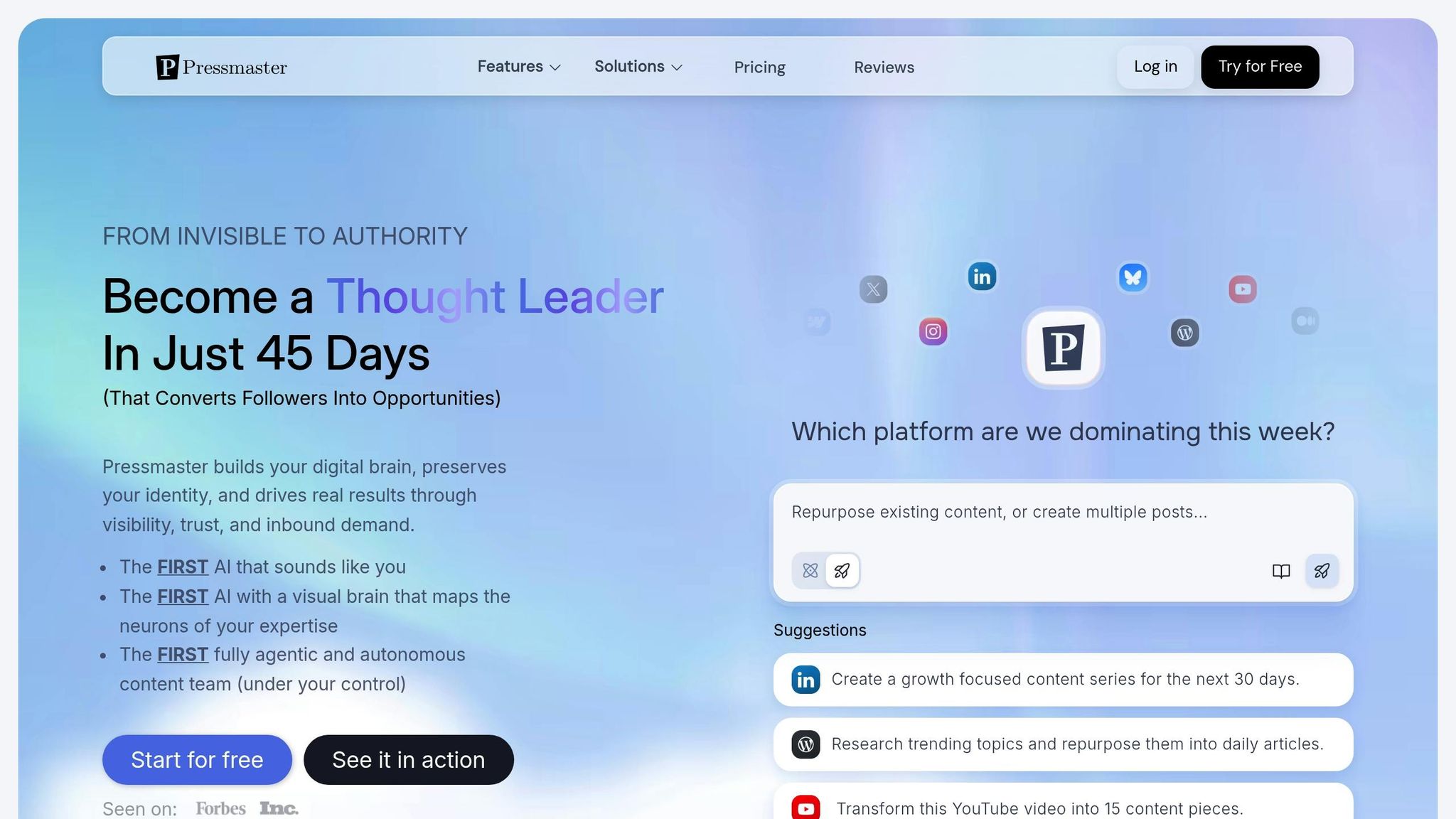
Once you've chosen your preferred AI framework, using it with Pressmaster.ai is a breeze. This platform transforms your ideas into a fully functional content calendar in just minutes. Here's how to set up, strategize, and fine-tune your monthly plan.
Set Up Workspaces and Define Brand Voices
Start by creating an organization account and assigning clear roles to your team members, such as Admin, Strategist, or Copywriter. For agencies or in-house teams managing multiple brands, it's best to create separate workspaces for each brand. This keeps assets, calendars, and analytics organized while ensuring compliance with NDAs and reporting requirements. For industries like finance or healthcare, setting up approval workflows is critical to ensure no content goes live without a senior review.
Next, train the AI to match your brand voice. Upload 5–10 reference materials - like press releases, blog posts, or social media updates - that have performed well. Specify details like tone (e.g., authoritative, friendly), level of formality, US spelling preferences, and typical post length. Include clear guidelines, such as "always use $ with no spaces" or "avoid slang", to ensure compliance. Generate a small batch of test posts, review them with your team, and adjust the voice profile as needed. Over time, use analytics to fine-tune this profile by identifying which voice traits drive better engagement.
Pressmaster.ai’s AI Twin feature creates a "digital brain" by analyzing your style, logic, and phrasing to replicate your voice authentically. You can also use the AI interview tool to extract unique insights and craft narratives that reflect your perspective - perfect for avoiding the generic tone of standard AI writing tools.
Once your workspace is ready and your brand voice is set, you can move on to building your content calendar with the AI Strategizer.
Build Content Calendars with the AI Strategizer
The AI Strategizer takes your chosen framework and turns it into actionable plans. Start by selecting or creating a framework template:
- Trend‑Driven: Focuses on timely, trending topics.
- Conversation‑to‑Campaign: Converts interviews, FAQs, or transcripts into content.
- Pillar‑to‑Post: Breaks long-form content into multiple posts.
For the Trend‑Driven framework, input details about your US audience, important topics, and key dates. The tool will identify emerging trends and event hooks relevant to your brand. If you're using the Conversation‑to‑Campaign approach, upload materials like webinar recordings, customer support logs, or media Q&As. The AI will identify recurring themes and suggest angles for multi-post sequences. With the Pillar‑to‑Post framework, you can upload a core piece of content - like a white paper or detailed blog - and let the Strategizer create a 30-day content plan with tailored variations.
To generate a calendar, provide details such as your business and PR goals, US audience segments, channel priorities, posting frequency, and any constraints (e.g., legal disclaimers or off-limits topics). The AI Strategizer will then produce a 30-day grid with themes, angles, and draft content aligned to your inputs. Its Trendmaster tool scans over 500,000 sources daily, ranking trends by relevance to your audience, saving you over 40 hours of manual research each month [1].
Once your plan is ready, the calendar view shows proposed themes and draft posts for each channel. You can click on specific days to see variations, adjust CTAs for US audiences, and apply your brand voice presets. The tool also suggests asset types (e.g., images, Reels, or quote cards) and recommends posting times based on historical performance in US time zones. Approved posts can be added directly to your scheduling queue or exported as a CSV/ICS calendar.
Monitor Performance and Adjust Your Strategy
After scheduling your content, optimization is key to staying effective. Connect your analytics tools - social platforms, Google Analytics, email marketing platforms, and PR monitoring systems - so Pressmaster.ai can pull in performance data daily. The analytics dashboard provides an overview of how each framework (e.g., Trend‑Driven vs. Pillar‑to‑Post) is performing, along with channel-specific metrics like impressions, engagement rates, click-through rates, and conversions. For PR-focused campaigns, you can track mentions, sentiment, and backlink quality for AI-assisted pitches. Set alerts to flag underperforming posts (e.g., engagement 50% below the 30-day median) or highlight topics that perform exceptionally well.
Regularly review your analytics - monthly or quarterly - to see which topics, formats, and frameworks deliver the best results. For instance, if Trend‑Driven posts generate high engagement but low conversions, you might balance your calendar by adding more mid-funnel content, like case studies or product demos. Use A/B testing to refine your approach, updating your brand voice presets and Strategizer defaults based on what works best. You can also adjust your posting schedule and refresh popular topics around key US dates annually.
Pressmaster.ai continuously improves your content using historical data, eliminating the need for third-party analytics and scheduling tools. According to the platform, users can see organic impressions increase by up to 4,100% within 90 days, with meaningful inbound results often achieved within the first 30 days [1].
For example, a B2B SaaS PR team targeting US CMOs could upload an industry report into Pressmaster.ai and use the Pillar‑to‑Post framework to create LinkedIn posts, a press release, article pitches, and webinar promotions for the month. By analyzing which insights generate the most engagement, they can focus on the most effective subtopics the following month. Similarly, a consumer brand might use the Trend‑Driven framework for Black Friday and Cyber Monday campaigns, leveraging US-specific offers and value-driven hooks. Reviewing analytics afterward can help identify which deals and stories performed best, shaping their Q1 strategy moving forward.
Conclusion
Planning a month's worth of content no longer has to feel like an overwhelming marathon of brainstorming sessions, juggling spreadsheets, and scrambling to meet deadlines. With AI content strategy frameworks, what once took days can now be streamlined into a quick, repeatable process. By aligning your goals, audience insights, and brand guidelines into structured inputs, these frameworks ensure that every piece of content serves a clear purpose while staying true to your brand's voice.
The real game-changer here isn’t just speed - it’s the ability to maintain strategic consistency at scale. Research shows that by 2025, 90% of content marketers plan to incorporate AI into their workflows [2]. This means that teams relying solely on manual methods may find it tough to keep up with the demands of high-volume content creation, rapid experimentation, and real-time responsiveness. Whether it’s the Trend-Driven, Conversation-to-Campaign, or Pillar-to-Post framework, the approaches outlined in this guide ensure you can stay ahead of trends, repurpose content effectively, and maintain a consistent presence across platforms - all without overloading your team.
Tools like Pressmaster.ai bring these frameworks to life by integrating workspace management, brand voice training, and AI-driven calendar generation into one seamless platform. Instead of bouncing between research tools, drafting apps, and scheduling software, you can save over 40 hours of manual work per month [1]. And the results speak for themselves: users have reported organic impressions growing by as much as 4,100% within just 90 days [1], with notable inbound leads often appearing in the first 30 days.
Getting started is straightforward. Begin with a pilot project focused on a specific goal - like boosting LinkedIn engagement among US audiences over the next month. Upload a few top-performing pieces to train the AI on your brand voice, pick a framework that fits your strategy, and let the AI Strategizer create your first draft calendar. From there, review it with your team, tweak the messaging and CTAs as needed, and schedule the posts. After just 30 days, you’ll have clear evidence of the time saved and the impact on performance.
AI won’t replace your strategic insights or creative direction, but it will give you the freedom to focus on what truly matters. By combining these frameworks with the efficiency of AI and the creativity of your team, you can build a content operation that’s not just faster and smarter - but ready to tackle whatever challenges lie ahead.
FAQs
How do AI frameworks make content planning faster and more effective?
AI frameworks take the hassle out of content planning by streamlining tasks like research, analyzing trends, and even creating content. They allow marketers to quickly produce an entire month's worth of posts that are perfectly aligned with their audience's interests, ensuring both consistency and relevance.
These tools also fine-tune scheduling and messaging, helping you stick to a unified strategy while cutting down on time spent. By using AI, you can shift your energy toward creative ideas instead of getting bogged down with repetitive planning, all while elevating the overall quality of your content.
What are the advantages of using the Pillar-to-Post framework for planning content?
The Pillar-to-Post framework is a straightforward way to streamline your content planning. It works by dividing broad topics into key themes, or "pillars", and then building out detailed posts around each one. This structure keeps your content well-organized, consistent, and aligned with your brand's overall messaging.
Using this method can help you save time, maintain a unified tone across platforms, and connect more effectively with your audience. Plus, it positions your brand as a reliable source of information by thoroughly covering each topic while keeping your content strategy sharp and on track.
How does Pressmaster.ai adapt content to match my brand's voice?
Pressmaster.ai creates content that mirrors your brand's unique voice by building a digital model of your tone and communication style. It carefully examines how you convey ideas, ensuring every piece of content aligns with your brand's personality and core values.
By matching your specific style, it produces content that feels genuine and connects with your audience, all while saving you time and keeping your messaging consistent.








Sign Up for our Pressmaster Newsletter
Sign up for our Pressmaster.ai newsletter to get instant alerts on trending topics, ensuring you stay ahead in your field with the latest insights and updates.


.avif)
.png)

.avif)


7 Viral Patterns That Drove 10,643% Growth
Turn natural conversations into content gold, make every insight count, and drive real conversations.

Please fill out the form to get our Viral Cheat Sheet


How to Become a Thought Leader in 6 Easy Steps
Increase your visibility, establish authority, and conquer your market with minimal effort.

Please fill out the form to get our PDF Checklist
