
AI Content Strategy for Teams That Want to Stay Organized and On Message
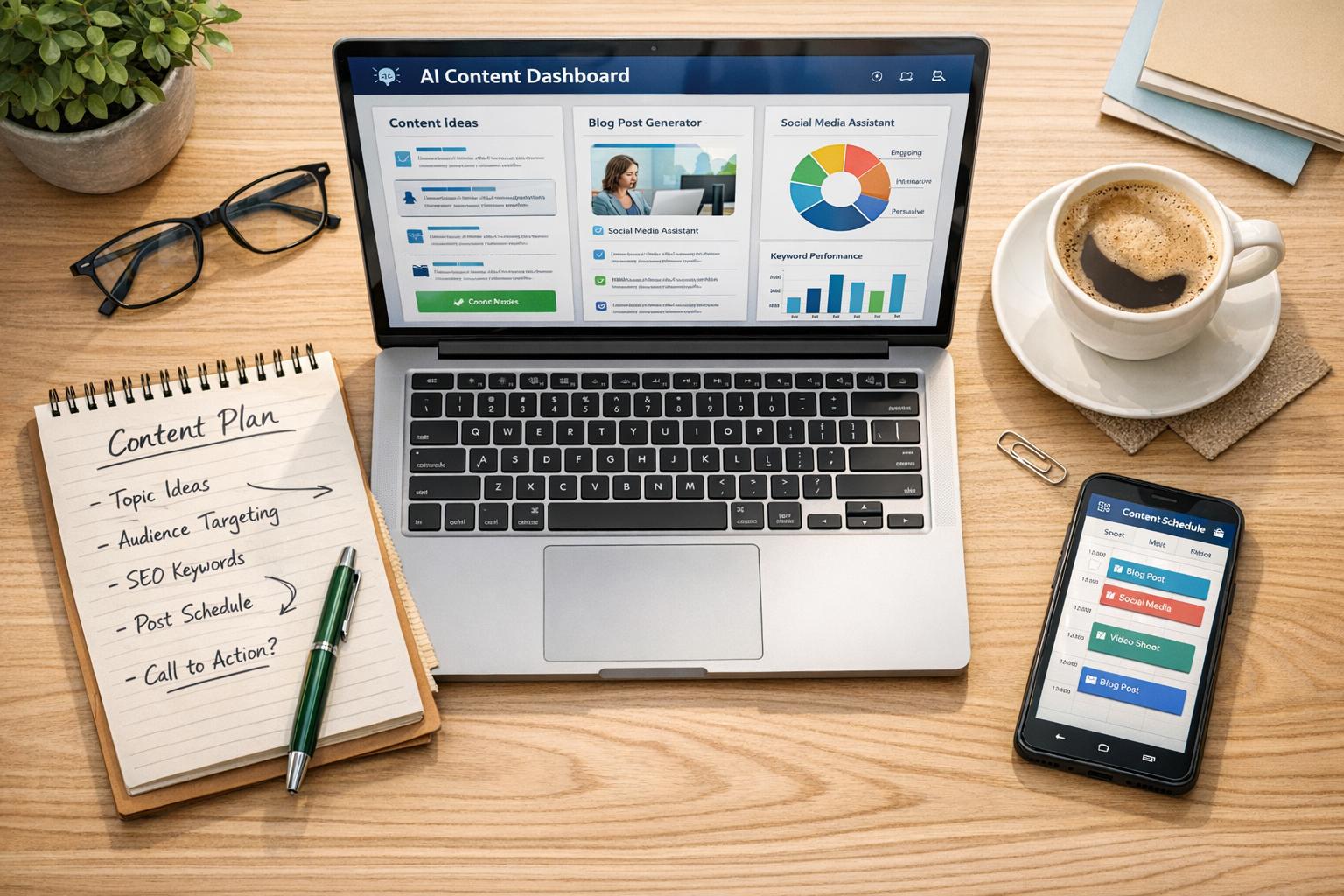
Managing content workflows feels overwhelming? Here's the fix: AI tools can simplify your process, keep messaging consistent, and save your team hours weekly. From maintaining your brand voice to automating multi-channel publishing, AI handles repetitive tasks so you can focus on high-impact work.
Key Takeaways:
- Brand Voice: Train AI with detailed examples to ensure consistent tone across platforms.
- Content Planning: AI predicts trends weeks in advance, helping you stay ahead.
- Workflow Management: Centralized tools improve collaboration and reduce bottlenecks.
- Efficiency Gains: Automate content creation and distribution, cutting production time drastically.
- Unified Analytics: Real-time dashboards consolidate metrics for faster, better decisions.
Example: Wyndly boosted organic traffic 20x and increased customer acquisition by 28% using AI.
AI isn't here to replace creativity - it’s here to remove inefficiency, helping your team stay organized without sacrificing quality. Let’s dive deeper into how this works.

AI Content Strategy Impact: Key Statistics and Results
How I Built a Complete AI Content Team (And Cut 10+ Hours Weekly)
Building and Keeping a Consistent Brand Voice
Your brand voice is more than just the words you use - it’s how your audience identifies and connects with your brand. Keeping that voice consistent across different teams and content types can be tricky. AI tools can help by learning and mimicking your specific communication style.
The trick lies in teaching the AI what sets your brand apart. Instead of using vague terms like "professional" or "friendly", give it clear instructions. For instance, you might specify, "8/10 on expertise and 4/10 on formality" [4]. This level of detail removes uncertainty and ensures every piece of content aligns with your brand's tone. Uploading a Brand Blueprint - which includes your mission statement, core values, and specific "Dos and Don'ts" - provides a solid foundation for the AI to work from [4]. With this groundwork in place, the AI can be trained using real examples to fine-tune its understanding of your voice.
"Pressmaster.ai is different. It doesn't write so much as it reorganizes my own words for me. I love the experience of the interview it does to pull information from me." - Todd Sivers, SaaS & AI Tester, LoudEgg [1]
Teaching AI Your Brand Identity
To train AI to adopt your brand voice, start by sharing examples of your best content. Upload side-by-side comparisons of pieces that perfectly capture your voice versus those that fall short [4]. This helps the AI draw clear boundaries and understand what "on-brand" means for your business.
The AI analyzes over 30 linguistic features to create a unique voice fingerprint [1]. It also uses conversational AI interviews to naturally extract insights - you speak, it listens, and it picks up on the subtle details of how you communicate. This process goes beyond static templates, capturing the nuances of your thought processes and communication style.
By providing examples and participating in voice-to-content interviews, you can help the AI map out your brand’s linguistic DNA. The outcome? Content that genuinely reflects your voice. Many teams find this approach produces content that feels authentic while also increasing their output without sacrificing credibility.
Managing Multiple Brand Voices for Different Projects
For agencies or companies that cater to diverse audiences, juggling multiple brand voices can be a challenge. Creating separate brand profiles for each project ensures that messaging stays consistent and distinct, avoiding overlap. This is particularly helpful when working with a mix of clients, like a corporate account requiring a formal tone and a startup needing a casual, energetic vibe.
A Brand Voice Chart, generated from your top-performing content, can act as a reference guide for each brand [6]. This chart helps your team stay aligned, even when multiple writers contribute to the same project.
Shifting from "AI-only writing" to "AI-first thinking" allows AI to handle drafting and research, leaving humans to focus on emotional resonance and strategic planning [4]. This hybrid approach makes it easier to manage multiple brand voices without overwhelming your team. Each brand profile operates independently, with tailored tone settings, vocabulary, and messaging rules - all accessible from a single platform.
Improving Content Planning and Workflow with AI
AI doesn’t just make content creation faster; it simplifies the entire planning process. Think about how tedious it is to manually juggle spreadsheets, track trends, and brainstorm ideas. AI changes the game by combining research, ideation, and scheduling into one streamlined system that identifies opportunities ahead of time.
This shift from reactive to proactive planning is a game-changer. Traditional methods often catch trends too late - when the market is already saturated. But AI-powered trend analysis scans over 500,000 data sources daily, pinpointing emerging topics a solid 3–4 weeks before they take off [9]. This gives your team a head start, allowing you to create content just as interest begins to grow. The result? A data-driven, strategic approach that replaces the last-minute scramble with well-timed, impactful content.
Take the example of Wyndly, a telehealth platform. In February 2025, they integrated AI into their content workflows and saw massive results. Monthly article production skyrocketed from 40 to 200, driving organic traffic from 10,000 to 200,000 clicks per month - a jaw-dropping 20x increase. On top of that, they boosted organic customer acquisition by 28% [9].
Using Trend Analysis to Stay Current
Trend analysis takes the guesswork out of content planning. Instead of relying on gut feelings, AI digs into search behavior, social media chatter, and industry publications to uncover topics your audience cares about. This data-driven approach eliminates the dreaded "blank page" moment, giving your team the confidence to assign projects that resonate. Once the right topics are identified, it’s all about scheduling efficiently.
Creating AI-Driven Content Calendars
Traditional content calendars require hours of manual effort to map topics and schedules. AI simplifies this by automatically creating content frameworks that align with trending topics and your team’s goals.
"My team now uses AI to generate a solid outline and structure, which frees us up to focus on adding insights and making sure the content feels human and aligned with our brand." - Colleen Barry, Head of Marketing, Ketch [8]
Here’s how it works: AI starts by organizing content into categories based on format and topic for the upcoming month [7]. It researches trending subjects, generates detailed outlines, and leaves room for your team to add insights and final touches. This approach cuts drafting time from hours to mere minutes while ensuring a consistent brand voice across all your content.
AI also takes formatting to the next level. For example, a single article can be transformed into 15+ social media posts tailored to different platforms - no tedious resizing required [9]. With an AI-populated content calendar, approvals stay on track, and your team can focus on strategy instead of logistics.
Working Together with AI-Powered Team Tools
AI-powered team tools are transforming how content production teams operate, ensuring smoother workflows and better collaboration. Disorganized communication and chaotic workflows can seriously hamper productivity. When team members constantly juggle emails and try to track project updates, progress slows to a crawl. AI tools step in to address this by creating a centralized hub where everyone can access the same drafts, goals, and performance data in real time [11].
Without these tools, teams often lose weeks in endless email threads and revision cycles. By integrating AI, productivity can increase by 40%, saving teams an average of 5 hours per week [11]. These tools streamline operations by ensuring everyone knows their role, and every task is tracked and managed efficiently. This unified approach ties into earlier strategies, enhancing both workflow and communication.
Setting Up Team Workspaces for Better Organization
AI-powered workspaces act as command centers tailored to specific projects. Instead of cluttered dashboards where client projects overlap, you can create separate workspaces for each brand or assignment. This keeps all assets neatly organized and allows for clear role-based permissions. For instance, writers can focus on drafting, editors handle revisions, and clients review content without the risk of accidental changes.
When unexpected challenges arise - like a graphic designer being overloaded or unavailable - AI systems can automatically reassign tasks to team members with the right skills and availability. For example, if your lead designer is tied up with urgent projects, new design requests are seamlessly routed to another qualified team member who can meet deadlines [12]. This dynamic task management eliminates bottlenecks without requiring managers to manually intervene.
"Pressmaster is built for collaboration. Agencies and teams can manage multiple clients, review content, and generate material tailored to each voice or brand." - Pressmaster.ai [3]
To make this system work effectively, it’s crucial to establish clear role definitions from the outset. Decide who will create content, who will approve the final versions, and who will handle sensitive brand guidelines. This clarity prevents accidental changes and ensures that workflows align with your organization’s processes [11].
Real-Time Editing and Input Collection
AI tools take collaboration to the next level by enabling real-time, parallel workflows. Traditional workflows often rely on sequential handoffs - writers finish their drafts, then editors review, and finally, brand managers check for alignment. AI flips this model, allowing multiple team members to work on the same document simultaneously. Writers can draft while editors review sections in real time, significantly reducing production timelines.
Instead of scheduling lengthy meetings or waiting for executives to weigh in, you can use shared interview links. Stakeholders can provide input conversationally - even via voice - and AI transcribes and organizes their insights into polished content [3][10]. By adopting this conversational workflow, users report spending 93% less time on content creation [10].
"The feature that stands out the most are the AI interviews... It's a seamless workflow from idea to repurposing your content." - Patrick Benske, Marketing Strategist [3]
Feedback also becomes instantaneous. Share a work-in-progress file through a single link, and comments appear on a centralized dashboard [3]. The system even flags potential conflicts and suggests ways to streamline timelines [12]. This approach ensures that all input is captured and addressed systematically, cutting down on the usual back-and-forth between team members [11].
Automating Content Creation and Multi-Channel Distribution
Once your team is working together seamlessly, the next big hurdle is producing and publishing content efficiently. While manual creation can take days, AI can generate content in just minutes. Plus, with voice mapping technology, AI ensures your brand voice remains consistent across all channels.
AI takes content production to a level that’s simply not achievable with human effort alone. Teams can produce dozens of pieces daily without pushing staff to the brink. In fact, 77% of companies are already using or exploring AI to automate their marketing efforts [9]. By automating these processes, businesses cut down on labor costs while still meeting quality standards. Let’s break down how AI optimizes every step, from generating content to distributing it.
Generating and Optimizing Content Efficiently
AI can turn simple inputs into polished, ready-to-publish content designed to engage audiences. Instead of spending hours drafting from scratch, you can provide insights conversationally - even through voice input - and the system will handle the heavy lifting.
Take Wyndly as an example: they managed to increase their monthly article output fivefold and saw a 20x jump in organic traffic [9]. Their AI system even handled technical SEO tasks during the content creation process, automatically enhancing discoverability.
"Pressmaster isn't just a writing tool, it's a thinking partner. It interviews you like a real journalist, captures your unique voice and ideas, and then executes content creation based on best practices." - Pressmaster.ai [2]
Another major time-saver is AI’s ability to automate internal linking. By scanning your existing content library, it suggests relevant links to integrate into new pieces [9]. This not only strengthens your SEO strategy but also eliminates the tedious task of manual cross-referencing. Once your content is optimized, the next step is distributing it effortlessly across multiple platforms.
Publishing Across Platforms in One Click
Even after content is created, distribution often becomes a bottleneck. Traditional workflows involve reformatting content for each platform - adjusting character counts for social media, resizing images, and scheduling posts manually. AI simplifies this process with integrated multi-channel publishing.
With just one click, AI can distribute content across websites, social media channels, and press networks simultaneously. It automatically adapts the content to fit the requirements of each platform - whether it’s LinkedIn’s professional tone, Twitter’s character limit, or Medium’s preference for long-form content. Thanks to these tools, 86% of marketers report saving at least an hour per day on creative tasks [14].
Harley Davidson took this approach to the next level by using AI-powered distribution to personalize and optimize digital ads across social and search platforms. The results? A five-fold increase in site traffic and an astounding 2,930% rise in monthly leads [13]. By letting AI handle repetitive tasks like formatting and scheduling, their team was able to focus on the bigger picture.
"AI-generated content is the new floor. Anyone can make it... If your content isn't better than what AI can produce, it's not worth making." - Rand Fishkin, Founder, SparkToro [9]
If you’re just starting with AI, try piloting it for a single task - like writing social media captions - before rolling it out across your entire distribution strategy [14]. This gradual approach allows your team to get comfortable with the technology and pinpoint which workflows benefit most from automation. Over time, the time savings will add up, allowing your team to focus more on strategy and less on execution.
Measuring Success with Unified Analytics
Making sense of performance metrics can be tricky, especially when your data is scattered across different platforms. Traditional analytics setups often require teams to shuffle between Google Analytics, social media dashboards, email tools, and CRM systems. This process usually involves manually compiling data into spreadsheets - a time-intensive task that can leave critical blind spots. For example, you might notice great engagement on LinkedIn but completely overlook an email campaign that's underperforming. AI-powered unified analytics solves this problem by bringing all your data together into a single, easy-to-read dashboard.
Consolidating Metrics for Clearer Insights
AI-powered dashboards simplify the process by pulling data from multiple sources into one place. This cuts down on the need to log into various platforms and can save teams over 5 hours a week, while also reducing costs by 12.2% [11][12].
With all your metrics in one spot, you gain a clear view of your performance. For instance, consolidated data might highlight a 30% click-through rate from Twitter or 500,000 impressions on LinkedIn [12]. Without this unified view, it’s much harder to decide where to focus your efforts or how to reallocate your budget.
These dashboards also track the metrics that matter most - like engagement rates (likes, shares, comments), conversion rates, reach, impressions, click-through rates, and ROI by channel. And because they display results in real time (using USD for financial figures and the MM/DD/YYYY date format), you can react quickly. Instead of waiting days or weeks for reports, you can spot underperforming content immediately and make adjustments before a campaign ends.
| Feature | Traditional Analytics (Fragmented) | AI-Unified Analytics (Consolidated) |
|---|---|---|
| Data Source | Multiple logins required | Single, unified dashboard |
| Speed | Delayed (days or weeks) | Real-time (instant) |
| Insight Type | Descriptive (what happened) | Predictive (what will happen) |
| Effort | Manual reporting/compilation | Automated reporting and insights |
This level of clarity makes it easier to fine-tune your content strategy and maximize results.
Using Analytics to Improve Content Strategies
Unified analytics doesn’t just show you what worked in the past - it helps you figure out what to do next. By analyzing engagement patterns, AI tools can identify the content formats, topics, and platforms that resonate most with your audience.
For example, if your data shows that video posts consistently generate twice as many shares as text-based content on social media, you can shift your focus to creating more videos [12]. Machine learning can even tag your top-performing content and suggest areas to prioritize for better conversions [11][12].
Predictive analytics takes this a step further. By studying historical data, these tools can forecast which types of content are likely to deliver the best ROI before you even hit "publish." Some teams have seen a 450% increase in qualified leads by using these insights to optimize campaigns and shift budgets toward high-performing channels [11][12]. During high-stakes periods like Black Friday, AI can automatically scale up winning content and recommend real-time changes, helping US-based marketing teams stay competitive without extra effort [12].
The secret to success lies in focusing on what works. Regularly review your top-performing articles and traffic sources, and double down on those. At the same time, adjust or phase out content that isn’t pulling its weight [15]. This data-driven approach ensures every piece of content serves a purpose and delivers measurable results.
Maintaining Quality and Credibility with AI Tools
In a world where 90% of publishers identify misinformation as a major concern and 85% stress the importance of audience trust, ensuring content quality is non-negotiable [16]. The challenge isn’t just about producing content faster - it’s about meeting the high standards your audience expects. AI-powered quality control tools are stepping in to bridge this gap, automating time-consuming verification tasks and catching errors that might slip past human reviewers.
Triple-Check System for Accuracy and Originality
Modern AI platforms rely on a robust three-step process to ensure content accuracy and originality. Here's how it works:
- Automated Fact-Checking: This feature scans content in real time, cross-referencing claims against reliable databases to highlight inaccuracies before publication.
- Plagiarism Detection: It goes beyond spotting copy-paste issues by analyzing paraphrased content and similar ideas across billions of web pages, providing detailed reports with source links for easy verification.
- Authenticity Verification: By analyzing over 30 linguistic features, this step ensures the content aligns with your brand’s tone and voice.
This systematic approach helps prevent low-quality, "spammy" content that could harm your credibility or trigger penalties from search engines. As Joey Marburger, VP of Content Intelligence at Arc XP, puts it:
"Publishers are cautious, rightfully so, about handing over too much to automation... human judgment has to stay in the loop." [16]
The real power lies in blending AI’s efficiency and precision with human insight. Tools like Pressmaster.ai handle the heavy lifting - fact-checking, plagiarism detection, and brand alignment - so your team can focus on strategic decisions and creative storytelling. This balanced approach ensures high-quality content that resonates with your audience while improving production efficiency.
Customer Success Stories: Time Savings and Engagement Boosts
The impact of integrating AI-driven quality control into workflows is clear from real-world results. For example, in 2025, Wesley Pitts, the Founder of KnoxBots and TerraSYNC, used Pressmaster.ai to supercharge his content strategy. Within just one week, he saw a staggering 10,643% increase in post impressions and a 24% growth in follower count [16][5].
Similarly, Adrian Zaldivar, Founder of Z&S Consulting, incorporated an AI-powered Newsroom into his agency’s sales process between August and October 2025. The result? His cold email lead conversion rates jumped from 8% to 21%, marking a 163% improvement in efficiency [16][5].
These results highlight how consistent quality and faster production times can transform outcomes. By automating repetitive tasks like proofreading and fact-checking, teams gain more time to focus on strategy, creativity, and building stronger relationships with their audience.
Conclusion
By now, it's clear how AI is reshaping content strategy at every stage - from planning to distribution. But this shift isn't about replacing your team's creativity. Instead, it's about amplifying their strengths. Automating tasks like research, formatting, and distribution can save teams over 5 hours each week, cut costs by up to 30%, and increase qualified leads by an impressive 450% [11]. These aren't just small gains - this means smaller U.S. teams can now compete with organizations that have much larger budgets.
Take Pressmaster.ai, for example. It simplifies the entire content lifecycle through a single dashboard, offering advanced trend detection, consistent brand voice management, and one-click publishing across multiple platforms [11].
The key to success lies in finding the right balance between automation and human insight. AI takes care of the repetitive, time-consuming tasks - like identifying trends, drafting content, fact-checking, and distributing - while your team focuses on the bigger picture: strategic direction, emotional resonance, and creative storytelling. These are the elements no algorithm can replicate, and they’re what drive a truly effective content strategy.
As mentioned earlier, using AI to address workflow bottlenecks can turn reactive processes into strategic advantages. Start small: identify two or three bottlenecks in your workflow, test AI solutions for those tasks, and set measurable goals (like a 15% boost in engagement) [11]. The teams achieving the most success aren’t necessarily the ones with the biggest budgets - they’re the ones that embrace AI as a collaborative tool, helping them stay organized, consistent, and ahead of the competition.
FAQs
How does AI help keep our brand voice consistent across all platforms?
AI helps maintain a consistent brand voice by embedding your brand guidelines directly into the content creation process. By uploading your style guide - including details like tone, phrasing, and key messaging - the AI uses this information in real time to fine-tune drafts to match your standards. Whether it’s a press release, blog post, social media caption, or email, all content stays aligned with your brand’s voice, even when adjusted for different formats.
What’s more, the system improves over time by learning from your feedback. Each time you approve or tweak content, the AI sharpens its understanding of your preferences, enhancing future results. Plus, features like tone-checking and platform-specific templates ensure your content suits character limits or unique platform requirements while still staying consistent. This process not only saves you time and effort but also keeps your messaging polished and on-brand.
How can AI help with identifying trends and planning content effectively?
AI takes the guesswork out of trend analysis by offering data-backed insights into emerging topics before they hit the mainstream. This gives marketers a head start, allowing them to craft and schedule content weeks ahead of time. By processing massive amounts of data daily, AI pinpoints opportunities early, helping teams zero in on stories that boost engagement and deliver strong ROI.
Beyond spotting trends, AI streamlines tasks like research, drafting, and formatting. This means less time spent on repetitive work and more time for creative storytelling - all while ensuring a consistent brand voice. Plus, with real-time analytics, teams can tweak strategies on the fly, keeping campaigns effective and on target.
How can AI enhance teamwork and streamline workflows for content teams?
AI makes teamwork and workflow management a breeze by bringing communication, files, and tasks together in one centralized hub. Gone are the days of endless email chains and mismatched document versions. Instead, teams can stay organized and work more efficiently. Features like real-time commenting and shared dashboards let team members give feedback instantly and keep track of progress effortlessly, ensuring everyone stays aligned.
On top of that, AI takes over time-consuming tasks like spotting trends, drafting content that matches a brand’s tone, and distributing approved materials across various platforms. By automating these repetitive jobs, teams can shift their focus to creative strategies and connecting with their audience. The result? Faster project completion and results you can actually measure.
Related Blog Posts








Sign Up for our Pressmaster Newsletter
Sign up for our Pressmaster.ai newsletter to get instant alerts on trending topics, ensuring you stay ahead in your field with the latest insights and updates.


.avif)
.png)

.avif)


7 Viral Patterns That Drove 10,643% Growth
Turn natural conversations into content gold, make every insight count, and drive real conversations.

Please fill out the form to get our Viral Cheat Sheet


How to Become a Thought Leader in 6 Easy Steps
Increase your visibility, establish authority, and conquer your market with minimal effort.

Please fill out the form to get our PDF Checklist
