
AI Tools for Blogs That Help You Write Strong Intros and Hooks Instantly

Your blog's introduction is critical - it grabs attention, sets expectations, and impacts SEO rankings. Struggling to craft the perfect opening? AI tools like Pressmaster.ai can help you create engaging intros in minutes. Here's how:
- Save Time: 71% of users say AI tools speed up content creation.
- Boost Visibility: Features like Trendmaster analyze 500,000 sources daily to align your intros with trending topics.
- Improve Engagement: Tools like AI Strategizer suggest angles based on 1M viral articles, helping you write intros that retain readers.
These tools simplify the process, offering multiple hook options, voice replication, and SEO optimization. Whether you're a new blogger or a seasoned writer, AI can help you turn ideas into polished intros quickly and effectively.
How To Write A Killer Blog Post (Using AI)
What Makes a Strong Blog Intro and Hook?

5 Proven Blog Hook Frameworks: When to Use Each Type
When using AI tools to streamline blog creation, nailing the intro is non-negotiable. A powerful blog intro grabs attention, connects with the reader, and promises value right away. Without these elements, readers are likely to bounce [4].
Clarity is king. Your intro should immediately answer why the reader needs this information now. Using the "5 Ws" - who, what, where, when, and why - helps ground your points in facts [4]. If you're writing in a specialized field, mentioning credentials early can establish expertise and build trust (E-E-A-T) [1]. Search engines also scan your intro for keywords, while readers use it to confirm you're tackling their specific issue.
Avoid vague generalities. Instead, include concrete details like, "47% of businesses using AI produce content faster" [5]. Numbers like these instantly build credibility. Keep the tone conversational - use contractions and aim for a Flesch Reading Ease score of 60 or higher [6].
To resonate with your audience, show empathy. Speak their language and address their pain points. For instance, acknowledge a marketing manager’s tight schedule or a new blogger’s struggle with writer’s block. Short paragraphs are also a must, especially for mobile readers [6].
How Intros Affect Reader Engagement
Your blog’s intro plays a huge role in keeping readers on the page. It impacts metrics like bounce rates, scroll depth, and overall retention. Fun fact: five times as many people read your headline as your body copy [7]. That means your intro needs to seamlessly deliver on the headline's promise. If it doesn’t, readers will leave before they even get to the main content.
A well-crafted intro keeps readers scrolling. Start with a strong hook - whether it’s a surprising stat, a bold statement, or a thought-provoking question - to build momentum [4]. Readers who connect with your opening are far more likely to stick around, and that deeper engagement can boost your search rankings over time.
Your intro should also clearly set expectations. When you outline what the post will solve or achieve, readers quickly decide if it’s worth their time [4]. Using vivid, descriptive language and “power words” that evoke emotion can further increase retention [4] [6].
These strategies naturally tie into various hook frameworks tailored to different audiences [4].
Proven Hook Frameworks
Different hooks work best in different scenarios, and choosing the right one depends on your audience and message. Here are a few proven approaches:
-
Problem-Agitate-Solution: Highlight a common issue, emphasize its impact, and hint at the solution.
Example:
"Struggling with high bounce rates? It’s costing you leads and revenue every single day. Here’s how to fix it in under an hour" [4]. -
Zinger Lead: Start with a shocking or provocative statement to grab attention.
Example:
"Everything you know about SEO is dead" [4]. -
Data-Backed Hook: Use a surprising statistic to establish authority right away.
Example:
"71% of writers now use AI to save time on content creation" [1]. -
Anecdotal Lead: Begin with a short, relatable story to create a personal connection.
Example:
"Last year, I almost deleted my blog until I discovered one tool that changed everything" [4]. -
Question Hook: Pose a compelling question that intrigues readers.
Example:
"What if you could write a month's worth of content in just one hour?" [4].
Here’s a quick comparison of these hook types:
| Hook Framework | Best Used When | Example Approach |
|---|---|---|
| Problem-Agitate-Solution | Your audience has a clear pain point you can solve | "Struggling with high bounce rates? It’s costing you leads and revenue every single day. Here’s how to fix it in under an hour" [4] |
| Zinger Lead | You have a contrarian or shocking insight | "Everything you know about SEO is dead" [4] |
| Data-Backed | You want to establish immediate credibility | "71% of writers now use AI to save time on content creation" [1] |
| Anecdotal Lead | You want to build an emotional connection | "Last year, I almost deleted my blog until I discovered one tool that changed everything" [4] |
| Question Hook | You’re addressing a specific desire or frustration | "What if you could write a month's worth of content in just one hour?" [4] |
The secret lies in matching the emotional tone of your hook to what your readers care about. Whether they’re looking for solutions, inspiration, or a fresh perspective, the right hook makes all the difference [4].
Key Features to Look for in AI Tools for Blog Intros
AI writing tools come with a range of capabilities designed to streamline workflows and craft intros that align with your brand. The ideal tool should elevate your writing, helping you create intros that are not just effective but also tailored to your audience.
One essential feature to consider is customization parameters. It's crucial to have the ability to define your target audience, set the tone (whether professional, conversational, or authoritative), and include focus keywords. Without these options, you risk ending up with generic intros that lack personality. Customizable settings ensure your content connects with your readers from the very first line. Advanced AI tools even analyze linguistic traits to mimic your brand's voice, helping your intros feel natural rather than mechanical.
Another key feature is multi-hook variation generation. The best tools can produce several hook options - typically 1 to 5 - so you can choose the one that resonates most with your audience. Whether you're aiming for a data-driven approach or a narrative tone, these variations give you flexibility. Some tools even scan hundreds of thousands of data sources daily to identify trending topics, allowing you to create intros that are both timely and engaging.
Features That Improve Speed and Quality
While speed is important, it should never come at the cost of quality. The best AI tools strike a balance by combining idea generation with voice replication, enabling you to craft intros that sound like you wrote them - only faster. Instead of struggling with writer's block, you can generate multiple options in seconds.
Look for tools that offer interactive AI interviews, where you can speak your ideas instead of typing them. This approach captures your natural thought process and transforms it into compelling, narrative-driven openings.
"Pressmaster has changed the way I create content... The feature that stands out the most are the AI interviews" [3].
This conversational method often results in more engaging intros because it retains the authenticity of your voice.
Another vital feature is context awareness. The AI should adapt to your topic and audience, adjusting the tone, technicality, and emotional depth as needed. For sensitive fields like finance or healthcare, the tool should guide you to include credentials early in the intro to establish E-E-A-T (Experience, Expertise, Authoritativeness, and Trustworthiness) [1].
Modern tools also provide SEO and GEO optimization. Beyond traditional SEO, Generative Engine Optimization (GEO) ensures your content is discoverable on AI platforms like ChatGPT and Perplexity. This dual strategy expands your visibility across both search engines and AI-driven discovery platforms. Once your workflow is streamlined, you can focus on fine-tuning your content for accuracy and originality.
Tools for Refinement and Originality
Even with advanced AI, a human touch is essential. That’s why tools for refinement and verification are critical. A reliable AI platform should include a built-in fact-checker to validate statistics and claims in your intro. Starting with incorrect data can instantly undermine your credibility.
Equally important is plagiarism detection. Your intro must be original, not a recycled version of existing content. Always run AI-generated intros through a plagiarism checker to ensure they’re unique. Some platforms also feature AI content detectors to flag overly robotic phrasing, allowing you to tweak the text for a more natural feel.
The ability to train the AI with your writing samples can significantly enhance its output. By providing a few of your best intros, the AI can learn your unique style. This "Twin" technology creates a voice profile based on linguistic characteristics, ensuring future outputs align with your tone [3].
Lastly, prioritize tools with editing and iteration features. These allow you to refine AI-generated suggestions by mixing and matching the best elements from multiple variations. This iterative process not only saves time but also ensures you maintain creative control over the final product.
How to Use Pressmaster.ai for Blog Intros and Hooks
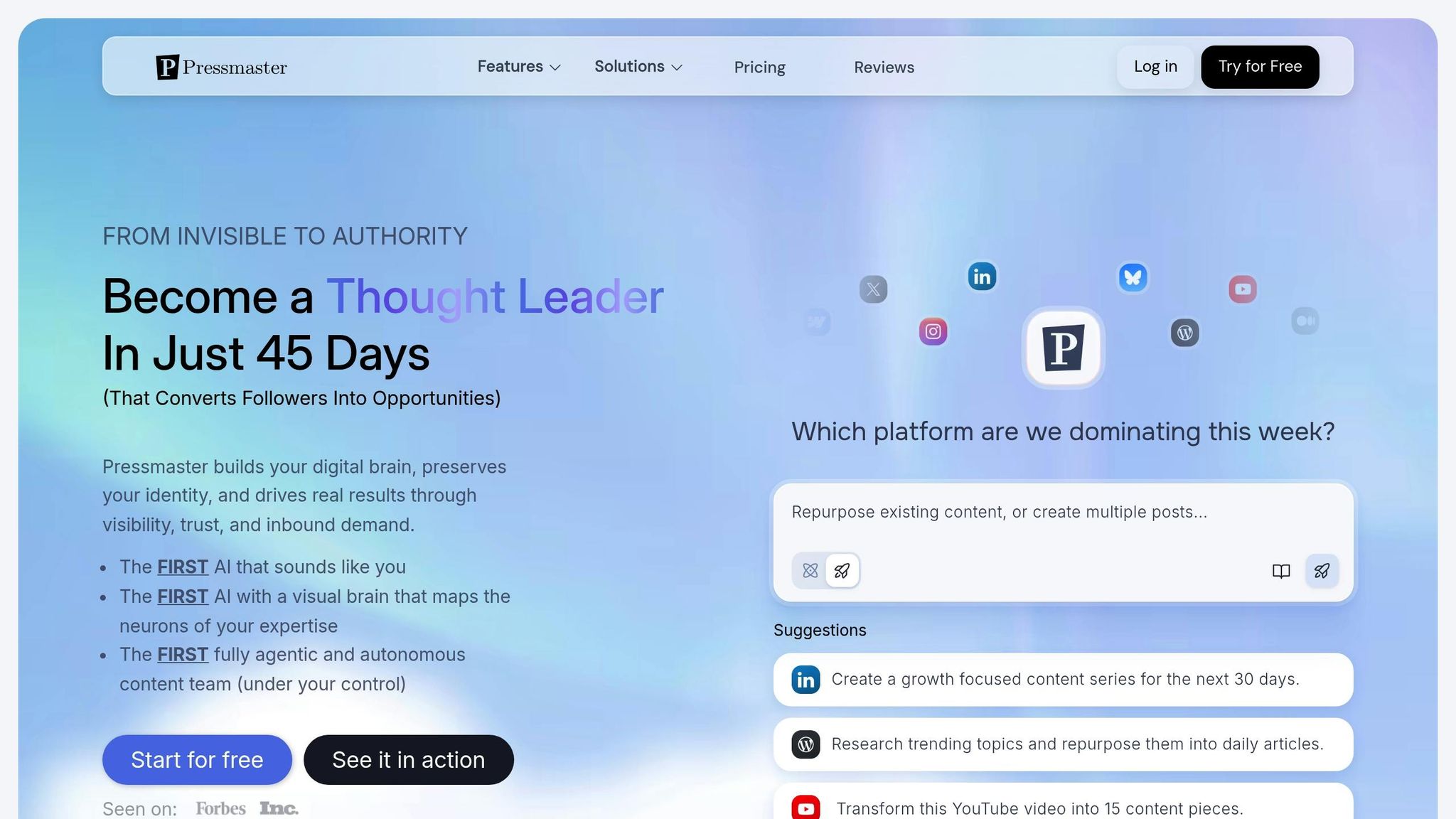
Pressmaster.ai simplifies the process of crafting attention-grabbing blog openings with its AI-powered tools. Acting like a creative partner, it combines smart planning with seamless execution to help you create intros that immediately draw readers in. Here’s a closer look at how Pressmaster.ai’s features can elevate your blog’s opening lines.
Using AI Strategizer for Content Angles
The AI Strategizer works as your brainstorming engine, analyzing patterns from thousands of popular articles to suggest angles that will connect with your audience. To get started, you simply choose your content type and adjust the core ideas and tone to fit your brand.
From there, the tool generates a detailed strategy, complete with tailored content angles, key themes, and tone recommendations. For instance, if you’re writing about AI productivity tools, it might propose an angle like, “How AI saved me 10 hours weekly - real case study.”
You can also align your writing style with well-known publications like the New York Times, Daily Mail, or Bild. Whether you want a thoughtful approach or something more sensational, the Strategizer adapts to your audience’s preferences.
"Pressmaster isn't just a writing tool, it's a thinking partner. It interviews you like a real journalist, captures your unique voice and ideas, and then executes content creation based on best practices." [8]
The Pro plan even includes a Hook Simulation feature, allowing you to test different angles with various audience profiles before settling on the perfect one.
Creating and Refining Intros with Pressmaster.ai
Once your content angle is set, the platform guides you through the creation process with an AI-powered interview. Instead of starting with a blank page, the AI asks tailored questions to draw out your insights and expertise, turning your responses into polished intros that reflect your voice.
Pressmaster.ai goes a step further by analyzing over 30 linguistic traits from your writing samples to create a "voice fingerprint." This ensures the generated intros sound like they came straight from you. You’ll receive 5–10 variations, each designed to match your chosen tone - whether casual, authoritative, or somewhere in between. Plus, the drag-and-drop editing tools make refining these options quick and easy.
For example, you can turn a simple opening into something more engaging: “Struggling to hook readers in 5 seconds? This AI slashed my bounce rate by 25% - here’s how.”
"I got goose bumps reading the content. This AI is crazy, it is so smart. It sounds so conversational. And just like ME." - Willie G, Start-Up CEO [9]
Every intro undergoes a rigorous triple-check process for fact accuracy, originality, and plagiarism detection, ensuring your content is both credible and engaging.
Using Trendmaster for Data-Driven Hooks
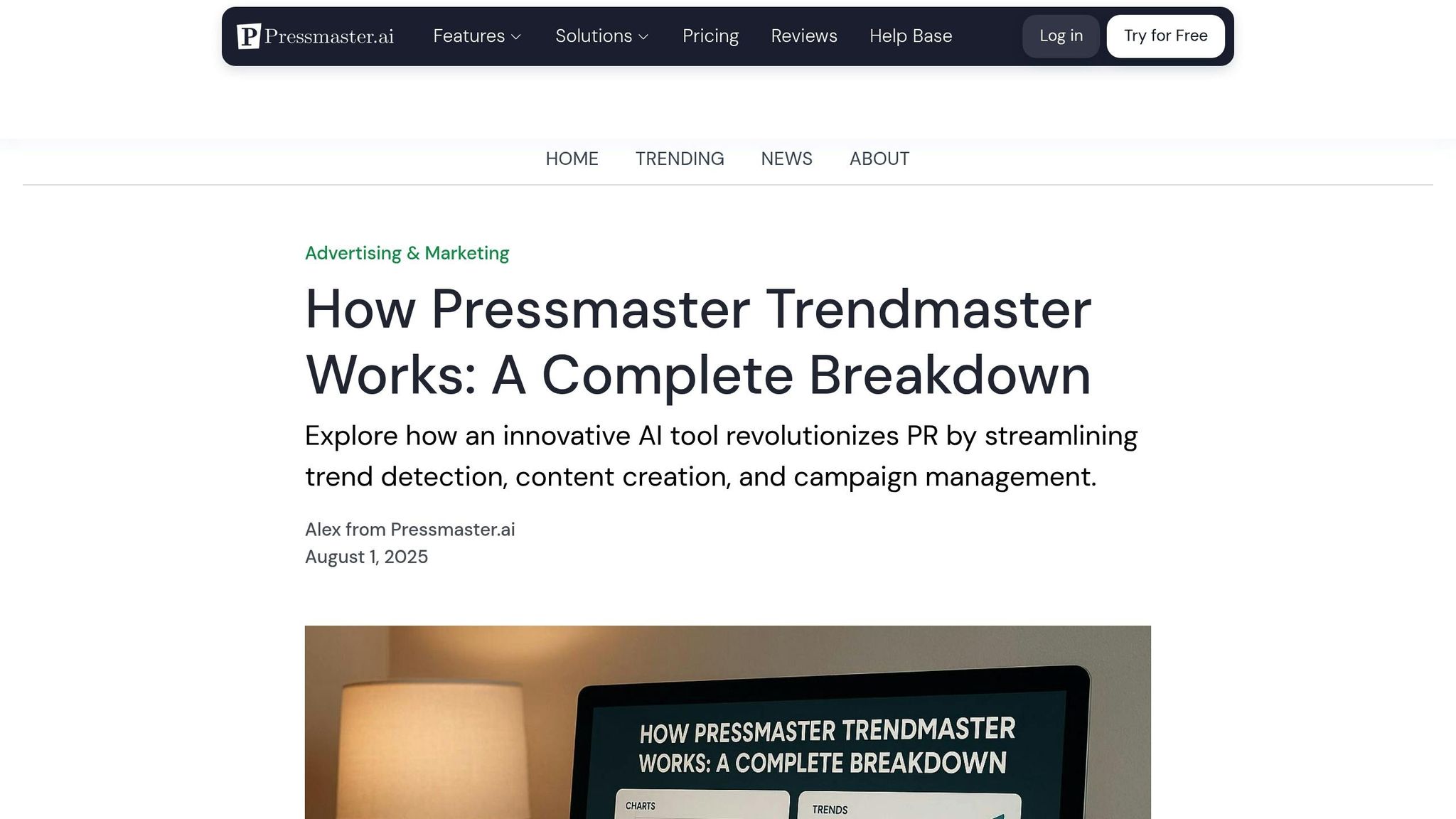
To make your intros stand out, Trendmaster injects them with timely, relevant data. This tool scans over 500,000 sources daily - ranging from social media and news outlets to forums and industry reports - to identify emerging topics before they hit the mainstream.
What sets Trendmaster apart is its predictive analytics, which can spot trends weeks before they gain widespread attention. Each trend is assigned a relevance score based on its momentum and how well it aligns with your brand’s voice. The tool even suggests pre-written angles you can use as hooks right away.
You can fine-tune your trend discovery process by applying filters for location (like the United States), industry (tech, healthcare, finance), or audience demographics. This ensures your hooks are laser-focused on your niche.
By combining Trendmaster insights with the AI Interview feature, you can seamlessly blend trending topics with your unique perspective, creating hooks that are both timely and authentic. The result? A 47% improvement in media pickup rates when using trend-based insights [9].
Tracking Hook Performance with Analytics
Once your blog is live, Pressmaster.ai’s analytics dashboard helps you monitor its performance. By consolidating engagement metrics from all your connected platforms, it eliminates the hassle of manual tracking.
The dashboard provides insights into key indicators like time-on-page, bounce rate reduction, scroll depth (aiming for over 60% for effective hooks), and overall engagement scores. Heatmaps show exactly where readers lose interest, offering actionable insights to refine your content. Within 24 hours of publishing, you can compare how different hooks perform. For example, one hook might reduce your bounce rate to 8%, while another only manages 15%, giving you a clear picture of what resonates with your audience.
This feedback loop allows for continuous improvement. Through A/B testing and adjustments, you can fine-tune your approach, with engagement rates often increasing by 20–50% over time. By completing the cycle from strategy to creation to measurement, Pressmaster.ai ensures that your content keeps getting better with every iteration.
Step-by-Step Workflow for AI-Assisted Blog Openings
Crafting engaging blog introductions with AI is all about combining the speed of automation with the finesse of human editing. By 2024, 80% of bloggers were using AI in their content workflows [10]. However, the ones seeing real results are those who pair AI-generated ideas with thoughtful refinement.
Define Your Audience and Content Goals
Before diving into AI tools, take a moment to clarify two key things: who you're writing for and what you want them to do. To guide the AI effectively, provide specific details like your post title, main keywords, audience demographics, and desired tone - whether it's professional, persuasive, or casual [1][11]. Go beyond surface-level demographics. Instead of targeting "marketing managers", narrow it down to something like "B2B marketing managers at mid-sized tech companies struggling to prove ROI on content strategies." This level of detail ensures the AI's output feels tailored and relevant.
Decide on the perspective early, too - first-person for authority, second-person for direct engagement, or third-person for neutrality. With these parameters in place, you're ready to generate attention-grabbing hooks.
Generate and Evaluate AI-Created Hooks
Ask the AI to produce 3–5 different hook styles - think anecdotal, statistical, or question-based approaches. Don’t just settle for the first option [1][4]. When reviewing these hooks, focus on E-E-A-T: Experience, Expertise, Authoritativeness, and Trustworthiness. This is especially important for topics that require credibility [1][10]. Look for hooks that use strong, emotion-driven language or create vivid imagery [4].
A useful trick is the "Summary Test": have the AI condense the intro into 3–4 lines. If the summary feels generic or misses the main point, the hook likely needs further tweaking to make it stand out [12]. Once you’ve identified the strongest option, you can refine it to fit seamlessly into your article.
Refine and Integrate Hooks into Full Articles
AI-generated content is a starting point, not the final product. Edit the chosen hook to tighten the language and ensure it flows naturally. Cut unnecessary words, replace vague terms with specific ones, and position your primary keyword early in the introduction to help search engines understand your topic [14]. Keep intros concise - 3–6 sentences is usually ideal for holding reader attention [14].
The hook should connect smoothly to the rest of your article. This means maintaining a logical transition from the opening statement to the value you're offering and, finally, to your call to action [13]. If the hook feels disconnected, revise either the intro or the body content to align better. You can also experiment with A/B testing: try one hook that highlights industry trends and another that addresses personal pain points to see which resonates more with your audience [13]. After all, 71% of AI users say saving time is the biggest advantage [1].
Conclusion
Starting your blog posts with captivating intros doesn’t have to feel like an uphill battle anymore. Thanks to AI tools, bloggers can now tackle this task with greater ease and efficiency, leaving behind the days of staring at a blank screen.
Take Pressmaster.ai, for example. This tool simplifies content creation by blending advanced data analytics with voice replication, ensuring your intros stay relevant and align with your unique style. By handling tasks like trend analysis and idea generation, it allows you to focus on what truly matters - adding the personal touch that makes your content stand out. In fact, organizations using automated workflows like these have reported organic impressions skyrocketing by as much as 4,100% in just 90 days [2].
If you’re looking for a way to turn raw ideas into polished blog openings in under 10 minutes, Pressmaster.ai might be the game-changer you need. From research to publishing, it’s designed to make the entire process seamless, so you can deliver engaging intros without breaking a sweat.
FAQs
How can AI tools help create better blog introductions?
AI tools like Pressmaster.ai are changing the way blog introductions are written, making it easier to create captivating hooks in just seconds. These tools analyze your content to match your tone and brand voice, ensuring every intro feels personal and consistent with your style. They’re designed to help you grab your readers’ attention right from the start while staying true to your brand identity.
What’s more, these tools keep your content relevant by identifying trending topics and seamlessly weaving SEO-friendly keywords into your opening lines. They also take care of fact-checking and originality, so your intros are both accurate and plagiarism-free. The best part? You can create clear, engaging introductions that save time and boost reader interest - all for just about $12 a month.
What features should I look for in AI tools to write engaging blog introductions and hooks?
When picking an AI writing tool to craft blog intros and hooks, it's important to focus on features that boost efficiency, quality, and audience engagement. Choose a tool that aligns with your writing style, ensuring each intro reflects your brand's unique voice. Tools offering real-time topic discovery can also be a game-changer, helping you tap into trending subjects and draw in more readers.
Key features to prioritize include SEO optimization to improve search rankings, seamless integration with platforms like WordPress, and real-time feedback to fine-tune your content on the fly. Look for tools with built-in plagiarism detection to guarantee originality, along with multi-format export options so you can easily repurpose intros for social media or other channels. These functions not only simplify the process of creating attention-grabbing openings but also save you valuable time while keeping your content fresh and engaging.
How does Pressmaster.ai help you create strong blog introductions and hooks?
Pressmaster.ai takes the hassle out of creating captivating blog hooks by blending cutting-edge AI with your personal writing style. It begins by analyzing your existing content to develop a voice fingerprint - a unique profile that mirrors your brand's tone and personality. This ensures that every hook feels authentic and consistent, which goes a long way in building trust with your readers.
The platform doesn't stop there. It leverages trend analysis and performance simulations to suggest opening lines that are crafted to grab attention and connect with your audience. You can even preview how different hooks might perform, giving you the confidence to pick the best one. And with easy integration into platforms like WordPress, you can quickly drop these hooks into your drafts, saving time while sparking your creativity.
Related Blog Posts








Sign Up for our Pressmaster Newsletter
Sign up for our Pressmaster.ai newsletter to get instant alerts on trending topics, ensuring you stay ahead in your field with the latest insights and updates.


.avif)
.png)

.avif)


7 Viral Patterns That Drove 10,643% Growth
Turn natural conversations into content gold, make every insight count, and drive real conversations.

Please fill out the form to get our Viral Cheat Sheet


How to Become a Thought Leader in 6 Easy Steps
Increase your visibility, establish authority, and conquer your market with minimal effort.

Please fill out the form to get our PDF Checklist
