
AI Writing Prompts That Help You Write With Confidence and Flow

Staring at a blank page can be frustrating. AI writing prompts solve this by giving you a starting point, helping you brainstorm, draft, and refine content effectively. Whether it's crafting headlines, overcoming writer's block, or tailoring content for specific audiences, these prompts save time and boost productivity. Here's what you need to know:
- Break Writer's Block: Use prompts like "Act as a skeptical journalist" to gain fresh perspectives or generate 50 headline ideas in seconds.
- Boost Creativity: Shift tones or simplify complex ideas by asking AI to rewrite content for different audiences, like a six-year-old or a historian.
- Maintain Structure: Start with an outline or refine drafts with prompts like "Humanize this text" for smoother transitions and flow.
- Target Specific Audiences: Use frameworks like SPOCK to ensure content resonates with your audience, whether Gen Z or C-suite executives.
AI prompts are tools, not replacements, for your creativity. They streamline your workflow, letting you focus on strategy and quality. Start experimenting with prompts today to make writing easier and more effective.
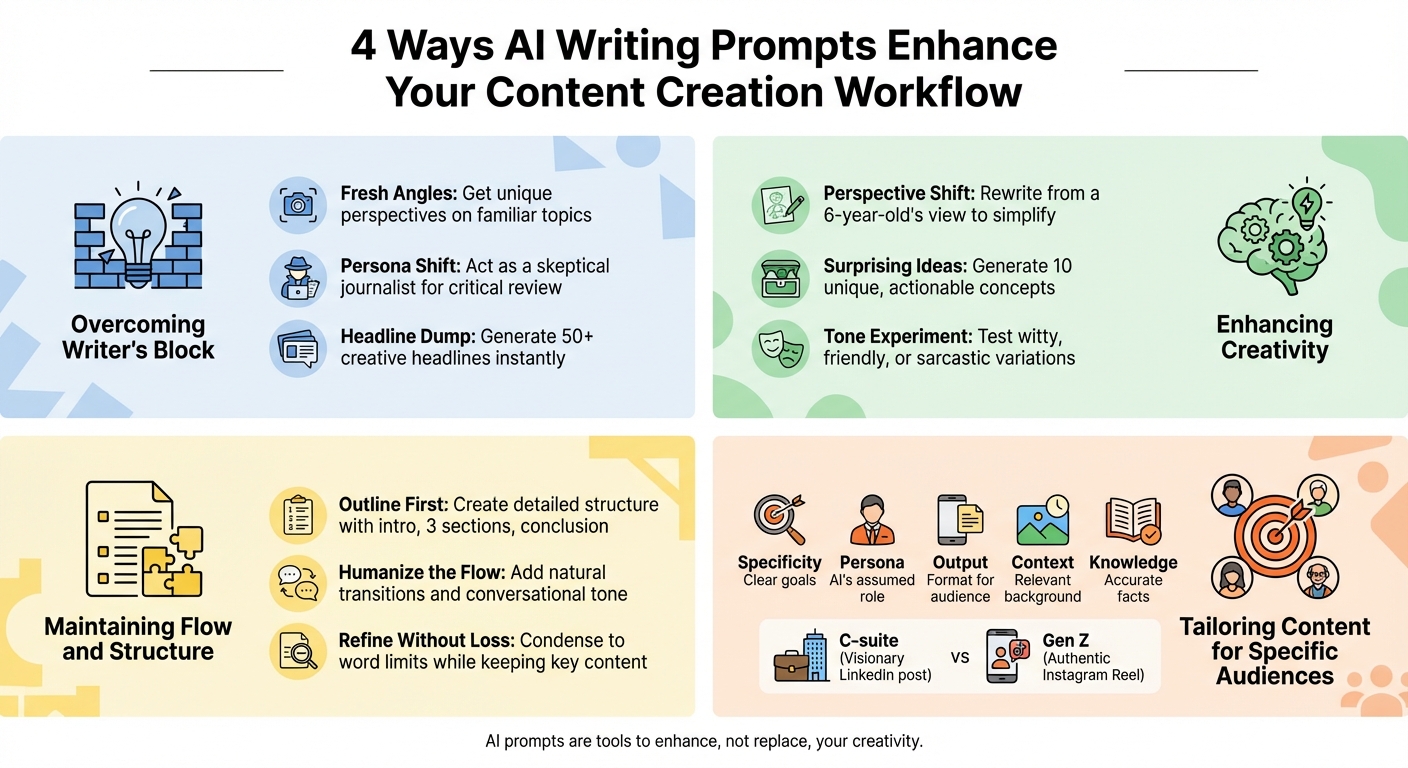
4 Ways AI Writing Prompts Enhance Your Content Creation Workflow
Simple guide to effective prompt writing
1. Overcoming Writer's Block
Writer's block can feel like hitting a wall, leaving you staring at a blank page with no idea where to start. AI writing prompts can help break through that mental block by offering a clear starting point instead of the daunting emptiness of a blank screen.
Here are some specific prompts that can help you get unstuck.
The "Fresh Angles" Prompt
Struggling to find a new take on a familiar topic? Try this: "I'm stuck on a [press release/pitch] about [topic]. What are some unique angles I can take to make this newsworthy?" [7]. This prompt encourages the AI to think beyond the obvious, offering ideas you might not have considered. For instance, if you're working on a product launch, it might suggest focusing on the problem the product solves instead of just listing features, or it could propose highlighting an unexpected use case that adds more depth to your narrative.
The "Persona Shift" Prompt
Sometimes, stepping into someone else’s shoes can reveal what’s missing in your work. Use the "Act as a..." approach to see things from a fresh perspective: "Act as a skeptical journalist at a major tech publication. Review these key points and tell me what questions you would ask or what parts you find boring" [2][8]. This technique mimics the kind of constructive criticism you might get from an editor or colleague - without the awkwardness of asking for feedback directly.
"Prompting AI with storytelling elements enables it to understand both the tone and the structure of what I'm looking for." – Eitan Goldstein, Communications Manager at Propel [8]
The "Headline Dump" Prompt
When inspiration runs dry, quantity can be your best ally. Ask the AI: "Generate a list of 50 creative headlines or subject lines for a story about [topic] aimed at [target audience]" [7][2]. While not every suggestion will be a winner, this method often sparks fresh ideas. Instead of hunting for the perfect headline, you’ll have a variety of options to explore, making it easier to find the direction that works best for you.
2. Enhancing Creativity
AI doesn’t just help you get started - it challenges you to think in new and exciting ways. Stale ideas can be replaced with prompts that open up fresh perspectives and push your creativity further.
The "Perspective Shift" Prompt
Struggling to simplify a complex idea? Here’s a trick: "Rewrite this from the perspective of a six-year-old to make it clearer and more engaging" [7]. This approach forces you to strip away unnecessary jargon and focus on the core message, making it easier to connect with your audience. Another option is to experiment with different personas: "Act as a historian and compare [Topic A] and [Topic B] in a conversational tone" [2]. By shifting perspectives, you can explore how your content might resonate with different audiences or in varied contexts.
The "Surprising Ideas" Prompt
Brainstorming can feel like spinning your wheels if the ideas don’t stand out. To break through, try something like: "Give me 10 ideas that are unique, surprising, and actionable" [5]. Adding constraints encourages AI to go deeper and uncover less obvious insights. This is especially useful for PR professionals crafting attention-grabbing campaigns. Kristen Dunleavy from Muck Rack explains: "AI provides a great starting point for PR pros creating content, but it's important to use AI responsibly... think of it as a way to help you brainstorm and find inspiration" [9]. You could also try prompts like "Brainstorm creative PR stunts to gain media attention for [organization]" [9] or "Give me three ideas for an op-ed piece on trending topics in [industry]" [9]. These prompts can help you generate ideas that stand out from the crowd.
The "Tone Experiment" Prompt
Sometimes, creativity comes down to how you say something. Instead of a generic request for creativity, be specific with tone: "Rewrite this paragraph to be witty and engaging" or "Make this friendly and a little sarcastic" [10]. This allows you to quickly explore different styles, giving you fresh options to refine into your unique voice.
3. Maintaining Flow and Structure
A solid structure is the backbone of effective writing. Without it, even the best ideas can lose their impact. AI prompts can help you create a logical and engaging flow. Let’s look at a few specific prompts that can guide your writing process.
The "Outline First" Prompt
Starting with an outline is a smart way to stay on track and avoid unnecessary detours. A prompt like "Create a detailed outline for a blog post titled [Title] with an intro, three main sections, and a conclusion" [11][7] sets the stage for organized content. This method saves time and ensures a clear direction for your writing. Want to go a step further? Add more details: "Please write a short, simple, and concise 3-sentence intro to a blog post titled [Title] in an educational yet approachable tone" [6]. By specifying tone, length, and audience, you can guide the AI to produce content that aligns with your goals.
The "Humanize the Flow" Prompt
AI-generated drafts can sometimes feel stiff or disjointed. To smooth things out, use a prompt like "Humanize this text by adding natural transitions and a conversational tone" [2]. This helps create a more fluid and engaging reading experience. For seamless transitions between sections, try asking the AI to "Complete this sentence..." to create a natural flow [2].
"AI prompts are commands the user enters into the AI writing assistant prompt box to request a task... Prompts should include all the details of what you need, such as the length or writing style of the generated text" - Matt Ellis from Grammarly [2].
The "Refine Without Loss" Prompt
When working with strict word limits, every word must count. Use a prompt like "Refine this text to [X] words without removing important content" [7]. This approach ensures that your message remains intact while eliminating unnecessary fluff. This is particularly useful for press releases, where brevity is key. The result? Concise, impactful writing that respects your reader’s time.
4. Tailoring Content for Specific Audiences
The "SPOCK Framework" Prompt
Creating content that truly connects with an audience requires more than just swapping out a few words - it’s about crafting messages that hit home. That’s where the SPOCK Framework comes in. This approach helps fine-tune audience-specific prompts by focusing on five key elements: Specificity (clear goals), Persona (the AI's assumed role), Output (format suitable for the audience), Context (relevant background), and Knowledge (accurate and relevant facts) [12].
Here’s how it works:
If you’re addressing C-suite executives on LinkedIn, you might say:
"Act as a Senior Strategic Communications Leader and create a LinkedIn post under 200 words about [Topic] in a visionary tone."
But if your audience is Gen Z, you’d adjust to:
"Create a script for an under-30-second Instagram Reel about [Topic] for Gen-Z, prioritizing authenticity."
The idea is to meet each audience where they are, addressing their specific needs and preferences instead of just shifting platforms.
"The higher the quality of the input, the more enjoyable the output. And for AI, the critical input that initiates system action and drives your output is the prompt." - PRSA [12]
Conclusion
AI writing prompts aren’t here to replace your creativity - they’re here to enhance it. Whether it’s late at night with a deadline looming or you’re stuck rewriting the same paragraph for the fifth time, these prompts act like a brainstorming partner. They help you push past creative blocks, stay true to your voice, and craft content that truly resonates with your audience.
There’s a noticeable gap between understanding AI’s potential and knowing how to use it effectively [3][4]. But within that gap lies an opportunity. Those who learn to leverage AI prompts today will be the ones who expand their reach tomorrow - without sacrificing their energy or burning out.
"I used to think AI was my competitor that might take over what I do. But honestly? Using AI has made me a better writer. I'm more efficient, I experiment more, and I have a creative tool that never gets tired of brainstorming." - Olha Novitska, Content Writer [1]
So, what’s next? Pick one prompt from this article and try it out this week. Share examples of your best work with the AI so it can learn your style. Use frameworks like "Act as" to get more polished results. And don’t expect perfection right away - refine your prompts as you go. The goal isn’t to become an AI expert overnight; it’s to build confidence in using these tools to make your workflow smoother and give you more time for the kind of strategic thinking only you can do.
Your voice is irreplaceable. AI prompts are just the tool to help you express it with consistency and ease. Use them to reclaim your time and focus on the creative work that truly matters. With these tools in hand, the blank page doesn’t stand a chance.
FAQs
How do AI writing prompts help with writer's block?
AI writing prompts can be a game-changer when you're staring at a blank page, unsure of where to start. By offering a clear direction, they help tackle writer's block head-on. For example, you could ask for something like "Give me three opening lines for a press release about a new eco-friendly product," and the AI will deliver ideas, outlines, or even a rough draft. This immediate input not only saves time but also sparks creativity, making it easier to get the words flowing.
What's great about these prompts is how flexible they are. Whether you're working on a media pitch, brainstorming catchy taglines, or coming up with blog post ideas, you can tailor the prompts to fit your specific needs. Instead of struggling to figure out what to write, you can shift your energy toward fine-tuning your tone and message. The result? A smoother, less stressful writing process - and a confidence boost along the way.
"I used to think AI was cheating until it made my writing ten times better." – A writer who overcame block using targeted prompts
What is the SPOCK framework, and how can it help create audience-specific content?
The SPOCK framework isn't a well-known or widely documented approach for adapting content to specific audiences. Unfortunately, there isn't enough information readily available to dive into its details or potential uses. If you have a source or more context about this framework, feel free to share it, and we can explore it further together.
How can AI writing prompts boost creativity and help maintain a smooth writing flow?
AI writing prompts act like a creative partner, offering fresh ideas, unique perspectives, and engaging phrasing to help you push through writer's block. For instance, you could ask the AI to "craft an engaging opening for a press release about a new sustainability initiative," and it will provide tailored suggestions that align with your brand's tone and messaging. This approach opens up new possibilities while keeping your content consistent and on-brand.
By providing instant suggestions, AI helps you maintain your writing momentum. Whether you’re stuck on a transition sentence, need a concise summary, or are searching for the next paragraph, the AI steps in to keep the process flowing. This minimizes the mental strain of deciding what to write next, allowing you to focus on fine-tuning your message. The result? A smoother, more efficient writing process that fuels creativity whenever you need it.
Related Blog Posts








Sign Up for our Pressmaster Newsletter
Sign up for our Pressmaster.ai newsletter to get instant alerts on trending topics, ensuring you stay ahead in your field with the latest insights and updates.


.avif)
.png)

.avif)


7 Viral Patterns That Drove 10,643% Growth
Turn natural conversations into content gold, make every insight count, and drive real conversations.

Please fill out the form to get our Viral Cheat Sheet


How to Become a Thought Leader in 6 Easy Steps
Increase your visibility, establish authority, and conquer your market with minimal effort.

Please fill out the form to get our PDF Checklist
