
AI Writing Prompts to Improve Blog Writing and SEO Performance

Creating SEO-friendly blog content is now easier and faster with AI writing prompts. These prompts act as detailed instructions for AI tools, helping writers produce well-structured, keyword-optimized posts that appeal to both readers and search engines. Here's a quick breakdown of what they offer:
- Keyword Optimization: Prompts ensure natural integration of primary, secondary, and long-tail keywords to improve search visibility.
- Content Structure: Detailed prompts guide the organization of headings, sections, and formats to enhance readability and SEO.
- Engagement and Tone: Prompts help tailor tone, voice, and interactive elements to connect with your audience and keep them engaged.
- SEO Metadata: AI-generated meta titles and descriptions improve click-through rates and search rankings.
Why it matters: Using AI prompts can speed up content production by up to 40% and boost organic traffic by 30%. Tools like Pressmaster.ai make this process even more efficient by automating SEO tasks and maintaining brand voice consistency.
AI writing prompts simplify blog creation, ensuring your content ranks higher while remaining relevant and engaging for your audience.
How I Use These 8 Free ChatGPT Prompts to Boost SEO Rankings (Step-by-Step)
1. Keyword Optimization
Keyword optimization has reshaped how content creators approach SEO. Instead of manually sprinkling keywords into content after it's written, AI tools now use prompts to naturally incorporate relevant terms right from the start. This not only boosts search engine visibility but also keeps the content engaging and easy to read.
Targeted Keyword Integration Prompts
The best AI prompts for keyword optimization clearly define primary and secondary keywords upfront. Vague instructions don’t cut it - specificity is key. For example, a strong prompt might say: "Write a blog section about sustainable home improvements that naturally includes the primary keyword 'eco-friendly renovation tips' and at least two secondary keywords, such as 'energy-efficient upgrades' and 'green building materials.' Ensure the content is both informative and engaging for homeowners." This type of prompt ensures the AI stays focused on the topic while seamlessly weaving in the keywords that matter most for search rankings.
Long-Tail Keyword Expansion Strategies
Long-tail keywords are often the secret to attracting highly qualified traffic. AI prompts can be tailored to focus on these detailed search phrases by addressing specific user questions. For instance, a prompt like "Write five detailed paragraphs answering common questions about 'budget-friendly meal prep for busy professionals,' with each paragraph targeting a different long-tail variation such as 'how to meal prep on $50 per week' or 'quick meal prep ideas for working parents'" can help capture multiple related queries within a single piece of content. This approach aligns perfectly with user intent, making the content more relevant to what your audience is searching for.
Keyword Variation and Synonym Integration
Incorporating varied terminology is another way to expand content reach. Search engines now understand context and related terms, so using synonyms and alternate phrases is just as important as including the primary keyword. An example of a variation-focused prompt might be: "Write a guide on digital marketing strategies, using the primary keyword while naturally integrating synonyms like 'online marketing tactics,' 'internet advertising methods,' and 'digital promotion techniques.' Keep the tone conversational and engaging." This strategy ensures your content appeals to a broader range of search queries while still sounding natural.
The most effective prompts combine all these strategies: they specify primary keywords, include long-tail variations, and encourage the use of synonyms. This layered approach allows your content to rank for multiple search terms while maintaining high-quality writing that resonates with readers.
Our tool takes these strategies a step further. By interpreting detailed keyword prompts, it generates SEO-ready content that seamlessly integrates your target terms while staying true to your brand's voice. This simplifies your keyword strategy and helps your content perform better in search results.
2. Content Structure
A well-organized content structure is the backbone of SEO success. With AI writing prompts, you can revolutionize how blog posts are organized, ensuring a logical flow that appeals to both search engines and readers. By crafting prompts that outline specific structural elements, you can create content that's both engaging and optimized for visibility. These strategies lay the groundwork for content that not only ranks well but also keeps readers coming back for more.
Hierarchical Heading Framework Prompts
Clear heading hierarchies are essential for creating structured content. When designing AI prompts, specify the exact heading levels and their relationships. For example, you might use a prompt like: "Write a 2,000-word guide on home security systems, starting with an H1 title, followed by five H2 sections detailing different security types, and include at least two H3 subsections under each H2 to cover specific features and installation tips." This method ensures your content has a logical structure, which search engines use to evaluate topic relevance and depth.
Websites with structured blog content see 55% more traffic compared to those without a clear organization[6]. Why? Because search engines can crawl and index content more effectively when it follows a clear hierarchy. To replicate this success, your prompts should include heading requirements, word count targets for each section, and the relationships between content levels. These strategies, built into your AI prompts, can significantly boost both SEO performance and reader satisfaction.
Format-Specific Structure Templates
Different types of blog posts demand unique structural approaches, and your AI prompts should reflect these needs. For instance, a how-to guide thrives on step-by-step instructions, while product comparisons benefit from side-by-side feature breakdowns. Consider a prompt like: "Compare three email marketing platforms with an introduction, H2 sections for each platform, a feature/pricing table, a list of pros and cons for each, and a conclusion with tailored recommendations."
This level of detail ensures the AI generates content that matches user expectations for the format. In fact, 58% of marketers surveyed use ChatGPT for content creation, with outlining and ideation being the most common applications[7]. By combining format-specific requirements with SEO considerations, you can create posts that are both user-friendly and search-engine-friendly.
Engagement-Driven Section Planning
Effective content structure isn't just about headings - it's also about keeping readers engaged. AI prompts can include instructions for adding interactive elements, expert insights, and actionable takeaways. For example, an engagement-focused prompt might say: "Write a guide on digital marketing trends with an engaging introduction, five detailed trend sections including examples and expert quotes, FAQ subsections, and actionable tip boxes."
Structured blogs can lead to 434% more indexed pages and 97% more backlinks compared to unstructured ones[6]. To maximize these benefits, prompts should also include details like smooth section transitions, internal linking opportunities, and strategic calls-to-action. By embedding these elements into your AI instructions, you ensure that every piece of content is designed to balance SEO needs with reader engagement.
The most effective structural prompts combine clear heading hierarchies, format-specific templates, and engagement-focused elements. This comprehensive approach not only enhances search performance but also delivers meaningful value to your audience.
3. Engagement and Tone
Once you've nailed down a clear structure for your content, the next step is to make it truly engaging. The tone you use can turn an ordinary blog post into something that grabs attention and keeps readers hooked. When crafted thoughtfully, AI writing prompts can help create this connection by focusing on your audience's specific needs and emotional triggers. By defining the desired voice, personality, and level of interaction in your prompts, you can produce content that feels relatable and sparks engagement.
Crafting a Voice That Speaks to Your Audience
To connect with your readers, your content needs to feel like it was written just for them. This is where tailoring your AI prompts comes into play. Instead of vague instructions like "write professional content", get specific about who you're speaking to. For example: "Write for small business owners who are juggling multiple responsibilities and feel overwhelmed by digital marketing. Use a warm, understanding tone and provide practical tips they can implement in under 30 minutes."
This level of detail helps the AI create content that resonates with your audience's experiences and emotions. Targeted content like this often outperforms generic alternatives in terms of engagement and SEO rankings[3]. You can take it a step further by including references that feel familiar to your readers. For a U.S. audience, this might mean weaving in mentions of American holidays, using feet and inches for measurements, or discussing business practices common in the United States. These small touches make your content feel more relatable and natural.
Adding Interactive Features to Boost Engagement
Today's readers expect more than just passive consumption - they want to interact with your content. By structuring AI prompts to include interactive elements, you can increase the time readers spend on your page and reduce bounce rates, which are both important for SEO. For instance, you could prompt the AI to include elements like: "End each section with a question that invites readers to share their opinions in the comments, and include a poll midway through asking them to vote on their biggest challenge related to this topic."
Interactive content like polls, questions, and calls-to-action can significantly improve engagement metrics, which in turn boosts search rankings[1][4]. Be specific in your prompts about the type of interaction you want. For example, you could ask the AI to create content that encourages readers to tag a colleague, share their own tips, or comment on their experiences. These kinds of interactive features not only engage your audience but also send strong quality signals to search engines.
Staying True to Your Brand Voice While Connecting Emotionally
Keeping your brand voice consistent across all your content can be challenging, especially when you're scaling up production. AI prompts can help by capturing both your unique communication style and the emotional tone you want to convey. For example: "Write as a positive and encouraging marketing expert who believes small businesses can thrive by using authentic and smart content strategies. Use language that inspires confidence and motivates readers."
AI can adapt to reflect your brand's voice and values, creating content that feels personal and authentic[5]. To take it further, include emotional goals in your prompts. Maybe you want readers to feel reassured, empowered, or excited about a new idea. By combining these emotional cues with your brand voice, you can create content that not only reflects your identity but also drives the reactions you’re aiming for. This emotional connection often translates into better engagement and stronger SEO performance.
4. SEO Metadata
Writing Meta Titles and Descriptions That Attract Clicks
Once you've nailed your keyword strategy and content structure, the next step is crafting SEO metadata that stands out. Meta titles and descriptions are your first chance to grab attention in search results. Think of them as mini-billboards for your content. Even the best-written posts can go unnoticed if these snippets fail to entice users. In fact, optimized meta descriptions can boost click-through rates by up to 5.8% compared to those left unoptimized[1].
Using AI can make this process more precise and less time-consuming. For example, you could use a prompt like this:
"Create a meta title under 60 characters and a meta description under 160 characters for a blog post about 'AI writing prompts for SEO.' Include 'AI writing prompts' at the start of both. The description should be engaging and encourage users to read the post."[4]
This approach ensures your metadata aligns with earlier strategies, like keyword integration and content structuring.
Meta descriptions appear in 62% of Google search results, making them critical for visibility[1]. To create metadata that resonates with both users and search engines, consider testing multiple variations. For instance, one version might focus on solving a specific problem, while another highlights the benefits of your content. A/B testing these options can reveal which version drives the most clicks. A great example: in 2024, an e-commerce blog used AI prompts to optimize metadata for over 1,000 product pages, resulting in a 7% increase in organic click-through rates within just three months[1].
While it's tempting to cram in as many keywords as possible, avoid keyword stuffing - it can make your metadata feel robotic. Instead, aim for natural-sounding text that clearly communicates the value of your content.
Tools like Pressmaster.ai can help streamline this process by generating SEO-friendly meta titles and descriptions that stick to character limits and follow best practices, giving your content the attention it deserves.
Conclusion
By combining optimized keywords, structured content, and engaging writing, AI-powered prompts are reshaping how blog posts connect with readers and perform on search engines.
AI writing prompts are more than just tools - they're game-changers for blog writing and SEO. They simplify workflows, speed up production, and drive organic traffic. In fact, teams using AI tools for blog creation report up to 40% faster content production and a 30% increase in organic traffic when prompts are tailored for SEO[1][3]. Instead of spending hours brainstorming, researching, and organizing, writers can focus on refining ideas and adding personal insights. A 2024 survey revealed that 68% of marketers now rely on AI-powered writing tools to enhance their SEO strategies, citing better efficiency and improved keyword targeting as key advantages[3].
The benefits extend beyond speed. AI prompts help craft well-structured articles with clear introductions, logical sections, and relevant examples. They ensure a consistent tone, seamless keyword integration, and thorough topic coverage. When used effectively, these prompts create content that appeals to readers while meeting search engine standards.
SEO performance also sees a boost. AI prompts can embed keyword strategies, meta descriptions, and internal linking directly into the writing process. This alignment with search algorithms increases the chances of higher rankings and better visibility. Specificity is key - detailed prompts that include elements like meta titles, descriptions, and multimedia suggestions can significantly enhance search performance[1][8].
To succeed with AI writing prompts, it’s essential to set clear goals, define structural elements, and carefully review outputs for originality and accuracy.
As prompt engineering evolves, it’s becoming easier for marketers to create precise, effective prompts. Many AI platforms now offer tools like prompt builders and templates, allowing users to customize tone, audience, content goals, and SEO requirements. This makes high-quality blog creation more accessible, even for those without technical expertise[2][3].
How Pressmaster.ai Simplifies AI-Powered Blog Writing
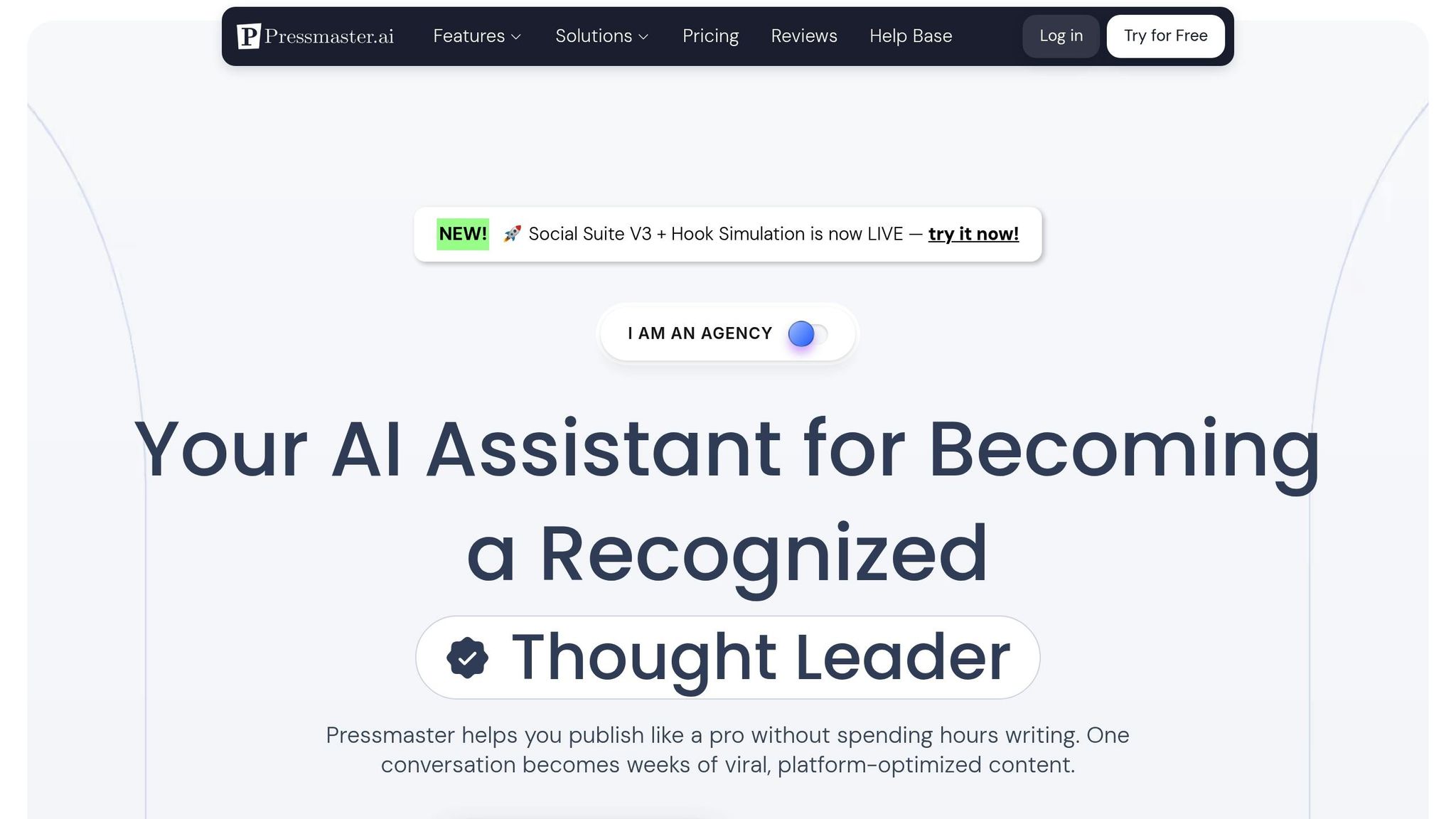
These advantages are amplified with tools like Pressmaster.ai, which takes AI-driven content creation to the next level.
What makes Pressmaster.ai stand out is its ability to preserve your unique voice while scaling production. Its brand voice feature analyzes real samples of your writing to ensure AI-generated content feels authentic. This directly addresses one of the biggest concerns about AI tools: losing the personal touch and tone that define your content.
Pressmaster.ai also automates SEO tasks, including fact-checking, plagiarism detection, and voice consistency. This integrated approach guarantees content that meets both quality standards and search engine requirements.
For teams juggling multiple projects or clients, Pressmaster.ai offers features like multiple workspaces, allowing seamless management of different brands and campaigns. Its unified analytics dashboard provides a clear view of performance metrics across platforms, helping you track how your AI-generated content is performing.
The future of blogging lies in blending AI’s efficiency with human creativity. By mastering tools like Pressmaster.ai and crafting well-thought-out prompts, content creators can produce SEO-optimized, engaging blogs faster than ever - freeing up time to focus on strategy, analysis, and the unique insights only humans can bring.
FAQs
How do AI writing prompts help improve the SEO performance of my blog posts?
AI writing prompts can play a big role in boosting the SEO performance of your blog posts. They help you weave relevant keywords and phrases into your content in a way that aligns with search engine algorithms. This gives your posts a better chance of ranking higher in search results.
On top of that, these prompts can suggest interesting topics and content structures that resonate with your audience. This not only grabs their attention but also encourages them to spend more time on your site. By simplifying the brainstorming process, AI prompts save you time while ensuring your blog content is both engaging and optimized for search engines.
How can I create AI prompts that reflect my brand's voice while improving SEO?
To create AI prompts that reflect your brand's voice and improve SEO, start by helping the AI understand your tone and style. A great way to do this is by analyzing content from your blog or website and using it as a guide for the AI. This ensures the generated content aligns with your brand's personality and messaging.
Make sure to weave target keywords naturally into your prompts to optimize for search engines. At the same time, craft prompts that inspire engaging, reader-focused content. This approach not only connects with your audience but also adheres to SEO best practices. Striking a balance between creativity and optimization allows you to maintain your brand's unique voice while enhancing your blog's visibility.
How does Pressmaster.ai make keyword integration more effective compared to traditional content creation?
Pressmaster.ai leverages cutting-edge AI algorithms to weave keywords into your blog posts in a way that feels smooth and reader-friendly. Forget the old-fashioned, clunky methods of manual keyword placement - this tool takes a smarter route. It evaluates context, user intent, and trending searches to recommend the best spots for keywords.
This means your content not only works well with search engine algorithms but also keeps its natural flow intact. By striking the right balance between keyword density and relevance, Pressmaster.ai boosts your blog's SEO performance without sacrificing the quality of your writing.








Sign Up for our Pressmaster Newsletter
Sign up for our Pressmaster.ai newsletter to get instant alerts on trending topics, ensuring you stay ahead in your field with the latest insights and updates.


.avif)
.png)

.avif)


7 Viral Patterns That Drove 10,643% Growth
Turn natural conversations into content gold, make every insight count, and drive real conversations.

Please fill out the form to get our Viral Cheat Sheet


How to Become a Thought Leader in 6 Easy Steps
Increase your visibility, establish authority, and conquer your market with minimal effort.

Please fill out the form to get our PDF Checklist
