
AI Writing Tips for Creators Who Want Authentic and High Converting Copy

Want to write better content that grabs attention and drives action? Here’s the core takeaway: Combine AI tools with your unique style to create clear, engaging copy that connects with your audience and boosts conversions.
Key points:
- Clarity is critical: Simple, direct language keeps your message effective.
- Emotion drives action: Address pain points and inspire readers to act.
- AI enhances efficiency: Use tools like Pressmaster.ai to scale content production while maintaining your voice.
- Know your audience: Analyze feedback and data to tailor your message.
- Test and refine: Use AI to track performance and improve results over time.
How to Build Your AI Writing System: The FULL Walkthrough
Building Your Brand Voice
When it comes to crafting effective, conversion-focused copy, having a distinct brand voice is a game-changer. Your brand voice is what makes your content instantly recognizable. It’s the difference between blending into the crowd and standing out as unmistakably you. In a world where AI can churn out endless streams of content, your voice becomes your edge.
Think of it like this: when you get a text from your best friend, you can tell it’s them before even seeing their name. That’s the kind of familiarity your brand should inspire - consistent, unique, and unmistakable.
How to Define Your Brand Voice
Defining your brand voice starts with identifying what makes your communication stand out. It’s not about creating a persona or mimicking someone else. Instead, it’s about amplifying the qualities that already make your voice uniquely yours.
Start with your core values and experiences. Ask yourself: What do I bring to the table that others don’t? What life experiences have shaped my perspective? What unique insights or connections do I offer? These answers form the foundation of your brand voice.
For instance, if you’re a fitness coach who overcame personal struggles with weight loss, that journey naturally influences how you connect with and inspire your clients.
Pay attention to your natural communication style. Take note of how you typically express yourself. Are your sentences short and snappy, or do you favor longer, more detailed explanations? Do you lean toward a professional tone, or is your style more casual and conversational? Maybe you sprinkle in humor or rely on industry-specific language. These patterns are the building blocks of your voice.
Learn from your audience. Dive into customer reviews, social media comments, and direct feedback to see how your audience talks about their challenges, needs, and successes. The words they use can guide you in making your content more relatable and engaging.
To keep things consistent, create a simple brand voice guide. Include details like your tone (friendly, professional, or authoritative), stylistic preferences (sentence length, contractions, or jargon use), and your unique perspective on your industry. This document becomes your go-to resource for maintaining your voice across all content.
Once your voice is clearly defined, you can use AI tools to help maintain that consistency as you scale your content production.
Using AI to Copy and Keep Your Brand Voice Consistent
AI tools can be incredibly helpful in ensuring your brand voice remains consistent, even as you produce more content. Platforms like Pressmaster.ai allow you to train AI to replicate your unique style and tone.
Upload your best content. Start by uploading examples of blog posts, emails, or social media captions that best represent your voice. The more examples you provide, the better the AI will understand your style.
Set clear guidelines. Be specific about what you want. For example, you might request short sentences, the use of contractions, or the inclusion of personal anecdotes. Clear instructions help the AI stay aligned with your voice.
Incorporate audience language. If your customers frequently describe a product as having a "pillowy strap", make sure that phrase is included in your AI prompts. Using customer language makes your content feel authentic and relatable.
Keep it updated. Over time, your voice may evolve, and so should your AI guidelines. Regularly review AI-generated content and provide feedback. If the tone feels off or no longer matches your current style, refresh the examples and retrain the AI.
As Stephen Meadows, COO at Coldwell Banker Premier, shares:
"It's one of the easiest programs for AI content creation. It captured my voice and tone amazingly well."
Adapt for different platforms. While your tone might shift slightly between a Twitter thread and a LinkedIn article, the essence of your voice should remain intact. AI tools can help you tweak your content for different platforms without losing its personality.
The key is to combine human creativity with AI efficiency. Let the AI handle the heavy lifting of generating content, and then add your personal touch to create an emotional connection with your audience.
Your brand voice is your signature in the online world. With a clear strategy and the right tools, you can ensure that signature shines through in everything you create - building trust and recognition with your audience at scale.
Using AI for Personalized Content Creation
Crafting content that resonates with your audience isn’t just about writing well - it’s about knowing who they are and what truly matters to them. AI has changed the game by helping creators analyze audience data in ways that make it easier to connect with different groups on a deeper level.
The secret to successful personalized content lies in blending AI-driven insights with human creativity. While AI is great at analyzing numbers and spotting trends, it’s your ability to translate those insights into relatable and meaningful content that makes the real difference.
Learning About Your Audience Through AI Data
In the past, understanding your audience meant hours of combing through comments, reviews, and engagement metrics. Now, AI tools can handle massive amounts of data, uncovering patterns and preferences you might have missed.
AI analytics can scan thousands of data points - like social media interactions and website behavior - to pinpoint what topics, formats, and messaging styles your audience responds to most. Tools like Pressmaster.ai even use machine learning to segment audiences, showing you which content performs best for specific groups.
Take Pressmaster.ai’s Trendmaster feature, for instance. It scans over 500,000 sources daily to identify trending topics that your audience is already interested in. This eliminates the guesswork from content planning, allowing you to focus on subjects that your audience actively wants to engage with.
AI also excels at sentiment analysis and real-time trend detection. It can help you spot emerging topics within your target demographic weeks before they hit the mainstream, giving you an edge as a leader in your niche rather than a latecomer.
Another powerful approach is leveraging Voice of Customer (VoC) data - the language your customers use to describe their needs, challenges, and experiences. AI can analyze reviews, social media comments, and even support tickets to identify recurring phrases or terms that resonate with your audience.
For example, in 2022, a major e-commerce retailer used AI to analyze customer reviews and social media feedback. By integrating common phrases and pain points into their product descriptions, they saw a 22% boost in conversion rates within just three months[2].
Armed with these insights, you can create content that feels truly relevant to your audience.
Making Content That Connects With Your Audience
Once you’ve gathered insights from AI, the next step is to craft content that genuinely connects by combining those insights with your unique voice and perspective.
Start with AI insights, then add your personal touch. Use the data to shape your strategy, but don’t rely on AI alone. The best content comes from blending AI’s findings with authentic language and your own creativity. For instance, if your analysis shows that customers describe a product feature as “pillowy” rather than “comfortable,” use that exact term in your content.
Leverage AI tools to refine your voice. Pressmaster.ai’s Expertise Interview feature can take your raw ideas and mix them with trending topics, resulting in content that sounds authentically like you while addressing what your audience cares about. This ensures your content remains personal and relatable.
Be specific with your prompts for better results. When using AI tools, clarity is key. Instead of a vague request like “Write a blog post about email marketing,” try something like “Create a landing page headline for beginner creators struggling with email marketing, using the AIDA framework.” Specific prompts lead to more precise and impactful content[5].
Experiment with AI-powered testing. Advanced tools now offer features like “Hook Engineering & Performance Simulation,” which let you test headlines, introductions, and calls-to-action to predict what will engage your audience most.
Adapt your message for different segments without losing your voice. While your brand voice should stay consistent, how you present information can vary depending on your audience’s preferences. AI can help you create tailored versions of the same message - for example, a data-heavy version for analytical readers and a more story-driven one for emotionally driven audiences.
A SaaS company demonstrated this approach by using AI-driven segmentation to personalize email campaigns based on user behavior. The results? A 34% increase in open rates and a 19% boost in click-through rates compared to generic campaigns.
Refine continuously based on performance. AI tools can automate A/B testing by generating multiple content versions and analyzing metrics like engagement, click-through rates, and conversions. These insights help you understand what works best for each audience segment, allowing you to fine-tune future content.
The goal isn’t to replace human creativity with AI. Instead, think of AI as a powerful tool that enhances your ability to create content that resonates. By combining AI’s data-crunching capabilities with your unique voice and perspective, you can deliver personalized content that drives engagement and conversions at scale.
Next, we’ll explore how to turn all that audience engagement into meaningful action.
Making Copy That Converts Better
Knowing your audience is just the beginning. The real magic happens when you turn those insights into copy that drives action. Every word, every call-to-action (CTA), should guide your audience toward making a decision.
AI has completely changed how we approach crafting conversion-focused copy. Instead of relying on outdated templates or guesswork, you can now use data-driven insights to create messages that truly connect with your audience and deliver measurable results.
The secret to writing high-converting copy lies in combining AI's analytical abilities with tried-and-true copywriting techniques and the language your customers actually use. When these elements come together, your content feels genuine while hitting the emotional and logical triggers that inspire action.
From there, your focus should shift to creating CTAs that don’t just sit there - they get readers to act.
Writing Better CTAs (Calls-to-Action)
Your CTA is the tipping point. Even the most engaging content can fall flat if the CTA doesn’t inspire the reader to take that next step. Thankfully, AI tools can help you craft CTAs that are not only compelling but also fine-tuned to your specific goals.
Instead of a generic "sign-up" button, use prompts that guide AI to create tailored CTAs. For example, you could ask, "Write a CTA for busy parents promoting a time-saving meal kit, using a friendly and reassuring tone that addresses their main concern about meal planning." This approach ensures your CTA speaks directly to your audience's needs and motivations.
Incorporate the exact words your customers use. For instance, if they rave about a product’s "pillowy strap", use that phrase in your CTA to make it more relatable and human.
Experiment with different CTA variations to see what resonates most. Compare something like "Start Your Free Trial Today" with "Join 10,000+ Creators Growing Their Audience." Tools like Pressmaster.ai’s Hook Engineering & Performance Simulation feature can even predict how your audience will respond to different CTAs before you publish them.
Lastly, make your CTAs specific and benefit-focused. Instead of a vague "Learn More", try something like "Get Your 5-Minute Content Strategy" or "Download the Complete Guide to Email Marketing." By addressing your readers’ immediate needs or emotions, you can significantly boost conversions.
Using Data to Improve Your Content
Creating copy that converts isn’t a one-time effort - it’s a continuous process of testing, analyzing, and refining based on performance data. AI analytics tools make this easier by tracking key metrics and uncovering patterns that might otherwise go unnoticed.
Pay attention to metrics like click-through rates, conversions, time on page, and bounce rates to measure how your content is performing[3][4].
AI can help identify the best-performing elements across your content library - like which headlines or CTAs deliver the most conversions. This allows you to build a collection of proven content pieces for future campaigns.
For example, one marketing strategist reported increasing their agency’s close rate on cold email leads from 8% to 21% in just three months by integrating AI-generated content into their sales process[1].
Analyzing audience behavior is another way to refine your content. AI can reveal how different audience segments engage with your content - whether it’s new visitors versus returning customers or how various demographics respond to your messaging. This insight helps you create more targeted, effective copy.
Set up automated performance monitoring to catch potential issues early. AI tools can flag drops in performance and suggest adjustments based on what’s worked well in the past, helping you maintain strong conversion rates even as audience preferences shift.
You can also use predictive analytics to fine-tune your content before it goes live. Advanced tools analyze your drafts and forecast performance based on historical data and broader trends, giving you the chance to make strategic tweaks during the creation process.
The goal isn’t to let data replace your creativity. Instead, combine your instincts with performance insights to create copy that consistently delivers results while staying true to your voice.
How Pressmaster.ai Helps You Create High-Converting Copy
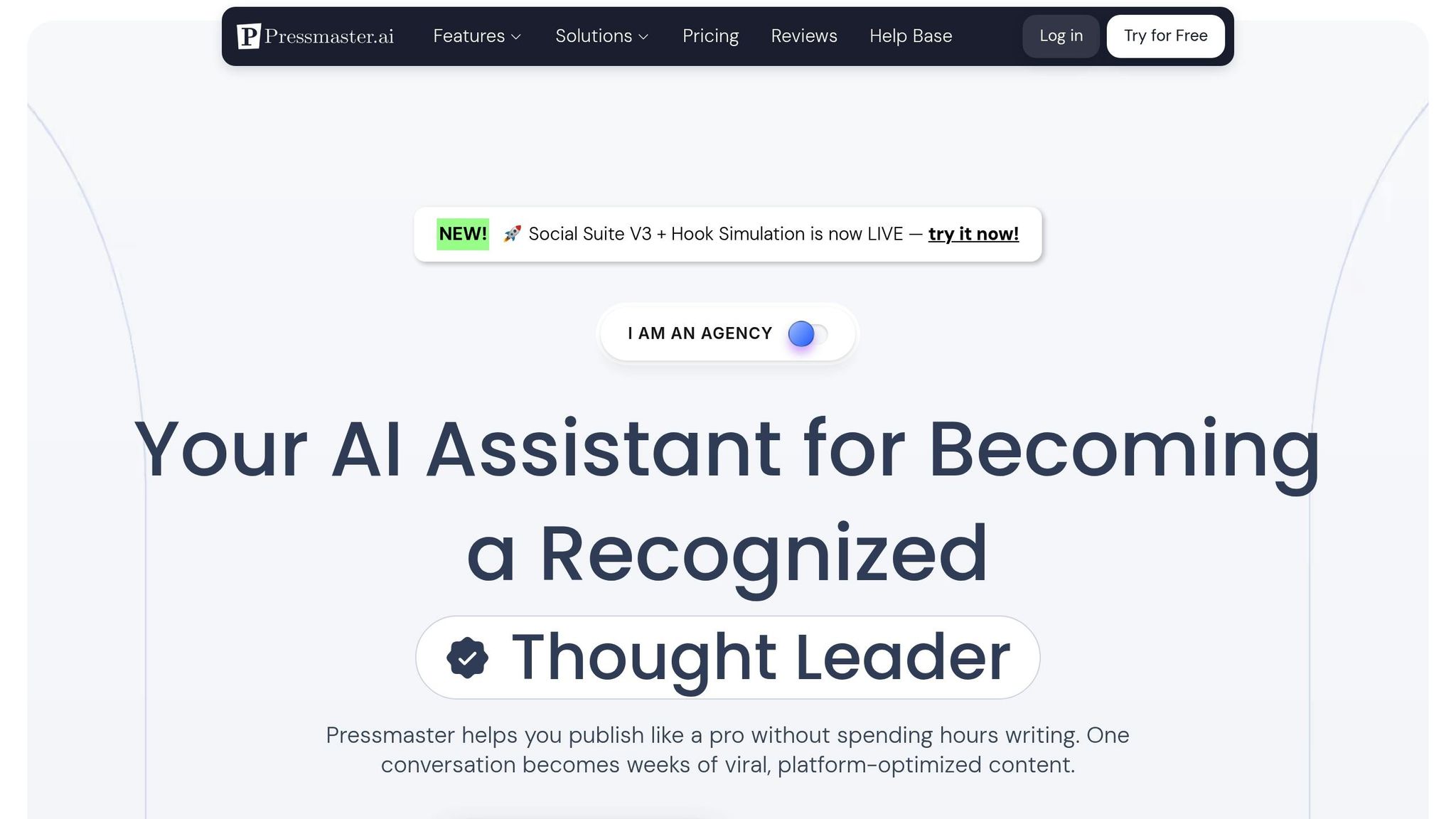
Pressmaster.ai brings all these strategies together with a suite of tools designed to help you create content that converts. Its AI Strategizer uses insights from over 1 million viral articles and proven frameworks to generate content angles tailored specifically to your audience.
With the Hook Engineering & Performance Simulation feature, you can test headlines, introductions, and CTAs before hitting publish. This tool predicts audience reactions and emotional responses, allowing you to optimize your content for maximum impact. Plus, the unified analytics dashboard gives you a clear view of what’s driving results across all your channels.
The Trendmaster tool scans hundreds of thousands of sources daily to identify emerging topics weeks before they go mainstream. This gives you the chance to create timely, relevant content that grabs attention when your audience is most engaged. And because Pressmaster.ai scales content production without losing your personal touch, you can experiment with different approaches while maintaining the authenticity that builds trust with your audience.
Publishing Content Across Multiple Channels
Once you've crafted high-converting copy and established a distinct brand voice, the next challenge is ensuring your message reaches your audience on their favorite platforms. With AI tools, distributing content across multiple channels has become far more efficient, eliminating the need to manually tweak posts for Facebook, LinkedIn, Instagram, or your blog. These tools adapt your content to fit each platform while keeping your message consistent and engaging.
Successful multi-channel publishing isn't just about showing up everywhere - it's about making sure your content feels natural and effective on each platform. Every channel has its own style, format, and audience expectations, and AI can help tailor your content to these nuances without compromising your brand identity.
Auto-Formatting Content for Different Platforms
Each platform has its own playbook. For instance:
- Twitter/X: Short, punchy posts capped at 280 characters thrive here.
- Instagram: Longer captions, visual storytelling, and strategic hashtags are key.
- LinkedIn: Professional, value-driven posts work best.
- Blogs: Detailed, SEO-friendly content rules.
Manually adjusting content for each platform can eat up hours. AI tools simplify this by using platform-specific templates to automatically tailor your content’s tone, length, and structure. For example, you could start with a blog post on email marketing strategies, and AI could reformat it into:
- LinkedIn posts highlighting key data points.
- Instagram carousel slides with actionable tips.
- Twitter threads breaking down the main ideas.
- An email newsletter driving readers to your full article.
AI even handles the finer details, such as optimizing hashtags, keywords, and platform-specific calls-to-action. It ensures your content isn’t just formatted correctly but also positioned to perform well, saving you time and effort.
On the technical side, AI tools manage specifics like ideal line lengths for email campaigns, social media character limits, and meta descriptions for blog posts. This ensures your content meets every platform’s technical standards while still looking polished and professional.
Keeping Your Message Consistent Across Platforms
Formatting is important, but consistency is the real challenge. Your audience should instantly recognize your content, whether it’s on LinkedIn, Instagram, or in their inbox. AI achieves this by learning your brand’s tone, vocabulary, and style, then applying them uniformly across all platforms.
For instance, if your brand voice is conversational, avoids jargon, and balances friendliness with authority, AI will replicate these traits in every post. This keeps your messaging cohesive while adapting to the unique demands of each platform.
That said, it’s important to regularly review AI-generated content to ensure it aligns with your evolving brand and audience preferences. Updating your AI tools with fresh insights ensures your messaging stays relevant and authentic as your brand grows.
With your content optimized and your message consistent, tools like Pressmaster.ai make multi-channel publishing even more seamless.
How Pressmaster.ai Simplifies Multi-Channel Publishing
Pressmaster.ai removes the headaches of managing content across multiple platforms. Its Social Suite and optimization features transform a single article into platform-specific posts designed to maximize engagement, then automatically distribute them.
By analyzing your existing content and conducting an onboarding interview, the platform learns your unique voice, tone, and brand values. This ensures every piece of content feels authentic, no matter where it’s published - whether it’s a blog, a social media update, or an email newsletter.
Pressmaster.ai also integrates with major platforms, allowing you to manage everything from one central hub. With just one click, your content is formatted and published across all your channels, sparing you the hassle of juggling multiple tabs or posting schedules. Plus, its unified analytics dashboard tracks performance, offering clear insights into what’s working and where to refine your strategy.
Measuring and Improving Content Performance
Creating great content is only half the battle - it’s what you do with it afterward that counts. Without tracking and improving performance, you’re essentially flying blind.
AI-powered analytics are changing the game for how creators monitor and refine their content. Instead of juggling data from multiple platforms and trying to make sense of scattered metrics, AI tools bring everything together into a single, clear dashboard. This streamlined view makes it easier to evaluate how your content is performing across all channels and focus on the metrics that align with your goals, whether that’s boosting sales, growing your email list, or increasing brand recognition.
Tracking Key Metrics with AI Analytics
Modern AI analytics platforms gather data from your website, social media, email campaigns, and advertising efforts, presenting it all in one cohesive view. This makes it simple to track key performance indicators like conversion rates, click-through rates (CTR), engagement (likes, shares, comments), bounce rates, average time on page, and lead generation stats.
To get started, integrate your platforms, define your KPIs, and set up real-time alerts. What makes AI tools so powerful is their ability to uncover patterns you might miss - like the best times to post or which headlines get the most clicks. These insights allow you to fine-tune your content strategy with precision.
Improving Content Based on Performance Data
Data is only valuable if you act on it. The best AI analytics tools don’t just show you numbers - they provide actionable insights. By analyzing your top-performing content, these tools can pinpoint what’s driving success.
For example, if your data shows that customer testimonials outperform product-focused posts, the AI might recommend incorporating more user-generated content into your strategy. It can also suggest tweaks like improving calls-to-action, adjusting content length for better readability, or targeting audience segments that are more engaged.
AI-driven A/B testing makes this process even easier. Instead of manually creating and testing multiple content variations, AI platforms can automatically generate and evaluate different versions to determine what works best. Combine this with audience feedback from comments or surveys, and you’ll have a deeper understanding of your audience’s preferences, helping you create content that resonates on a personal level.
Businesses using AI analytics for content optimization often see a 20-30% boost in conversion rates compared to those relying on manual methods[6]. Pairing AI insights with authentic customer language can also lead to improved engagement, ensuring your content feels relatable and effective.
To keep improving, establish a routine: regularly review your AI-driven insights, implement the top recommendations, and measure the results. This iterative approach ensures your content strategy evolves and strengthens over time.
How Pressmaster.ai Enhances Performance Tracking
Pressmaster.ai takes the complexity out of content performance tracking with its unified analytics dashboard. Instead of bouncing between platforms, you can access all your key metrics - social media engagement, website traffic, email performance, and more - in one place.
The platform consolidates data from all your connected channels into an intuitive dashboard, saving you the hassle of manual data collection. With real-time insights, you can identify what’s working, replicate successful strategies, and improve underperforming content.
"My first posts with Pressmaster were incredible. 10,643% increase in post impressions and 24% increase in followers in less than a week. Amazing results!" - Wesley Pitts, Founder at KnoxBots and TerraSYNC
"Hendrik - I had to call you here. Two posts using your system got me over 6,000 impressions on LinkedIn. My own post never resonated this well. Thanks guys." - Ethan Bonar, CEO at CFO Family
Pressmaster.ai offers a single dashboard to manage, edit, reuse, and track your content, eliminating the need to juggle multiple tools. Use this unified data to refine your strategy and scale effectively.
Conclusion: Scaling Clear and High-Converting Content with AI
Content creation has come a long way. Users have reported jaw-dropping results - post impressions skyrocketing by over 10,000% and follower counts climbing by 24% in less than a week [1]. These outcomes highlight the power of blending AI's efficiency with human creativity. AI takes care of the repetitive, time-consuming tasks, while human insight ensures the content feels genuine and relatable. This combination allows creators to produce 21 times more content without increasing team size, as shown by Pressmaster.ai users.
AI isn't here to replace your voice - it’s here to amplify it. By integrating Voice of Customer data (the real words and concerns shared by your audience) into AI drafts, you can turn bland, generic copy into messaging that truly resonates. This approach has consistently helped creators boost engagement and improve conversion rates across various platforms.
Training your AI tools with your brand guidelines ensures that every piece of content feels authentically yours, no matter how much you scale. Whether you're crafting posts for social media, email campaigns, or website updates, maintaining a consistent voice builds trust and strengthens your audience's connection to your brand. Pair this with data-driven insights, and you have a recipe for continuous growth and refinement.
The creators excelling in this AI-driven world focus on four key principles: clarity to cut through the noise, conciseness to respect readers' time, credibility rooted in customer insights, and compelling calls-to-action that drive results. While AI can help shape content around these pillars, it’s your human touch that makes it impactful and persuasive.
Tracking performance is where the real edge lies. Unified analytics let you see what’s working across all platforms, so you can double down on successful strategies. This ongoing cycle of creating, measuring, and refining ensures your content evolves alongside your audience.
How Pressmaster.ai Accelerates Your Content Scaling
Pressmaster.ai simplifies every step of the content process, from brainstorming to distribution. The platform’s AI Strategizer, trained on over 1 million viral articles, helps you uncover content angles that captivate your audience. Meanwhile, Trendmaster monitors over 500,000 data sources daily, spotting industry trends weeks before they go mainstream.
What sets Pressmaster.ai apart is its ability to maintain your authentic voice while scaling your output. By analyzing your writing samples and conversational style, it creates content that not only feels personal but also passes AI detection tools. This means you can generate weeks' worth of content in just five minutes - without losing the personal touch that makes your brand stand out.
The platform also streamlines distribution with automatic multi-channel publishing to over 400 syndication partners. Seamless integrations with WordPress, Webflow, and major social networks allow you to manage all your content from one central dashboard. And with its triple-checking system - fact-checking, plagiarism detection, and AI content verification - you can trust that every piece is accurate, original, and aligned with your brand voice.
For creators looking to scale without sacrificing quality, Pressmaster.ai offers a complete solution. From identifying trends and crafting content to distributing it and tracking performance, the platform keeps your unique voice front and center while helping you grow efficiently and effectively.
FAQs
How does Pressmaster.ai help me create consistent, authentic content as I scale?
Pressmaster.ai learns your brand's tone, style, and values, making it easier to create content that truly reflects your identity. As your content needs grow, it ensures every piece stays aligned with your brand, helping you maintain a consistent and genuine voice without the extra hassle.
How can I make sure my AI-generated content connects with my audience and drives conversions?
To make sure your AI-generated content connects with your audience, focus on personalization and relevance. Start by getting a clear picture of who your audience is - what they like, the challenges they face, and the goals they’re striving to achieve. Then, use AI tools to fine-tune your tone, language, and messaging so it matches their expectations.
Leverage data-driven insights to craft content that feels specific and genuine. For instance, dive into audience behavior or feedback to sharpen your messaging. You can also experiment with different versions of your copy to see which one sparks the most engagement and drives better conversion rates.
Don’t skip the step of reviewing and editing AI-generated content. Adding a human touch ensures that your message feels genuine and stays true to your brand’s voice.
How can AI analytics help improve my content's performance on different platforms?
AI analytics can transform how you approach content creation by offering precise, data-backed insights for every platform. It goes beyond guesswork, pinpointing trends, audience behaviors, and engagement patterns so you can tweak your content for maximum impact.
By diving into metrics like click-through rates, time spent on a page, and conversion rates, AI tools can suggest changes to your content's tone, structure, or timing. This means your material can better connect with your audience and perform consistently well across platforms like social media, email campaigns, and websites. Using these insights, you can craft personalized, high-performing content more efficiently than ever.








Sign Up for our Pressmaster Newsletter
Sign up for our Pressmaster.ai newsletter to get instant alerts on trending topics, ensuring you stay ahead in your field with the latest insights and updates.


.avif)
.png)

.avif)


7 Viral Patterns That Drove 10,643% Growth
Turn natural conversations into content gold, make every insight count, and drive real conversations.

Please fill out the form to get our Viral Cheat Sheet


How to Become a Thought Leader in 6 Easy Steps
Increase your visibility, establish authority, and conquer your market with minimal effort.

Please fill out the form to get our PDF Checklist
