
Best AI Tools for Content Creation to Scale Without Adding More Work

Content demand is rising, but resources are tight. AI tools can help you create more without adding extra workload. Companies like Adidas and Cushman & Wakefield have already leveraged AI to save time and boost output. This article reviews seven AI tools to tackle your content challenges, focusing on features, pricing, and team scalability:
- Pressmaster.ai: Automates PR workflows, builds brand voice profiles, and saves time with multi-brand management.
- Jasper: Designed for marketing teams, offering brand voice training, SEO integration, and campaign automation.
- ChatGPT: Flexible for brainstorming, drafting, and visual content, with Custom GPTs for personalized outputs.
- Claude: Best for long-form content and technical writing with precise and detailed outputs.
- Gemini: Integrated with Google Workspace, ideal for teams using Docs and Sheets.
- Rytr: Budget-friendly, great for quick drafts and multilingual support.
- Writesonic: Focused on SEO content with tools for keyword research and bulk creation.
Each tool has strengths depending on your needs, from SEO optimization to maintaining brand voice. Pricing starts as low as $9/month, making AI accessible for teams of all sizes.
Quick Comparison
| Tool | Best For | Key Features | Starting Price |
|---|---|---|---|
| Pressmaster.ai | PR workflows | Trend tracking, multi-brand management | $12/month |
| Jasper | Marketing teams | Brand voice, SEO, campaign automation | $39/month |
| ChatGPT | General content | Custom GPTs, visual content generation | $20/month |
| Claude | Long-form content | High-context understanding, accuracy | $20/month |
| Gemini | Google integration | Works with Docs/Sheets, token handling | $19.99/month |
| Rytr | Quick drafts | Templates, low cost, multilingual | $9/month |
| Writesonic | SEO content | Keyword tools, bulk creation | $15/month |
Choose the tool that aligns with your goals and budget to scale your content production effectively.
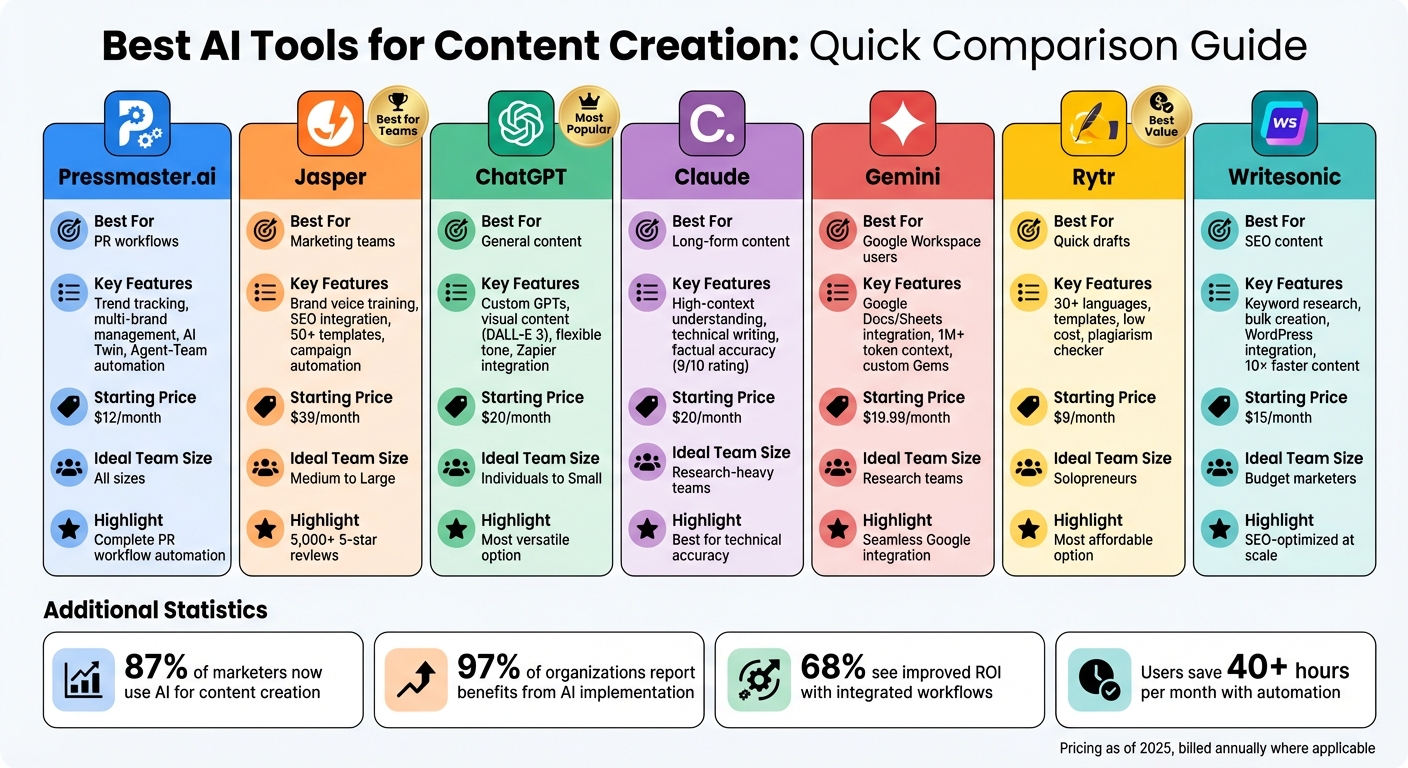
AI Content Creation Tools Comparison: Features, Pricing, and Best Use Cases
10 AI Tools That Save Creators 20+ Hours Every Week
1. Pressmaster.ai
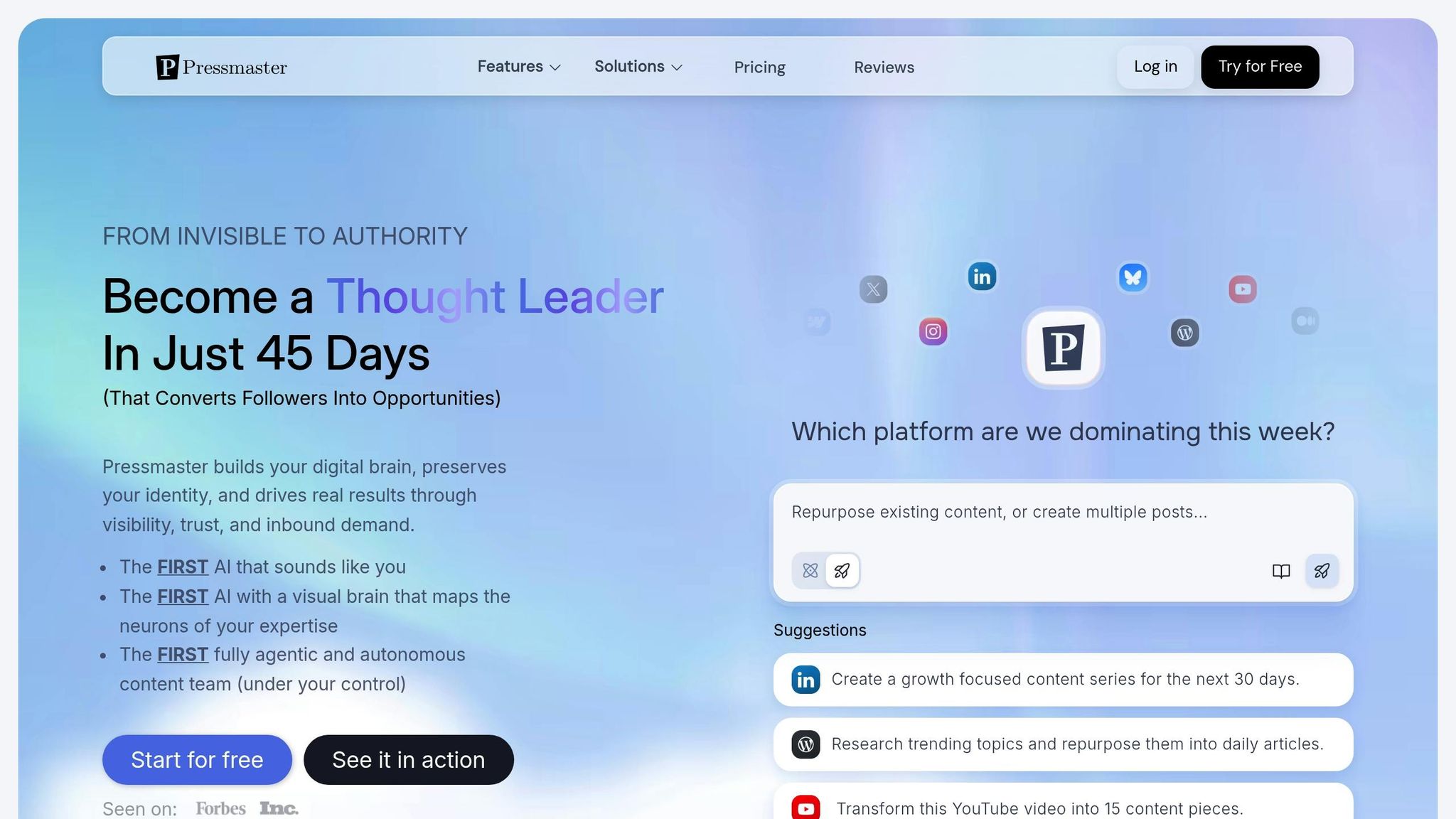
Pressmaster.ai introduces the concept of an AI Twin - a digital model designed to mimic your unique phrasing, rhythm, and thought patterns. Through a conversational AI interview, it transforms your insights into polished, publishable content. Instead of creating entirely new text, it reorganizes your words to maintain your authentic style.
Automation Capabilities
Pressmaster.ai's Agent-Team functions like a fully automated content department. Using its Trendmaster feature, it scans over 500,000 data sources daily to identify trending topics weeks before they peak in your industry. After you share your insights - whether through an interview or a quick voice note - the Agent-Team takes over. It researches, drafts, and populates your content calendar with ease. For example, a 10-minute voice memo about a recent client success story can be transformed into a long-form blog post, 15 LinkedIn updates, an X thread, and even email newsletters. Everything is formatted for each platform and ready to publish.
The Content Suite streamlines the entire content production process, from brainstorming to distribution. You can integrate it with over 1,500 apps, including WordPress, Webflow, LinkedIn, and X, so your content flows effortlessly into your publishing pipeline. For teams juggling multiple campaigns, the bulk generation feature allows you to upload a CSV file with product descriptions or ad briefs and create dozens of variations in one go. This level of automation has reportedly saved users more than 40 hours per month[9]. Plus, it ensures your brand voice remains consistent across all outputs.
Content Quality and Voice Authenticity
To get started, you upload writing samples, tone descriptors (e.g., "conversational but authoritative for B2B SaaS CMOs"), and brand guidelines. This creates a brand voice profile that the AI Twin uses to replicate your style. It picks up on your preferred sentence structures, vocabulary, and logical flow, refining its output as you provide feedback.
"It doesn't write so much as it reorganizes my own words for me. I love the experience of the interview it does to pull information from me." - Todd Sivers, SaaS & AI Tester[9]
The platform also includes tools for AI content detection, plagiarism checks, and fact verification, ensuring your content is error-free. Its "Pin Your Thoughts" feature organizes raw ideas into structured drafts efficiently.
Scalability for Teams
Pressmaster.ai is built to grow with you, offering features that simplify team collaboration. Multi-user workspaces with role-based permissions allow strategists to set brand guidelines and approve drafts while writers and editors work together on shared projects. Activity logs and version histories ensure transparency, which is especially crucial for industries like healthcare or finance that require compliance.
For agencies and enterprise teams, the platform supports multi-brand management, enabling users to handle multiple clients or departments from a single account. Each brand gets its own voice profile, templates, and content library. Agencies can even opt for a white-label version, delivering AI-powered workflows under their own branding. Over 150 agencies already rely on Pressmaster.ai for their content needs[9].
Pricing and ROI
Pressmaster.ai uses a subscription model with pricing in USD. The Starter plan costs $12/month (billed annually) and includes basic article generation and limited social media features. The Pro plan, priced at $72/month (billed annually), offers access to multiple brand voices, trend alerts, and unified analytics. Agencies and enterprises can request custom pricing, which includes perks like white-label reporting, press distribution discounts, and dedicated account management.
2. Jasper
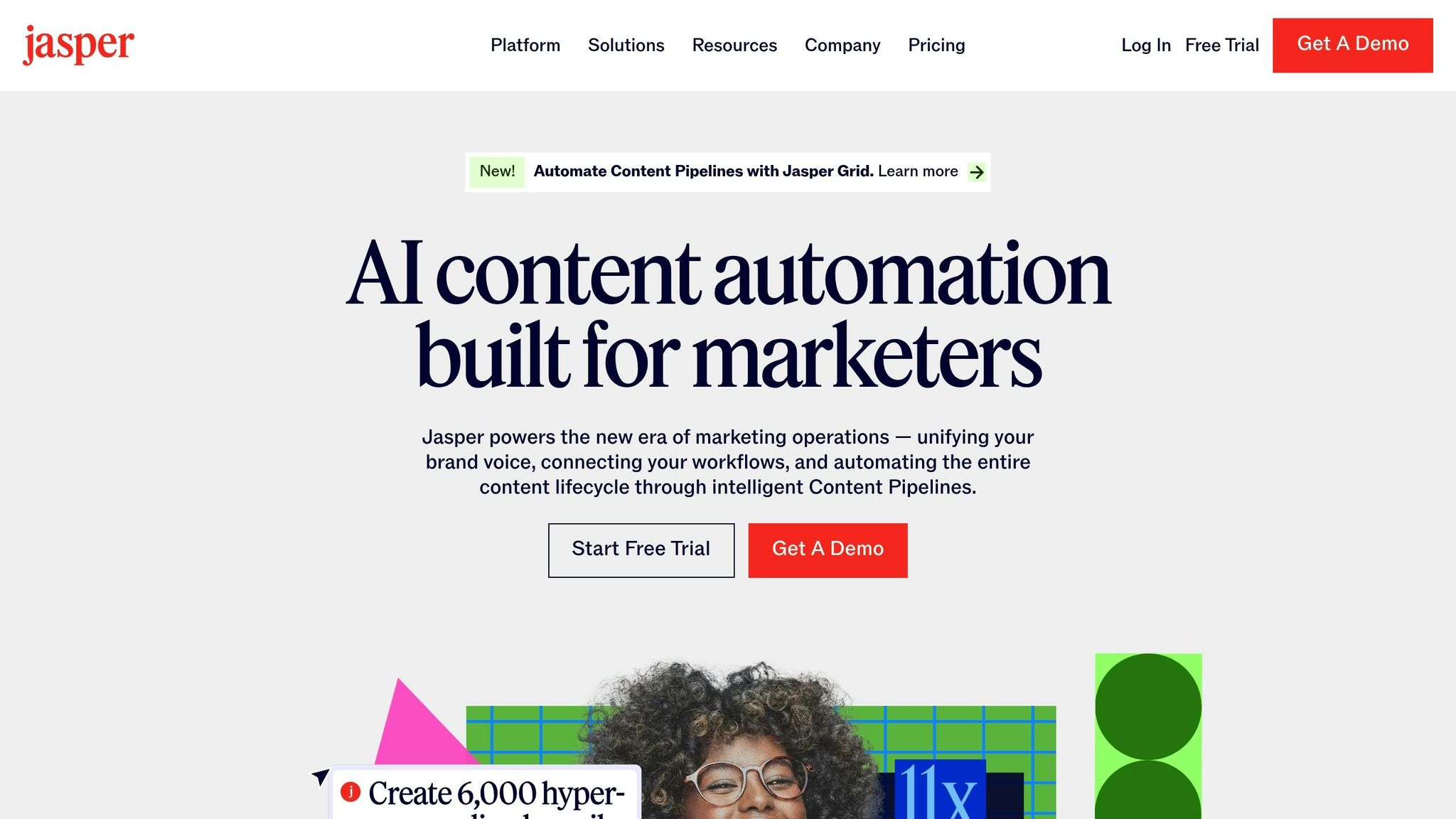
Jasper is an AI platform tailored for marketing teams that need to produce large volumes of content while maintaining a consistent brand voice. Unlike general-purpose AI tools, Jasper is built with specialized templates, workflow automation, and brand voice training, making it perfect for everything from blog posts to full-scale marketing campaigns. Its automation features simplify the entire content creation process.
Automation Capabilities
Jasper's Content Pipelines bring together data, creativity, and distribution into one seamless system, automating every stage of the content lifecycle. The platform features AI Agents, which are autonomous tools designed to handle marketing tasks. For example, you can set up workflows where Jasper generates ad copy from brief inputs and automatically delivers it to Slack using Zapier’s integration with over 8,000 apps.
The Jasper Grid offers a spreadsheet-style interface for efficiently generating content at scale. With over 50 templates, you can quickly create blogs, social media posts, and product descriptions in bulk. For more control, the Boss Mode feature allows you to issue direct commands within the editor to refine, expand, or generate content based on the context. Jasper can even connect to the internet for real-time research and summarize lengthy documents in seconds, saving hours of manual effort.
Content Quality and Brand Voice
Jasper doesn’t just focus on speed - it ensures the content meets quality standards and aligns with your brand’s voice. The Brand Voice tool analyzes your uploaded content samples and guidelines to learn your tone, vocabulary, and style. This means every piece of content, whether it’s a Facebook ad or a detailed white paper, reflects your brand’s identity.
The platform also includes Jasper IQ and Brand IQ, which act as centralized hubs for company-specific information and marketing insights. These tools help ensure outputs are accurate and aligned with your brand’s message. Additionally, Jasper integrates with Surfer SEO, so you can optimize content for search engine rankings while you write. With support for over 25 languages, Jasper is ideal for global marketing teams. Its training on roughly 10% of the internet gives it a strong grasp of language patterns [6].
"Writing with Jasper has helped me move from idea to results in less time. Crafting compelling and persuasive copy that really captures my readers' attention and effectively communicates my message has led to increased brand recognition and growth in my business." - Amanda Weston, Founder, Blogs By Jasper [6]
While users appreciate the platform’s accuracy in reflecting brand voice and its variety of templates, some note that advanced features require a learning curve. Additionally, human fact-checking is recommended to ensure accuracy [1][3].
Scalability for Teams
Jasper is designed to grow with your team. Shared libraries, role-based permissions, and a collaborative Canvas workspace make it easier for agencies and corporations to manage workflows. For enterprise users, the platform provides advanced governance controls and role-based permissions, ensuring compliance and oversight.
One standout feature is Campaign Automation, which can generate entire marketing campaigns - including landing pages, email sequences, and ad copy - from a single briefing document. This efficiency has contributed to positive outcomes in 97% of AI implementation cases, including reduced human error and improved productivity [4].
Pricing and ROI
Jasper’s pricing is structured to cater to different needs:
- The Creator Plan starts at $39/month (billed annually) and is ideal for individual users.
- The Pro Plan, priced at $59/month (billed annually), offers higher word limits and more flexibility for teams [6].
- Enterprise teams can request custom pricing for the Business Plan, which includes advanced governance controls, enhanced security, and dedicated support [1][6].
New users can explore the platform with a 7-day free trial. Jasper has received over 5,000 five-star reviews across multiple platforms, with many users noting that its outputs require minimal editing compared to standard AI tools [8]. The entry-level plan includes 50,000 words per month [11]. Plus, the Chrome extension integrates Jasper directly with CMS platforms, email tools, and social media, making it even more convenient.
3. ChatGPT
ChatGPT has quickly become a favorite tool for teams looking for a flexible content assistant. Powered by GPT-5.1 as of late 2025 [2], it can tackle a wide range of tasks - from brainstorming blog ideas to creating social media graphics using its integrated DALL-E 3 image generator. One of its standout features is Custom GPTs, which are tailored versions of the tool that can be trained on your brand guidelines, frequently asked questions, and existing content. This ensures consistency across marketing, sales, and support teams [10].
Automation Capabilities
ChatGPT simplifies content creation by pulling together research, outlining ideas, and drafting copy in just minutes. Its integration with Zapier, which connects to over 8,000 apps [2], allows it to automate repetitive tasks like summarizing customer feedback or crafting personalized follow-up emails. For paid users, the Sora feature adds a powerful text-to-video generation tool, making it easy to create engaging visual content without leaving the platform. It’s also a great solution for writer’s block, helping to organize research into clear, structured outlines. All these features work together to maintain a consistent brand voice while streamlining workflows.
Content Quality and Voice Authenticity
Consistency in brand voice goes beyond just good writing - it requires a unified tone and style across all content. ChatGPT makes this possible with its Custom GPTs, which mimic your specific tone, vocabulary, and style. By uploading tone-of-voice documents or examples of successful past campaigns, you can create a "Brand Voice Assistant" tailored to your needs [10].
"Still the backbone of many content teams, ChatGPT continues to shine, especially when trained with your own tone, examples, and FAQs." - IMPACT Team [10]
That said, human oversight is still crucial to catch any inaccuracies or awkward phrasing that might slip through.
Scalability for Teams
ChatGPT’s ability to maintain a consistent voice makes it easy to scale across different departments. Teams can create specialized GPTs for specific needs, like a "Social Media Voice" GPT or a "Technical Documentation" GPT, ensuring uniformity without requiring every team member to become an expert at crafting prompts. In fact, 97% of organizations using AI report benefits like improved productivity and fewer errors [4].
Pricing and ROI
ChatGPT offers straightforward pricing that works for teams of all sizes. The Free Plan covers basic features, while ChatGPT Plus, at $20 per month, unlocks GPT-5.1, DALL-E 3 image generation, higher usage limits, and Custom GPTs. Enterprise plans are also available for larger teams [5]. Additionally, images generated through DALL-E 3 include commercial use rights, making them a valuable resource for creating business visuals [6]. This combination of affordability and functionality enables teams to scale content production efficiently.
4. Claude

Claude is a standout tool for handling long-form content. Its ability to retain context makes it perfect for creating white papers, detailed reports, and in-depth blog posts - all while adhering to brand guidelines seamlessly [10][12].
Automation Capabilities
Claude simplifies workflows with its Model Context Protocol (MCP), which connects directly to your marketing tools - no custom coding required [8]. Its "Claude Artifacts" feature takes automation to the next level by generating reports and converting insights from videos and webinars into content for blogs and social media [8][12]. This makes it an excellent choice for scaling up the use of existing materials.
Content Quality and Brand Voice
One of Claude's strengths is its balanced and refined tone, which ensures natural, accurate output while minimizing errors or hallucinations. This makes it a reliable option for brand-sensitive projects where precision matters [10][12]. It also excels at analyzing complex data to produce content that’s both context-rich and professional.
Scalability for Teams
Claude's large context window is a game-changer for teams. It allows users to upload comprehensive brand style guides and past content examples, ensuring that the output aligns with established brand voices across various departments. The platform’s adaptive modes let team members toggle between quick suggestions and deeper insights, making it versatile for tasks ranging from technical documentation to marketing materials. Plus, its integration with automation tools like Zapier extends its functionality across your entire content ecosystem, making it a scalable and efficient solution.
Pricing and ROI
Claude offers a free tier with robust features for creating long-form content, making it ideal for smaller teams exploring AI tools [3]. For larger organizations, enterprise and pro plans are available through third-party automation platforms, offering advanced features and higher usage limits. It’s particularly effective at summarizing technical papers, patents, and lengthy reports, delivering tangible returns on investment [12].
5. Gemini
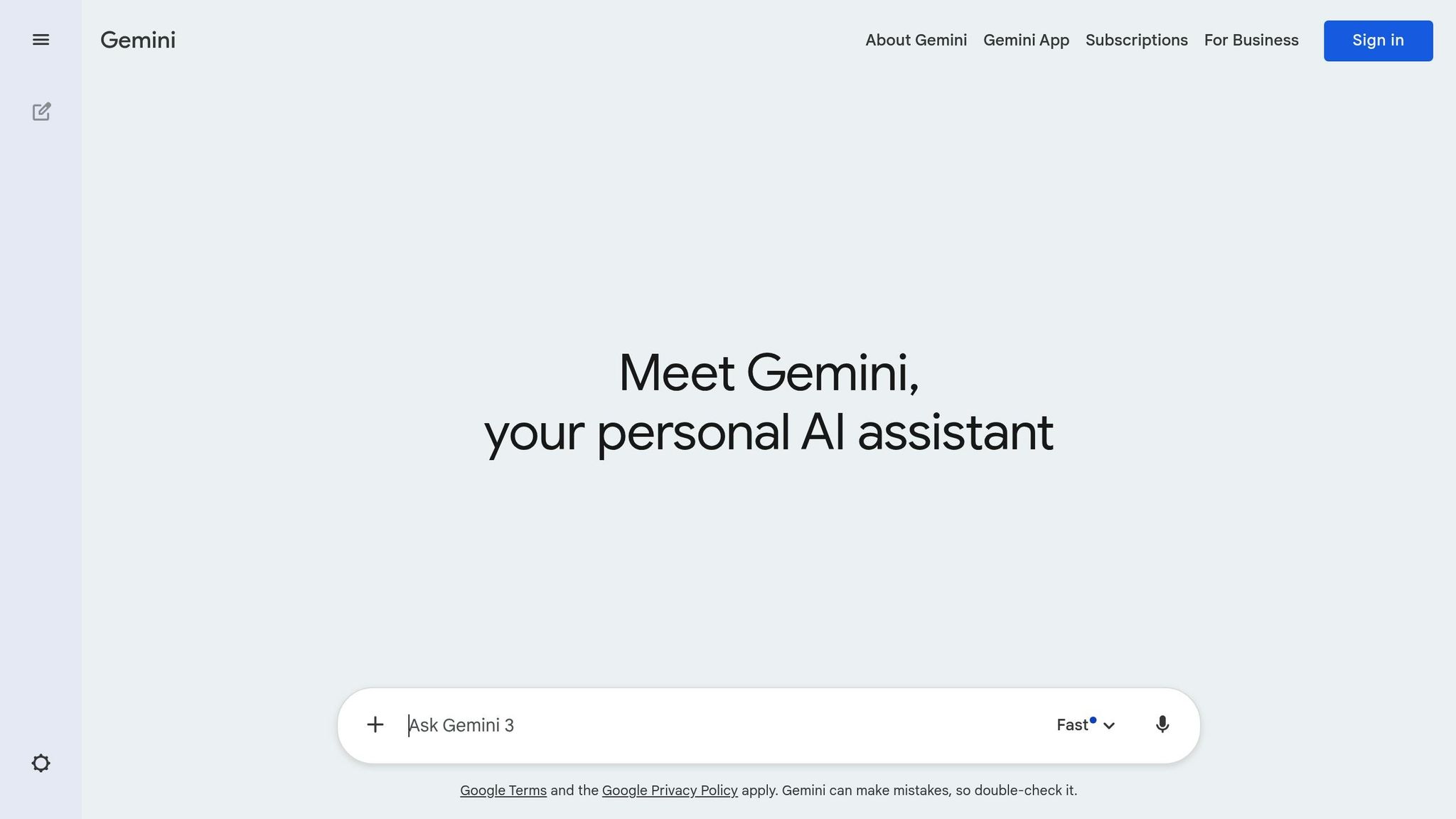
Gemini takes content creation to the next level by seamlessly integrating with Google Workspace tools like Docs and Sheets. This setup eliminates the hassle of switching between platforms, letting you generate content, polish drafts, and structure blog posts - all within a single document. By staying within a familiar ecosystem, Gemini streamlines workflows and sets the stage for efficient automation.
Automation Capabilities
Gemini introduces custom AI agents called "Gems." These pre-configured assistants are designed with specific instructions, tones, and objectives to tackle repetitive tasks like brainstorming topics, editing drafts, or crafting sales copy. Within Google Docs and Sheets, Gemini automates tasks such as organizing blog posts with proper headings, adding keyword-focused sections, and summarizing content directly in your document. By integrating with Google Workspace, Gemini complements other tools by keeping everything in one place, helping teams work faster without complicating their tech stack.
Content Quality and Brand Voice
Beyond automation, Gemini ensures content aligns with your brand's voice by refining outputs directly within Google Workspace. Since it's developed by Google, Gemini leverages diverse perspectives to enhance technical tasks and content brainstorming, resulting in well-rounded final outputs. Its integration allows teams to maintain consistency across various document formats while eliminating the need to jump between platforms.
Scalability for Teams
Gemini offers a practical way for teams to scale their content production. By automating repetitive tasks, it frees up human creators to focus on strategic and creative work. Whether it's blogs, social media posts, or email campaigns, teams can produce more without needing to hire additional staff. Even the free version comes packed with features that smaller teams can use to master the basics of content creation before upgrading their AI capabilities.
Pricing and ROI
Gemini has earned a reputation as one of the best free AI tools for content creation [3]. For those needing advanced features, paid options are available through Google Workspace subscriptions or premium tools like Perplexity [2][7]. These tiers expand Gemini's functionality, making it a valuable addition to any content strategy.
6. Rytr
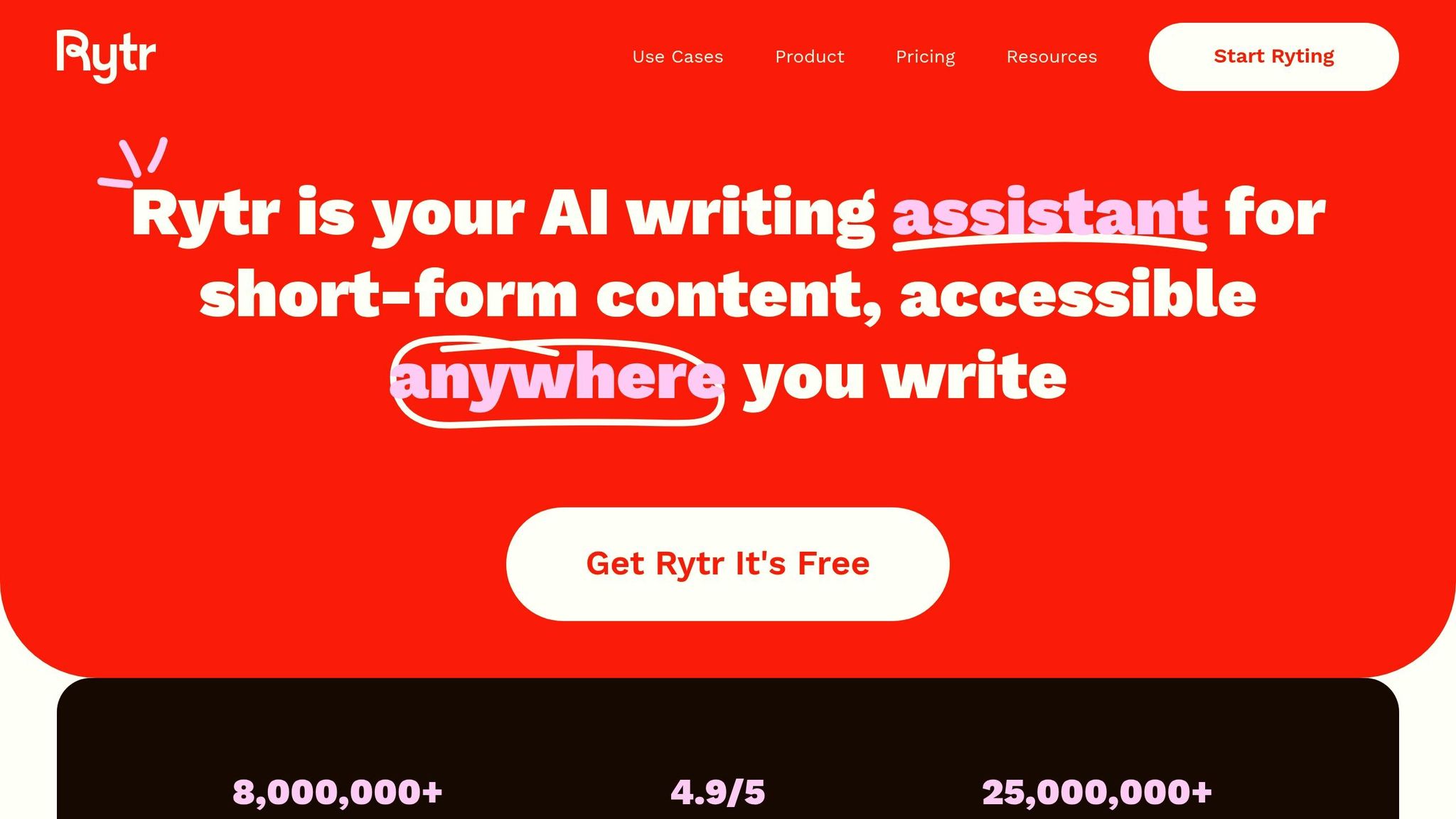
Rytr is a budget-friendly tool designed to streamline content creation. Instead of starting with a blank slate, it provides ready-to-use templates for tasks like product descriptions, landing pages, and other marketing essentials. Its straightforward approach makes it a go-to option for generating short-form content quickly and efficiently.
Automation Capabilities
Rytr leverages automation through frameworks like PAS (Problem-Agitate-Solution) and AIDA (Attention-Interest-Desire-Action). Its browser extension seamlessly integrates into your workflow, while the editor includes tools for plagiarism checks, adjusting content length, and generating ideas. An integrated chat feature also supports quick brainstorming sessions. Impressively, Rytr supports over 30 languages, catering to both Right-to-Left and Left-to-Right scripts, which is particularly useful for global teams[13].
Content Quality and Voice Options
To refine your drafts, Rytr provides real-time grammar and style suggestions, helping you produce polished content[1]. It also comes with tone-of-voice presets - like humorous, appreciative, or urgent - that make the output feel more natural and less mechanical[13]. For SEO-focused users, its integration with Surfer SEO offers real-time keyword suggestions and optimization tips directly within the platform. However, creating a custom tone of voice tailored to your brand is only available with the Premium plan, which might limit smaller teams to the preset options[13].
Scalability for Teams
Rytr’s features make it ideal for solo creators, startups, and professionals working within tight budgets. It’s particularly effective for generating consistent short-form content across various marketing channels. While it’s not designed to handle the complexities of long-form content, it’s a reliable and cost-effective tool for scaling short-form copy production without needing to expand your team.
Pricing and ROI
Rytr offers a free plan with a 10,000-character monthly limit - perfect for testing its capabilities. For higher usage, the Unlimited Plan is available at $7.50 per month, while the Premium Plan, which includes custom tone-of-voice options and advanced features, costs $24.16 per month[13]. These pricing options make it a worthwhile investment for teams requiring large volumes of short-form content.
7. Writesonic

Writesonic is designed to be an affordable solution for creating SEO-optimized content. It simplifies the entire process, from research to publication, by analyzing top-performing content and identifying essential topics for competitive SEO. With its Chatsonic feature, the platform pulls real-time data from the internet, ensuring your content stays up-to-date.
Automation Capabilities
Writesonic provides end-to-end automation, covering everything from keyword research to publishing. Its competitor analysis feature identifies what’s currently ranking for your target keywords, taking the guesswork out of structuring your content. The platform also includes built-in fact-checking with citations, which boosts accuracy and saves time on verification. It even generates article images and supports direct publishing to WordPress, making it easy to go from outline to live post. This level of automation creates a smoother, more efficient workflow.
Content Quality and Voice Authenticity
While Writesonic does a great job aligning content with search intent and competitor strategies, the results often need human editing to improve readability and add personality. The output can sometimes feel overly optimized for search engines, so refining it for a more natural tone is crucial. On the plus side, its fact-checking feature enhances accuracy, which is a big win for SEO-driven content.
Scalability for Teams
Writesonic’s automated research tools make it a solid choice for teams managing large-scale content marketing efforts. It’s especially useful for marketers needing to produce a high volume of SEO-competitive content without overspending. However, the interface can feel a bit overwhelming, and there’s a learning curve compared to more straightforward tools. That said, features like direct WordPress publishing are a major advantage for teams creating dozens of articles each month, helping them stay organized and efficient.
Pricing and ROI
Writesonic offers a free trial with 10,000 words[3], giving users a chance to explore its features before committing. Paid plans start at $16 per month[3], making it an economical option for SEO-focused content creation. For teams producing large volumes of blog posts or landing pages, this pricing delivers strong value - especially considering the time saved on tasks like keyword research and competitor analysis.
Pros and Cons Comparison
Here’s a streamlined look at the strengths and trade-offs of each AI tool discussed earlier. These tools are designed to simplify content creation and meet the growing demand for automation, helping users tackle large-scale projects with less manual effort.
Claude stands out for its output quality and factual accuracy, earning a 9/10 rating in 2025 expert assessments [17]. It’s a strong choice for technical writing or long-form projects that require precise reasoning. ChatGPT, also rated 9/10, excels in speed and adaptability of tone [17], making it suitable for fast content generation. However, both tools may need additional refinement to perfect their outputs [15].
If automation and brand consistency are top priorities, Jasper is a great option. It’s specifically trained to maintain a consistent brand voice and offers over 50 templates. While its output might require some tweaking for a more natural tone [14], it has received more than 5,000 5-star reviews [8]. That said, its $49/month starting price might be steep for individual creators. On the other hand, Writesonic provides bulk content generation at a more affordable $15/month, producing content up to 10× faster. However, it’s less effective when tackling highly technical subjects.
Gemini brings a unique advantage with its ability to process up to 1 million tokens at once [15], ideal for handling extensive documents or books. Its seamless integration with Google Workspace makes it particularly appealing for research-focused teams in the Google ecosystem, earning it a 9/10 for ease of integration [17]. Meanwhile, Rytr caters to solopreneurs and freelancers with its low $9/month starting price and multilingual capabilities [15]. However, it may lack the depth necessary for more complex, long-form content.
To make things clearer, here’s a quick side-by-side comparison of these tools:
| Tool | Best For | Key Strengths | Consideration | Starting Price | Team Size |
|---|---|---|---|---|---|
| Pressmaster.ai | Complete PR workflow | End-to-end automation, press distribution | Focused on PR tasks, not standalone writing | $12/mo | All sizes |
| Jasper | Marketing teams | Brand voice consistency, SEO mode, 50+ templates | May need extra edits for natural tone | $49/mo | Medium to Large |
| ChatGPT | General purpose | Speed, tone flexibility, custom GPTs | Needs expert prompting to avoid generic outputs | $20/mo | Individuals to Small |
| Claude | Technical writing | High reasoning, factual accuracy, clean code | Limited bulk generation features | $20/mo | Research-heavy teams |
| Gemini | Google users | 1M+ token context, Google Workspace integration | Best for those in the Google ecosystem | $19.99/mo | Research teams |
| Rytr | Quick drafts | Low cost, multilingual support | Not ideal for long-form articles | $9/mo | Solopreneurs |
| Writesonic | SEO content | Bulk creation, WordPress integration | Struggles with technical topics | $15/mo | Budget marketers |
When it comes to pricing, personal plans generally range from $10 to $30 per month, while business plans are priced between $50 and $100 per user monthly [1]. Both ChatGPT Plus and Claude Pro hit the $20/month mark [16], offering professional-grade features without the need for extensive team collaboration. For larger organizations, enterprise plans from Jasper, ChatGPT, and Gemini provide custom pricing, single sign-on (SSO), and dedicated support, catering to advanced security and operational needs [16].
Conclusion
Choosing the right AI tool depends on your team size, budget, and content goals. If you're a freelancer or solopreneur with limited resources, Rytr ($9/month) or Writesonic ($15/month) can help you quickly generate drafts for social media posts or short-form content. For small teams seeking a versatile option, ChatGPT ($20/month) offers flexibility in tone and speed, while Claude ($17/month) is well-suited for producing accurate, long-form content. These tools are ideal for individual creators or small-scale operations, while larger teams often need solutions that can handle more complex requirements.
For marketing teams managing multiple brands, Jasper ($49/month) stands out with its ability to maintain consistent brand voice and its extensive template library, although some manual editing may be needed to fine-tune the output. The numbers speak for themselves: 87% of marketers now use AI for content creation [19], and those leveraging AI are over 25% more likely to report successful outcomes [18].
If your focus is on public relations or end-to-end content automation, Pressmaster.ai ($12/month) offers a comprehensive solution tailored to PR workflows.
To maximize ROI, integrate tools thoughtfully into your processes. Avoid overloading your workflow with too many tools - focus on a primary writing tool, a visual content tool, and a planning assistant. This approach aligns with findings that 68% of companies see improved content marketing ROI when AI tools are integrated into cohesive workflows rather than used in isolation [18].
Ultimately, the key to success lies in combining AI-generated content with human expertise. This balance allows you to scale your content production while maintaining brand authenticity - a strategy that 79% of marketers report as effective [18].
FAQs
How do AI tools ensure consistent brand voice in content creation?
AI tools help keep your brand's voice consistent by studying your existing content to grasp your specific tone, style, and messaging. After they've been trained, these tools can apply your brand's guidelines across different formats like blog articles, social media posts, and marketing materials.
This ensures every piece of content aligns with your brand identity, streamlining the process and minimizing inconsistencies - all while making it easier to scale your content production.
What should I look for in an AI tool for creating SEO-friendly content?
When choosing an AI tool for creating SEO-driven content, focus on features that boost both productivity and quality. Opt for tools that offer SEO-friendly capabilities, like keyword research, content analysis, and readability assessments, to help your content perform well on search engines. It’s also important that the tool is easy to use and works smoothly with your existing systems, making your workflow more efficient.
You’ll also want to evaluate whether the tool can generate engaging, audience-specific content and if it includes multilingual options, should your needs require it. Lastly, ensure the platform is upfront about its approach to data privacy and steers clear of bias, as these factors are key to building trust and maintaining credibility in your content creation efforts.
How can AI tools simplify workflows and boost productivity?
AI tools simplify workflows by taking over repetitive tasks, integrating effortlessly with your favorite apps, and analyzing data to guide better decisions. This not only cuts down on manual work but also speeds up processes, making content creation quicker and more efficient.
With features like automation triggers, customizable workflows, and intelligent recommendations, these tools help you move seamlessly from brainstorming ideas to hitting "publish." By managing the more time-intensive steps, AI tools free up your time so you can focus on crafting top-notch content and accomplishing more without the extra effort.
Related Blog Posts
- Best AI Tools for Content Creation to Help You Write More and Edit Less
- Best AI Tools for Content Creation to Scale Your Brand Without Losing Authenticity
- Best AI Tools for Content Creation to Transform Your Team’s Productivity
- Best AI Tools for Content Creation to Keep Your Brand Voice Consistent Everywhere








Sign Up for our Pressmaster Newsletter
Sign up for our Pressmaster.ai newsletter to get instant alerts on trending topics, ensuring you stay ahead in your field with the latest insights and updates.


.avif)
.png)

.avif)


7 Viral Patterns That Drove 10,643% Growth
Turn natural conversations into content gold, make every insight count, and drive real conversations.

Please fill out the form to get our Viral Cheat Sheet


How to Become a Thought Leader in 6 Easy Steps
Increase your visibility, establish authority, and conquer your market with minimal effort.

Please fill out the form to get our PDF Checklist
