
How to Build an AI Content Strategy That Keeps Every Team Member Aligned

Artificial Intelligence (AI) can supercharge your content strategy by automating tedious tasks like audience segmentation, performance forecasting, and content ideation. But the real challenge? Keeping your team aligned. Without alignment, you risk inconsistent messaging, wasted resources, and poor results. Here's how to fix that:
- Set Clear Goals: Define objectives tied to business priorities (e.g., lead generation or cost reduction). Companies with clear goals see up to a 47% increase in content output.
- Align Content with Business Goals: Organize content into categories like Growth (revenue-driven), Authority (trust-building), and Innovation (new formats). Structured plans lead to better results.
- Track Key Metrics: Focus on metrics like content velocity, engagement rates, and conversion rates. For example, tracking AI visibility (mentions in AI tools) is critical for staying relevant.
- Clarify Team Roles: Assign clear responsibilities, such as Editors for brand voice and SEO Leads for rankings. This avoids confusion and boosts productivity.
- Document Workflows: Map out where AI starts and human review begins. AI can draft, but humans ensure accuracy and creativity.
- Maintain Brand Voice: Train AI to replicate your tone and use clear guidelines to prevent generic outputs.
- Leverage AI for Distribution: Automate publishing across channels while tailoring content to each platform’s audience.
AI tools like Pressmaster.ai simplify these steps by centralizing planning, creation, and analytics. The key takeaway? AI is a support system - not the driver. Success comes from blending AI's speed with human creativity and oversight.
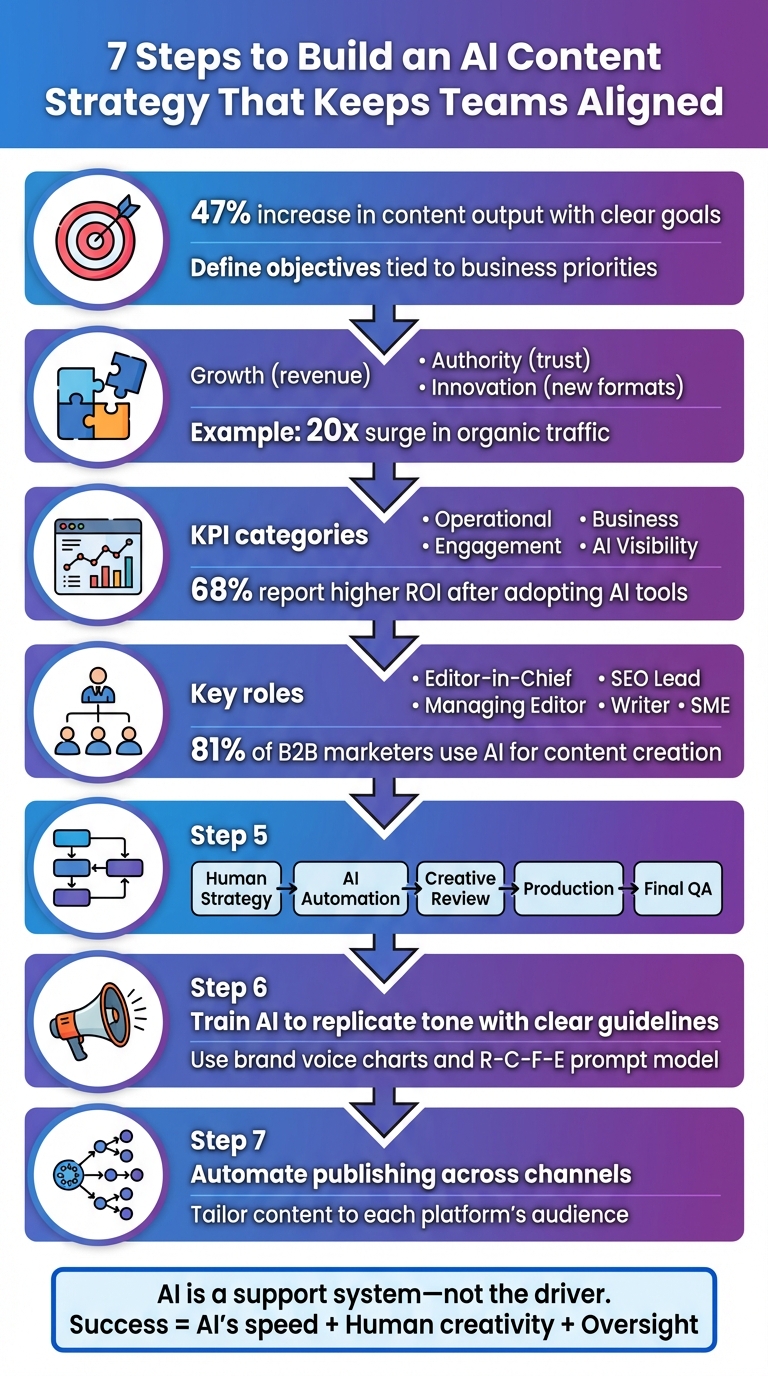
7-Step Framework for Building an Aligned AI Content Strategy
Scaling Content with AI: Empowering (Not Replacing) the Modern Marketer
Set Clear Goals for Your AI Content Strategy
The first step in building an effective AI content strategy is defining your objectives. Companies that integrate AI into their content workflows often see impressive results, like a 47% increase in content output and a 28% improvement in engagement metrics [5]. But here's the key: these outcomes stem from clear business objectives, not just adopting new technology for the sake of it.
Rebecca Lieb, a respected Digital Marketing Analyst and Author, puts it perfectly:
"The companies seeing the highest ROI from AI content aren't those with the most advanced tools, but those with the clearest understanding of how content supports their business model" [5].
So, start with your "why." Are you aiming to generate leads, build industry authority, or reduce production costs? Your answer will shape how AI fits into your team's workflow. When everyone understands the end goal, it becomes easier to decide which tasks to automate and which require human creativity and expertise.
Align Content Objectives with Business Goals
Your content objectives should directly support your organization’s broader goals. Every piece of content needs a purpose that ties back to those priorities.
One way to approach this is by dividing content into three main categories:
- Growth Content: Focused on driving revenue and conversions.
- Authority Content: Establishing credibility through formats like whitepapers and thought leadership pieces.
- Innovation Content: Experimenting with new formats or channels [2].
This structure helps ensure your AI-driven content strategy serves multiple business areas at once. For instance, in 2025, the telehealth platform Wyndly used AI workflows to scale from 40 to 200 articles per month. This fivefold increase led to a 20x surge in organic traffic, reaching 200,000 clicks, and boosted organic customer acquisition by 28% [2].
Collaboration across teams is crucial. Using shared templates and centralized workspaces keeps everyone - from PR to marketing - aligned on key performance indicators (KPIs). This ensures all efforts contribute to broader goals, like hitting quarterly revenue targets or increasing brand awareness [5].
AI should be a tool that supports your strategy, not the driver of it. Decisions about target markets, content topics, and how content fits into the customer journey must remain with your team [8]. However, AI can assist by analyzing first-party data and audience signals to identify content gaps that align with your business priorities [7].
Define and Track Key Performance Indicators (KPIs)
Once your objectives align with business goals, tracking the right KPIs becomes critical. These metrics should measure both operational efficiency and the business impact of your content.
Here’s a breakdown of key KPI categories:
| KPI Category | Specific Metrics | Outcome |
|---|---|---|
| Operational | Content velocity, cost per piece, editing time | Efficiency and scaling capabilities |
| Engagement | Time on page, bounce rate, social shares, CTR | Audience resonance and content quality |
| Business | Conversion rate, lead quality, ROI | Revenue growth and customer acquisition |
| AI Visibility | AI mentions, AI citations, LLM rankings | Staying relevant in AI-powered search |
Tracking the right metrics matters. For example, 68% of companies report higher content-marketing ROI after adopting AI tools [3]. But this only happens when you measure outcomes, not just output.
It’s helpful to monitor both leading and lagging indicators. Leading indicators, like production speed and quality scores, reveal how healthy your process is. Lagging indicators, such as organic traffic and conversion rates, show whether your content is achieving its intended business goals [2].
A newer metric worth noting is AI visibility - how often your brand is mentioned or cited by tools like ChatGPT, Perplexity, or Gemini. As more users turn to AI assistants for answers, this metric is becoming essential for maintaining industry relevance [6].
Consider how HubSpot adapted its strategy based on KPI insights. After seeing a drop in organic traffic due to Google's AI Overviews in 2024–2025, they shifted focus to AI-driven content clusters around high-intent keywords. This pivot resulted in a 134% increase in website traffic and a 107% rise in inbound leads for their Marketing Hub customers within six months [3].
To simplify KPI tracking, platforms like Pressmaster.ai offer unified analytics dashboards. These tools allow your team to monitor metrics like content velocity, engagement, and conversion rates - all in one place. This transparency ensures everyone understands what success looks like and can adjust their efforts in real time based on performance data.
Map Team Roles, Workflows, and Guidelines
Once you've set clear goals and measurable KPIs, the next step is organizing your team structure to ensure the strategy is executed effectively. Without this structure, AI tools can often create more confusion than solutions. For example, as of 2024, 81% of B2B marketers were already using generative AI tools for content creation, yet many teams still face challenges with accountability and quality control [3].
The real issue isn't the technology itself - it’s the lack of structure. When team members understand their roles, follow defined workflows, and adhere to clear guidelines, AI becomes a powerful tool rather than a source of chaos. Establishing clear roles and workflows is essential to making this happen.
Identify Key Team Members
Start by mapping out each team member’s role and responsibilities. In AI-driven workflows, traditional roles evolve to include strategic oversight, quality control, and technical coordination. Here's a breakdown of key roles most teams need:
| Role | Primary AI Responsibility | Human Accountability |
|---|---|---|
| Editor-in-Chief | Set AI parameters | Ensure brand voice and strategy [8] |
| Managing Editor | Oversee briefing and automation calendars | Manage review cycles and enforce SLAs [8][4] |
| SEO Lead | Handle topic clustering | Monitor rankings and AI-driven visibility [8] |
| Writer | Generate drafts and rephrase content | Conduct fact-checking and storytelling [8][4] |
| SME (Subject Matter Expert) | Provide expertise for prompts | Ensure technical accuracy [9][4] |
To avoid confusion, clearly define "who decides what" and "who ensures quality." For instance, your SEO/Content Strategist should manage topic selection, keyword strategy, and success metrics, while the Managing Editor takes charge of review cycles, defines service level agreements (SLAs), and sets the "definition of done" - a checklist that confirms when content is ready for publication [4].
A practical method for streamlining content creation is the "Reporter Model." Instead of asking SMEs to write or spend hours reviewing drafts, have your marketing team conduct short 15-minute interviews with them. The marketing team then creates the content, which reduces bottlenecks while still leveraging SME expertise. This approach positions SMEs as sources and marketers as journalists, speeding up the process [9].
For industries with strict regulations, like healthcare, finance, or legal services, introduce a Legal/Compliance role to review AI-generated content for accuracy and adherence to regulations.
Document Your Content Workflow
With roles in place, the next step is mapping out a clear content workflow. This ensures everyone knows where AI support ends and human input begins. Break the process into these stages:
- Human Strategy: Plan editorial direction and content goals.
- Workflow Automation: Use AI for tasks like research, outlining, and drafting.
- Creative Review: Refine content for brand voice, accuracy, and storytelling.
- Production Automation: Automate technical tasks like formatting and metadata creation.
- Final QA: Perform human-led quality checks.
AI tools can assist with tasks like identifying trends or gaps, but humans should make strategic decisions [9]. For example, platforms like Pressmaster.ai can automate research, generate outlines, and create drafts that align with your brand voice [9]. Editors can then refine these drafts by adding personal insights, unique data, and perspectives that AI can't replicate [9]. Meanwhile, AI can handle technical tasks like formatting, metadata generation, and CMS integration, freeing up your team to focus on creativity and strategy [9].
A great example of this in action is the telehealth platform Wyndly, which scaled its content production while maintaining quality by clearly defining handoff points between AI and human review [3].
When documenting your workflow, set Service Level Agreements (SLAs) for each stage to prevent delays. For example, assign specific timelines for editorial, SEO, and legal reviews [4]. To ease the transition, consider a phased rollout: start with a training phase where the team learns the workflow, then move to a pilot production phase before scaling up [9].
Set Guidelines for AI Usage and Brand Standards
To maintain consistency and accuracy, establish clear guidelines for how AI should be used. Begin with a human-in-the-loop ownership rule: humans should own strategy, judgment, and final approval, while AI acts as a supporting tool [8].
Define forbidden use cases. Prohibit AI from fabricating quotes, testimonials, case studies, or inventing data - areas where authenticity is critical [8].
Enforce source tracking and verification. Writers must verify all URLs or sources suggested by AI and ensure primary sources back up any statistics. This prevents misinformation and strengthens credibility [8].
For prompt engineering, apply the R-C-F-E model (Role, Context, Format, Examples) to produce consistent, on-brand outputs. For example: "You are a B2B content strategist (Role) writing for marketing directors at mid-sized tech companies (Context). Create a 1,200-word article (Format) similar to this example (Examples)." This approach helps align AI outputs with your brand’s expectations [7].
Use an editorial checklist to ensure brand consistency and accuracy. Include checks for fact verification, brand voice alignment, originality, and adherence to E-E-A-T principles (Experience, Expertise, Authoritativeness, Trustworthiness) [7]. Tools like Pressmaster.ai can streamline this process with built-in features like fact-checking, plagiarism detection, and AI content identification.
Another helpful practice is integrating source tracking within drafts. Writers should indicate which sections were AI-generated versus manually written, making it easier for editors to review and ensure accountability [8].
Finally, consider the TIP Method: match specific AI models to tasks based on their strengths. For instance, use one model for summarizing meetings and another for conducting in-depth research. This ensures each task is paired with the most suitable AI tool [10].
As Nathan Wahl from Animalz puts it:
"Letting AI fill your blank page is like sending a robot to the gym for you. Your mental muscles atrophy" [10].
The goal isn’t to avoid AI - it’s to use it strategically while preserving the creativity and critical thinking that only humans can provide.
Build Your AI Content Architecture
Once your team structure and workflows are set, it’s time to develop a content architecture that bridges your strategy with execution. Think of this as your blueprint - it dictates what you create, how it sounds, and where it’s shared. A well-designed framework keeps your team aligned and your brand voice consistent.
A solid structure is key to success. 77% of companies are already using or exploring AI for content creation and marketing automation [2]. Without clear content pillars, brand voice guidelines, and platform-specific plans, AI-generated content can feel scattered, undermining your overall strategy.
With an effective content architecture, every piece of content - whether it’s a blog post, press release, or social media update - has a clear purpose and speaks in a unified voice. This framework lays the groundwork for defining themes, tone, and distribution channels.
Define Content Pillars and Messaging Frameworks
Content pillars are the backbone of your strategy, focusing your efforts on themes that align with your business goals. They ensure every piece of content stays aligned with your objectives.
AI can help categorize these pillars into three key types: Growth Content (focused on driving revenue), Authority Content (building trust and credibility), and Innovation Content (pushing boundaries and exploring trends) [2]. By clustering topics around these pillars, you signal to search engines and AI tools that your content thoroughly covers a subject. AI can also analyze your existing content, highlight gaps, and suggest new topics to strengthen your position [6]. The key is to ensure these pillars address your audience’s specific needs and challenges [2].
Tools like Pressmaster.ai can simplify this process. For instance, its Trendmaster feature scans over 500,000 data sources daily to spot emerging trends weeks before they gain traction. This helps you shape content pillars around timely topics, positioning your brand as an industry leader.
Once you’ve defined your pillars, create a messaging framework for each. This framework outlines the tone, key points, and value propositions for every pillar, guiding your team and ensuring AI-generated content stays on track. For example, if one pillar is "AI-driven content strategy", your messaging might emphasize efficiency, scalability, and data-driven insights.
As Rand Fishkin, Founder of SparkToro, explains:
"AI-generated content is the new floor. Anyone can make it. Most of it is at least OK. Some of it's pretty good. If your content isn't better than what AI can produce, it isn't worth making." [2]
The goal isn’t to let AI take over but to use it to identify opportunities, streamline strategy, and free your team to focus on crafting standout content. With well-defined pillars and messaging frameworks, your brand voice can guide every piece of AI-generated content.
Maintain Consistent Brand Voice with AI
Your brand voice is what makes your content distinct and relatable. Whether your tone is casual and conversational or formal and authoritative, consistency is crucial - especially when both humans and AI contribute to content creation.
The challenge is clear: 81% of B2B marketers were already using generative AI tools for content creation by 2024 [3]. Without clear guidelines, AI-generated content risks sounding generic. The solution? Document your brand voice and train AI to replicate it. Start by analyzing your existing content to identify consistent language, tone, and style. Use this to build a brand voice chart with columns for Voice Attribute, Attribute Definition, Do’s, and Don’ts [11]. For example, if your voice is “supportive,” a “Do” might be “Respond empathetically to reader inquiries,” while a “Don’t” could be “Avoid sounding condescending.”
Integrate this documentation into your AI workflows with detailed prompts. Specify the desired tone, audience, and personality traits (like “casual,” “warm,” or “forward-thinking”) [6].
A great example of this approach comes from Wyndly, a telehealth platform. In 2025, they used AI workflows to transform their video library into SEO-optimized articles. By combining AI research with brand voice consistency and expert oversight, they boosted content production fivefold (from 40 to 200 articles monthly) and grew organic traffic from 10,000 to 200,000 clicks per month [2].
To maintain quality, implement human-in-the-loop workflows. Writers should heavily edit AI drafts, adding real-world insights, personal experiences, and brand-specific touches [8][2]. Tools like Pressmaster.ai can assist with features like Brand Voice Replication, which analyzes your communication style, and includes AI content detectors, plagiarism checks, and fact-checking tools to ensure accuracy.
Finally, define forbidden use cases for AI. Clearly state where AI shouldn’t be used - such as creating fake testimonials, fabricating research, or drafting regulated advice without expert review. This protects your brand’s credibility [8].
As Erika Heald, a Content Marketing Consultant, points out:
"AI's capacity to analyze vast datasets means it can understand your brand's voice across different contexts." [11]
When used thoughtfully, AI can amplify your brand voice rather than dilute it.
Create Channel-Specific Content Plans
Content that works on LinkedIn might fall flat on Instagram or Reddit. That’s why it’s important to tailor your content to each platform while maintaining a consistent message. A channel-specific plan ensures that your content resonates with the unique audience and format of each platform.
AI can adapt content for different platforms. For example, it can analyze the language and preferences of specific Reddit communities to create posts that feel authentic [3]. Similarly, it can adjust tone, length, and format for platforms like LinkedIn, Twitter, or Instagram to match their norms.
Modern strategies often rely on a Triple-Optimization Framework, which balances SEO, Answer Engine Optimization (AEO) for voice search, and Generative Engine Optimization (GEO) for AI model referencing [3][10]. For instance, SEO-driven content focuses on keywords and backlinks, while AEO content uses concise Q&A formats to cater to voice search.
AI also enables scalable personalization. A single article can be tailored with different examples, case studies, or levels of technical detail based on the reader’s industry or behavior [2]. By leveraging these tools, your content can meet the specific demands of each platform while staying true to your brand’s message.
Implement AI Workflows for Team Collaboration
After setting up your content architecture, the next logical step is integrating AI-driven workflows to boost team collaboration. The real power of AI lies in its ability to unify workflows, ensuring everyone is on the same page. This means content gets produced faster, stays consistent in quality, and eliminates confusion about the next steps.
A whopping 68% of companies reported improved content marketing ROI after adopting AI tools and strategies [3]. But here’s the catch: 74% of organizations surveyed by BCG in 2024 failed to see measurable benefits from AI because they didn’t adapt their workflows or train their teams [12]. The difference between success and failure isn’t the tech itself - it’s how seamlessly you incorporate it into your team’s daily operations.
Think of AI workflows as the backbone of your team’s operations. They standardize how content is planned, created, reviewed, and distributed, ensuring everyone knows their role and nothing slips through the cracks. By automating repetitive tasks, your team can focus on what really matters: strategy, creativity, and maintaining quality.
Standardize Content Planning and Ideation
Content planning used to involve endless meetings, scattered spreadsheets, and a lot of guesswork. AI changes the game by transforming raw data into actionable insights. With AI, your team can identify trends, uncover content gaps, and create calendars based on performance data.
This works best when you establish a Human-in-the-Loop (HITL) workflow. Here’s how it plays out: humans define the objectives, AI provides initial recommendations, and your team refines the strategy using their expertise [1]. Start by feeding your business goals and audience insights into your AI tools. The system can then analyze trends, competitor content, and search data to suggest topics. Your team evaluates these suggestions, adds their insights, and prioritizes based on your goals.
For example, tools like Pressmaster.ai’s AI Strategizer analyze over a million viral articles and proven frameworks to generate content ideas tailored to your audience. Pair this with Trendmaster, which scans 500,000+ data sources daily to spot trends weeks before they go mainstream. Together, they help you create content calendars that position your brand as a leader, not a follower.
By standardizing how your team identifies and schedules topics, you eliminate redundant efforts and ensure your content strategy aligns with business objectives. This streamlined planning process sets the stage for smoother production and review workflows.
Streamline Content Creation and Review Processes
Knowing what to create is just the beginning. The real challenge is producing high-quality content efficiently. This is where AI-powered templates and review workflows come in handy. AI can generate first drafts, which your team can then refine [8].
Start by developing templates for your most common content types - blog posts, press releases, social media updates, and more. Feed these templates, along with your brand voice guidelines, into your AI system. The AI will generate drafts that serve as a foundation. From there, writers can add real-world examples, verify facts, and ensure the content reflects your brand’s unique perspective.
To maintain quality, build checkpoints into your workflow. After AI generates a draft, assign it to a writer for detailed editing. Then, run it through a brand voice check - either manually or using AI - before a final stakeholder review. This ensures every piece meets your standards before it’s published.
Pressmaster.ai supports this process with features like Brand Voice Replication, which ensures AI-generated content stays on-brand. It also includes tools for plagiarism detection, fact-checking, and even gathering expert insights via the External Interview feature. This tool generates adaptive questions, collects responses, and transcribes them into polished content.
"Organizations that don't show people how to use AI, well, all they did was increase their workload" [12].
To avoid this pitfall, apply the 10-20-70 Rule: dedicate 10% of your effort to AI algorithms, 20% to the technology itself, and 70% to training people and refining processes [12]. When your team knows how to use AI effectively, they can produce more content in less time - without burning out.
Coordinate Distribution Across Multiple Channels
Creating great content is only half the battle - getting it in front of your audience is just as important. AI-powered distribution workflows ensure your content is published consistently across all channels while maintaining your brand’s voice and message.
Without AI, 62% of email marketing teams take two weeks or more to create a single email [13]. Multiply that across blog posts, social media updates, and press releases, and distribution can become a major bottleneck. AI addresses this by automating repetitive tasks like formatting, tagging, scheduling, and optimizing content for specific platforms. This frees your team to focus on strategy and final approvals.
Start by integrating your content creation tools with your distribution platforms. Modern AI systems can automatically adapt a single piece of content for multiple channels, adjusting tone, length, and visuals to fit each platform. For example, a long-form article can be transformed into LinkedIn posts, Twitter threads, Instagram captions, and email newsletters - all tailored to their respective audiences.
To maintain consistency, establish a "Definition of Done" checklist for distribution. Before anything goes live, confirm it has complete metadata, platform-specific visuals, internal links, and proper tags. This eliminates last-minute scrambles and ensures every piece meets your standards [4].
Pressmaster.ai simplifies this with integrations for platforms like WordPress, Wix, Medium, Webflow, and social media channels. Its Social Suite feature automatically transforms articles into platform-ready posts optimized using engagement data from 50,000+ viral posts. It also publishes them across all your channels and provides a unified analytics dashboard to track performance.
The result? A seamless workflow where content moves effortlessly from creation to publication. Your team stays aligned, with real-time visibility into what’s published, how it’s performing, and what needs attention. This not only saves time but also ensures your content reaches the right audience, every time.
Measure, Refine, and Scale Your Strategy
You've got your workflows up and running, your team aligned, and content rolling out. Now comes the critical part: measuring, refining, and scaling your AI strategy to ensure it delivers real results. Skipping proper measurement could mean losing out on the full potential of your AI investments. Success isn't just about the technology - it's about tracking performance, acting on insights, and scaling without sacrificing quality. Metrics not only gauge success but also help keep your team unified. Companies that nail this process often see a 47% boost in content output and a 28% jump in engagement metrics [5]. With a strong foundation in place, the next steps are to track performance, fine-tune your approach, and grow your strategy.
Track Performance Metrics
Steer clear of vanity metrics. Focus on metrics that highlight impact and efficiency rather than just big numbers. A good measurement framework should cover three key areas: operational efficiency, quality alignment, and visibility.
Start with operational efficiency metrics. Keep an eye on content velocity and cost per piece, factoring in tool subscriptions and human effort. More importantly, track how much time you’re saving and how that time is being reinvested into strategic work [14][7].
Next, look at quality and alignment metrics. Measure how many revisions each piece requires before it’s ready to publish and track your first-draft acceptance rate - how often AI-generated drafts need minimal editing. Use brand voice consistency ratings to ensure your content stays on-brand as you scale [14].
Finally, monitor visibility in both traditional and AI-driven search spaces. Beyond standard SEO rankings, pay attention to "AI Visibility" or Generative Engine Optimization (GEO) - tracking how often your brand gets cited or mentioned in AI-powered answer engines [3][6].
"The magic isn't in how many people use the tools or time saved. It's in how the tools are transforming the team and work itself."
– Samantha Stark, Founder and Chief Strategist, Phyusion [14]
Tools like Pressmaster.ai make tracking easier by consolidating metrics from platforms like Google Analytics, social media insights, and content management systems into a single dashboard. This unified view helps you spot trends, identify what’s working, and make data-driven decisions faster.
| Metric Category | Key Indicators | Strategic Purpose |
|---|---|---|
| Efficiency | Content Velocity, Cost Per Piece, Time Saved | Assess scaling and resource optimization [14][7] |
| Quality | Revision Rounds, Brand Voice Adherence, E-E-A-T | Maintain professional and brand standards [14][7] |
| Visibility | SEO Rankings, AI Mentions/Citations (AEO/GEO) | Measure performance in traditional and AI search [3][6] |
Optimize Based on Data Insights
Gathering data is only half the battle. The real value comes from using that data to refine your strategy. The best teams create a feedback loop where performance insights shape their next steps, feeding back into AI tools to improve content ideation, creation, and distribution.
Start by analyzing which content types and topics perform best. Look for patterns in your top-performing pieces: What formats or themes resonate most with your audience? Use these insights to guide your AI content planning. For instance, if content on specific industry trends drives higher engagement, prioritize those topics in your calendar.
Adopt a Triple-Optimization Framework to balance traditional SEO with Answer Engine Optimization (AEO) for voice and AI assistants, as well as Generative Engine Optimization (GEO) to make your content citation-worthy for AI models [3].
AI can also help with content refreshes. Compare your older posts to current market leaders to find gaps. Regular updates ensure your content stays relevant [8].
In 2024, HubSpot faced declining blog traffic due to Google’s AI Overviews. By using Smart Content and AI SEO tools to focus on high-intent keyword clusters, they achieved a 134% increase in website traffic and a 107% boost in inbound leads within six months [3]. Their success wasn’t just about producing more content - it was about using data to create the right content.
Set clear guardrails to maintain quality while optimizing. Document what AI should never do - like fabricating case studies or making up statistics - and involve human experts for final reviews to ensure emotional impact, accuracy, and brand consistency [8]. These steps lay the groundwork for scaling your strategy effectively.
Scale Across Multiple Teams and Regions
With a proven strategy in place, the next challenge is scaling it across teams, brands, or regions. While centralized analytics dashboards simplify this process, scaling requires more than just adding tools - it’s about maintaining alignment and quality as you grow. Interestingly, over 70% of organizations have implemented only a fraction of their planned Generative AI projects [16].
Start by creating a unified governance model. Develop a centralized framework that standardizes brand voice, tone, and compliance across regions. Consolidate style guides into a single global version accessible to all teams, ensuring consistent terminology and tone [15][17].
Choose an organizational structure that fits your needs. A centralized model offers strong control and shared infrastructure for brand consistency, while a federated model provides flexibility for domain-specific agility. Many companies combine the two, maintaining central governance while allowing teams autonomy in execution [18].
Integrate AI guardrails directly into your authoring tools. These built-in assistants provide real-time feedback, catching issues early and enforcing standards [17].
To keep everyone aligned, form a content committee with representatives from marketing, product, support, and legal teams. Regular meetings ensure best practices are shared and strategy adjustments are communicated organization-wide [15].
When expanding into new markets, don’t just translate - localize. Consider regional dialects, cultural nuances, and regulatory requirements [17].
Pressmaster.ai’s multiple workspaces feature streamlines scaling by allowing you to switch between projects and brands effortlessly, with separate settings and access controls for each workspace.
Train your teams to use the R-C-F-E Prompt Model - Role, Context, Format, and Examples - for consistent AI outputs across the board [7]. Finally, implement a Human-in-the-Loop (HITL) review process to verify facts, ensure brand alignment, and maintain E-E-A-T (Experience, Expertise, Authoritativeness, Trustworthiness) as you scale [7].
Conclusion
Building an effective AI content strategy means setting clear goals, defining workflows, and continuously tracking progress. When your objectives are tied to measurable business outcomes, and team roles are clearly defined, you eliminate the confusion that often slows down content teams. Establishing content pillars, brand guidelines, and channel-specific plans creates a structure that keeps everyone aligned and working toward the same goals. This foundation supports better efficiency and improved results.
The real game-changer comes when AI is integrated into your workflows. With AI tools standardizing planning, simplifying content creation, and coordinating distribution, teams can work more efficiently and focus on higher-value tasks.
Measuring progress is just as important. Keep an eye on metrics like content production speed, time saved, quality (e.g., fewer revisions, consistent brand voice), and visibility through SEO and AI-driven search. Aligning these metrics with team responsibilities ensures every member plays a role in driving growth. Use these insights to refine your strategy and scale operations across teams and regions with unified processes. It’s worth noting that 68% of companies report better content marketing ROI after adopting AI tools [3]. But success requires ongoing adjustments and commitment to improvement.
Pressmaster.ai is designed to support every step of this process. From Trendmaster’s insights that help your team focus on relevant topics to the Brand Voice Engine that ensures consistent messaging, the platform offers tools to streamline your efforts. Real-time analytics, multiple workspaces for scaling projects, and features like the AI Strategizer and Social Suite make it easier to automate routine tasks while keeping human oversight for strategy and quality. By thoughtfully incorporating AI into your workflows, you can boost performance while maintaining alignment and achieving long-term success.
FAQs
How does AI help teams stay aligned in their content strategy?
AI makes it easier for teams to stay on the same page by simplifying workflows, standardizing communication, and keeping brand messaging consistent. It acts as a central hub, giving everyone access to the same content drafts, goals, and performance data - all in real time.
By taking over repetitive tasks and offering useful insights, AI frees up team members to concentrate on more impactful work. At the same time, it helps ensure that every piece of content aligns with the team's overall strategy, saving time and encouraging seamless collaboration.
What metrics should I track to measure the success of my AI content strategy?
To gauge how well your AI content strategy is working, keep an eye on engagement metrics like likes, shares, comments, and click-through rates. These numbers give you insight into how your audience is connecting with your content.
It’s also crucial to track conversion rates - whether it’s sign-ups, purchases, or other actions you’re aiming for. Beyond that, pay attention to bounce rates, how often you’re publishing (publication frequency), and whether your content maintains a consistent brand voice. These factors help ensure your messaging stays on point and supports your goals.
By diving into these metrics regularly, you’ll have the information you need to fine-tune your approach and get the best results for your team.
How can AI tools help maintain a consistent brand voice?
To maintain a consistent brand voice while using AI tools, start by developing a detailed style guide. This guide should clearly define your tone, preferred vocabulary, and the expectations of your target audience. Share high-quality examples of your brand's content - like your "About Us" page or a top-performing blog post - with the AI. These examples help the tool understand and replicate your brand's unique personality.
After the AI generates content, make sure to include a human review process. This step ensures the content aligns with your style guide and allows for any necessary tweaks. Keep the AI updated by providing fresh examples over time, helping it stay aligned with your evolving brand voice. Storing your style guide and templates in a shared workspace ensures everyone on your team is on the same page, keeping your messaging consistent and unmistakable.
Related Blog Posts








Sign Up for our Pressmaster Newsletter
Sign up for our Pressmaster.ai newsletter to get instant alerts on trending topics, ensuring you stay ahead in your field with the latest insights and updates.


.avif)
.png)

.avif)


7 Viral Patterns That Drove 10,643% Growth
Turn natural conversations into content gold, make every insight count, and drive real conversations.

Please fill out the form to get our Viral Cheat Sheet


How to Become a Thought Leader in 6 Easy Steps
Increase your visibility, establish authority, and conquer your market with minimal effort.

Please fill out the form to get our PDF Checklist
