
How Real-Time Brand Voice Monitoring Works
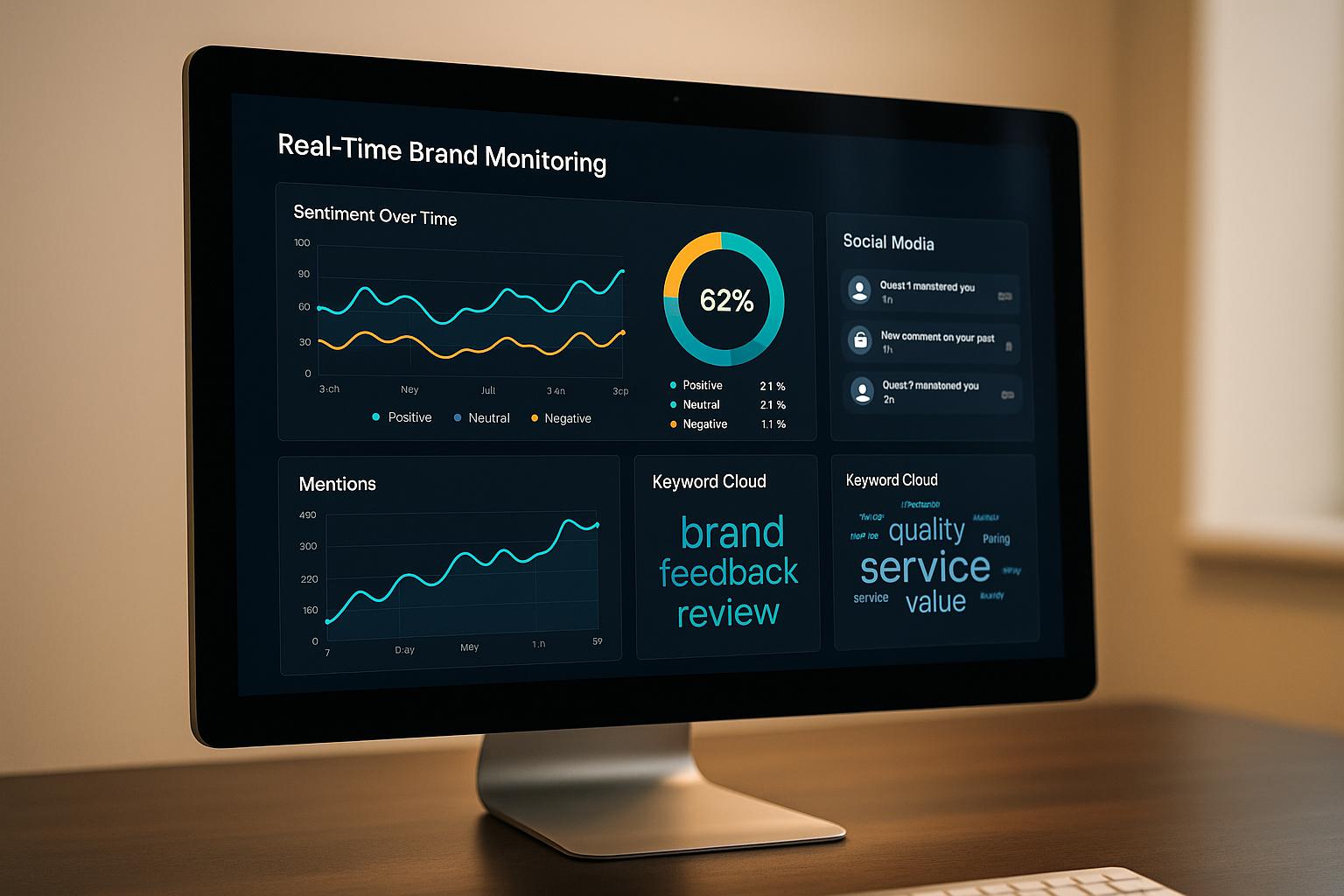
Real-time brand voice monitoring helps you track mentions, sentiment, and trends about your brand across platforms like social media, news outlets, blogs, and review sites as they happen. This process is essential for managing crises, improving customer relationships, and understanding public perception. Tools powered by AI now analyze not just text but also images and videos, giving businesses a complete view of their brand's presence.
Key Points:
- Tracking Mentions: Monitor social platforms (e.g., Twitter, TikTok), news sites, and even images or logos in user-generated content.
- Sentiment Analysis: Understand whether mentions are positive, negative, or neutral and identify the root causes behind public opinion.
- Trend Detection: Spot emerging patterns or issues early, allowing you to respond quickly to crises or amplify positive trends.
AI tools like Pressmaster.ai simplify this by automating monitoring, sentiment analysis, and trend detection while providing actionable insights through a single dashboard. This approach reduces response times, improves engagement, and helps brands stay ahead of potential challenges.
Automated Brand Monitoring Using Gumloop + Apify
Core Components of Real-Time Brand Voice Monitoring
Real-time brand voice monitoring depends on three interconnected elements that work together to provide a clear picture of your brand’s online presence. These components - tracking mentions, analyzing sentiment, and detecting trends - capture, interpret, and respond to brand conversations as they unfold across the digital landscape. Each piece is essential, creating a seamless system for staying in tune with public perception.
Tracking Mentions Across Platforms
At the heart of brand voice monitoring is the ability to track mentions across all platforms where your brand might come up. This goes far beyond basic keyword searches on popular social media sites.
Modern tools monitor platforms like Twitter, Facebook, Instagram, and TikTok, but they don’t stop there. They also scan news outlets, blogs, forums like Reddit, and review sites. Advanced systems even use visual recognition technology to identify your brand in user-generated content, such as photos, even when your name isn’t mentioned in text. For example, a picture of your logo on a product could be flagged, ensuring no conversation slips through the cracks.
To ensure thorough coverage, these systems track brand name variations, mentions of executives, and visual assets. Keywords and hashtags remain central to identifying mentions, but AI-driven algorithms take it further by understanding context. This means indirect references or subtle mentions are detected, and automated alerts notify you of unusual activity, such as spikes in mentions or emerging patterns.
Sentiment Analysis and Public Perception
Once mentions are tracked, the next step is sentiment analysis - turning raw data into insights about how people feel about your brand. This analysis categorizes mentions as positive, negative, or neutral, giving you a real-time understanding of public perception.
But it doesn’t stop at categorization. Sentiment analysis digs deeper to identify what’s driving public opinion. For example, if criticism arises, the system might reveal that negative feedback centers on customer service, not product quality, allowing you to respond more effectively.
Advanced AI models handle challenges like sarcasm, slang, and context-specific language. These tools can interpret nuanced expressions and platform-specific jargon, providing a clearer picture of sentiment. By monitoring emotional tone over time, brands can spot shifts in perception early and address potential issues before they escalate, whether they’re momentary reactions or long-term trends.
Trend Detection and Crisis Management
The third key component focuses on recognizing patterns and detecting early warning signs to help brands navigate emerging challenges or seize positive opportunities. Trend detection involves analyzing mentions, keywords, and sentiment over time to identify unusual spikes or recurring themes.
Real-time alerts play a crucial role here. If a sudden surge in negative sentiment occurs - say, due to complaints about a product defect - brands can act quickly, issuing statements or taking corrective measures before the issue spirals out of control. Early intervention can turn a potential crisis into a manageable situation.
On the flip side, trend detection can spotlight positive momentum. If a campaign or product launch generates growing excitement, brands can amplify these moments through targeted social media engagement or by collaborating with influencers. Geographic and demographic insights also help tailor responses, showing how sentiment differs across regions or audience segments.
Step-by-Step Guide to Real-Time Brand Voice Monitoring
Keeping tabs on your brand's voice in real-time might seem daunting, but breaking it into manageable steps makes the process much easier. Here’s how you can set up a system that keeps you on top of public sentiment and emerging trends.
Setting Up Monitoring Tools and Defining Keywords
The first step is picking the right tools for the job. Look for platforms that can monitor a variety of sources, including social media, news outlets, blogs, forums like Reddit, and review sites such as Yelp and Google Reviews [1][2]. These tools should handle both structured content (like articles) and unstructured data (like tweets or Instagram posts). For U.S.-specific monitoring, focus on platforms popular in the region and ensure the tool can handle American spelling and slang.
Next, build a solid keyword strategy. Start with the basics: your brand name, product names, and common misspellings. Then, expand to include industry-specific terms, trending hashtags, and campaign-related phrases [3][4]. Don’t forget indirect references - like the names of your executives, competitor brands, or even visuals like your logo that might appear in user-generated content.
To refine your keyword list, dive into historical data or use AI tools for suggestions. Keep an eye on seasonal trends and events that could influence conversations, such as Black Friday for retail or tax season for financial services. Also, define the brand attributes you care about most - like customer service, pricing, or innovation. Tracking mentions of these attributes gives you deeper insights into what drives public opinion.
Once everything is set up, your system will start collecting and interpreting data from various sources, giving you a comprehensive view of your brand's online presence.
Collecting and Analyzing Data
With your monitoring system in place, the next step is to let it do its job: gathering and analyzing data. Advanced AI tools are especially helpful here, as they can process mentions in real time, even identifying visual content like images or videos without accompanying text [3].
Sentiment analysis takes things a step further by breaking down feedback into specific areas. For example, a restaurant chain might find that while customers love their food, they often complain about long wait times during busy hours. This kind of detailed insight helps you focus on the areas that need improvement.
Patterns and trends emerge during this phase. AI algorithms can track spikes in mentions, shifts in sentiment, and recurring themes. A sudden surge in mentions might indicate viral content, while steady sentiment changes could reveal evolving opinions about your brand. Geographic and demographic breakdowns add another layer of insight, showing how different groups perceive your brand, which is invaluable for tailoring your responses.
Creating Alerts and Taking Action
Now it’s time to act on the insights you’ve gathered. Intelligent alert systems are key here, notifying you of specific triggers - like a spike in negative sentiment, a viral post, or a mention from a high-profile media outlet [1][4]. Your alert thresholds should reflect your brand’s needs. For instance, a startup might flag any mention with significant engagement, while a larger company might focus on unusual patterns or mentions from influential sources. Alerts can be sent via email, SMS, or team tools like Slack, ensuring your team stays informed in real-time.
Having a response plan in place is critical. Create templates for common scenarios, such as addressing customer complaints or amplifying positive feedback. Your plan should outline quick acknowledgment steps, escalation paths for serious issues, and strategies to engage with positive mentions [2][4].
"In this video, I'll show you how to set your brand guidelines and train Pressmaster AI to understand your unique brand voice by analyzing your website and using sample content." - Feisworld Media, Business Strategist [5]
Speed is everything when it comes to real-time monitoring. Responding promptly to concerns can turn potential problems into wins, while delays may escalate issues and damage your reputation. For example, catching a viral negative post early can help you address the issue before it spirals.
Finally, learn from your actions. Track which responses work best, what resonates with your audience, and how effectively you resolve issues. Use this information to fine-tune your monitoring and response strategies. And don’t forget to seize opportunities - positive sentiment and emerging trends are golden chances to boost your brand’s image.
How Pressmaster.ai Simplifies Brand Voice Monitoring
Managing brand voice monitoring can feel like a daunting task, but Pressmaster.ai makes it easier by turning a complicated process into a smooth, efficient workflow. It bridges the gap between monitoring your brand's presence and implementing actionable PR strategies, saving time and effort.
AI-Powered Monitoring and Insights
Pressmaster.ai uses advanced AI algorithms to track brand mentions across a variety of platforms, including news outlets, social media, blogs, and forums - all in real-time. Unlike traditional methods that require constant human oversight, this platform processes massive amounts of data and pinpoints the conversations that matter most. It also categorizes sentiment instantly, providing a clear picture of public perception at any given moment.
What makes it stand out is its trend detection feature, which doesn’t just monitor mentions but also identifies shifts in conversation volume, sentiment patterns, and emerging topics. This allows you to spot potential issues or opportunities weeks before they become widespread. For example, if negative sentiment suddenly spikes or a major media outlet mentions your brand, you’ll know about it within minutes, not hours or days.
Beyond just gathering data, Pressmaster.ai delivers actionable insights. It highlights trending industry topics, identifies key influencer discussions, and sends early warnings for potential PR crises. This helps PR teams understand not only what’s being said but also why it matters and what steps to take next.
The platform’s natural language processing capabilities are another game-changer. Its models are trained to understand context, sarcasm, and subtle language nuances that often confuse basic monitoring tools. This means fewer false positives and more accurate sentiment analysis, giving you reliable information to guide critical PR decisions.
Unified Dashboard and Multi-Channel Management
Traditional brand monitoring often involves juggling multiple platforms, manually compiling reports, and coordinating responses across various teams. Pressmaster.ai solves this problem with a unified dashboard that brings all monitoring, analytics, and publishing tools into one place.
"Pressmaster gives you one dashboard to control all your content. Edit, reuse, and track everything without jumping between platforms." [5]
This centralized dashboard offers a real-time view of mentions, sentiment trends, and performance metrics across all key channels. By consolidating this information, the platform not only speeds up response times but also simplifies the entire process of gathering and analyzing data.
Pressmaster.ai also makes multi-channel management seamless. When you need to respond to a crisis or amplify positive coverage, the platform automatically optimizes and distributes your content across press networks, social media, and your custom newsroom - all at once. Each piece of content is formatted specifically for its intended platform, ensuring maximum engagement and reach.
"Publish everywhere at once: Content is automatically optimized for each platform's specific format and algorithm." [5]
The platform also tracks performance metrics, such as mention volume, sentiment breakdowns, engagement rates, and crisis response times. Instead of jumping between analytics tools, you get a complete picture of your PR efforts in one place. Features like role-based access controls and collaborative tools ensure that everyone - from PR teams to executives - can access the information they need while maintaining proper permissions. Real-time notifications and shared workspaces further enhance coordination during critical moments.
Customer Success Stories
The platform’s capabilities come to life in real-world examples. Take, for instance, a U.S.-based startup that faced a sudden surge in negative sentiment after a product launch. Thanks to Pressmaster.ai’s AI-powered alerts, their PR team quickly identified the root cause - a misunderstood social media post. Within minutes, they responded with clarifying content, which was automatically distributed across all channels. The result? They managed to prevent reputational damage and even turned public sentiment around. Analytics later confirmed a complete recovery in perception, proving how swift action can transform a potential crisis into a manageable situation.
Another organization used Pressmaster.ai’s trend detection tools to stay ahead of industry conversations. Instead of reacting to trends after they gained momentum, they identified emerging topics early and positioned themselves as thought leaders. This proactive strategy led to increased media coverage and stronger industry recognition - all because they had timely insights at their fingertips.
For growing companies, the platform’s ability to maintain a consistent brand voice while expanding their digital presence has been especially valuable. It ensures quality and consistency across all channels, cutting down on the manual effort typically required to manage such tasks effectively.
Benefits and Challenges of Real-Time Brand Voice Monitoring
Real-time brand voice monitoring offers organizations clear advantages, but it also comes with its own set of hurdles. By understanding both the benefits and challenges, businesses can make informed decisions about implementing these systems and maintaining a consistent brand presence.
Benefits and Advantages
One of the biggest perks of real-time monitoring is strengthened reputation management. With the ability to spot and address negative mentions quickly, brands can prevent small issues from escalating into major crises. In fact, Cision reports that companies using real-time media monitoring can reduce their average response time to PR crises by up to 80% compared to those relying on periodic monitoring[1]. That kind of speed can mean the difference between effective damage control and a full-blown public relations disaster.
This speed advantage also supports faster crisis response. For example, identifying negative sentiment early on emerging platforms allows brands to take action before reputational damage occurs. Acting quickly not only minimizes harm but also demonstrates accountability and responsiveness, which can enhance public trust.
Another major benefit is improved customer engagement. Real-time monitoring enables brands to participate in conversations as they happen, creating opportunities to build loyalty and trust. A 2024 survey by AIM Technologies revealed that 68% of businesses using real-time monitoring saw higher customer satisfaction within six months of implementation[2]. When customers see their concerns addressed promptly, they feel valued, which strengthens the brand-customer relationship.
Early trend detection is another game-changer. By identifying emerging topics before they go mainstream, brands can position themselves as thought leaders and gain a competitive edge. This proactive approach not only boosts industry authority but also opens doors for increased media coverage.
The data supports these benefits as well. ICUC found that companies actively monitoring their brand online are 2.5 times more likely to avoid major reputation crises than those that don’t[4]. This makes real-time monitoring both a protective measure and a strategic tool for maintaining a strong brand image.
Challenges and Solutions
Despite its advantages, real-time brand voice monitoring isn’t without challenges. One of the most common issues is data overload. Monitoring mentions across multiple platforms generates an overwhelming amount of information, making it hard to pinpoint actionable insights. Important signals can easily get buried under the noise.
Another challenge is dealing with false positives. Monitoring systems often flag irrelevant mentions, wasting time and resources. This can desensitize teams, making it harder to recognize genuine issues when they arise.
Complex sentiment analysis is also a significant obstacle. Understanding sarcasm, humor, and subtle language nuances across various platforms requires advanced tools. Basic systems often misinterpret sentiment, leading to inappropriate responses or missed opportunities.
Additionally, emerging risks like deepfakes and niche influencer content present new threats. Traditional monitoring tools may not be equipped to detect manipulated media or conversations happening in specialized communities, leaving brands vulnerable to unseen reputation risks.
To tackle data overload, organizations can implement AI-powered automation. Advanced filtering systems can prioritize mentions based on relevance, sentiment, and impact, helping teams focus on what truly matters. Customizable alerts allow for a more targeted approach, ensuring that critical topics don’t slip through the cracks.
For false positives and nuanced sentiment analysis, aspect-based sentiment analysis offers a solution. By focusing on specific aspects of mentions rather than assigning broad sentiment scores, this approach reduces errors and provides deeper insights into public conversations.
Emerging risks, such as deepfakes, require adaptive monitoring tools and regular updates. Collaborating with cybersecurity experts and refining monitoring parameters can help organizations stay ahead of these challenges. Platforms like Pressmaster.ai simplify these processes by automating insights and responses, making it easier to manage both the benefits and challenges of real-time monitoring.
Comparison Table: Benefits, Challenges, and Solutions
Here’s a quick breakdown of the key benefits, challenges, and solutions:
| Benefit | Challenge | Solution |
|---|---|---|
| Improved reputation management | Data overload | AI-powered filtering and prioritization |
| Faster crisis response | False positives | Customizable alerts and sentiment analysis |
| Better customer engagement | Complex sentiment/context interpretation | Aspect-based sentiment analysis |
| Early trend detection | Emerging risks (deepfakes, niche influencers) | Adaptive tools and regular updates |
| Strategic decision-making | Resource investment requirements | Unified dashboards and automated workflows |
The key to success lies in choosing the right tools and strategies. By investing in unified, automated platforms, organizations can minimize challenges while maximizing the benefits of real-time monitoring. The focus should be on monitoring what matters most, turning data into actionable insights that drive smarter decisions.
Conclusion and Key Takeaways
Real-time brand voice monitoring has shifted from being a luxury to a must-have for businesses navigating today’s fast-paced digital world. By combining core tracking, sentiment analysis, and trend detection, companies can build a dynamic monitoring system that not only identifies potential crises but also strengthens audience engagement. This approach transforms raw data into actionable insights, enabling businesses to stay ahead of the curve.
To implement effective monitoring, start with clear goals, select the right tools, and set up alert systems for quick responses. The real power lies in transitioning from reactive measures to proactive strategies that use real-time data to drive smarter decisions.
AI and machine learning have revolutionized the monitoring process, making it faster and more precise. With over 80% of companies now using automated tools, it’s clear that manual methods alone can’t keep up with the sheer volume of digital interactions[4]. These tools streamline public relations workflows and tackle the challenges of modern monitoring head-on.
A standout example is Pressmaster.ai, which integrates AI-driven monitoring with content creation, distribution, and performance analytics. This all-in-one platform addresses the entire PR workflow, making it accessible for organizations of all sizes while reducing resource demands.
Data underscores the value of proactive monitoring. Brands that respond to customer feedback within an hour are 60% more likely to retain those customers[2]. These timely responses can give businesses a competitive edge, boosting both reputation and outcomes.
Of course, challenges like data overload and false positives remain. The solution lies in advanced AI filtering, detailed sentiment analysis, and platforms that automate repetitive tasks while ensuring human oversight for critical decisions.
As digital landscapes continue to evolve, integrating AI-powered monitoring into your PR strategy is no longer optional. Businesses that invest in comprehensive monitoring today will be better equipped to navigate tomorrow’s challenges. Real-time monitoring isn’t just about damage control - it’s about building stronger customer connections, positioning your brand as a thought leader, and making decisions rooted in data to drive long-term growth.
The takeaway? Successful organizations go beyond simple data collection. They integrate monitoring with content creation, distribution, and performance measurement, ensuring that insights lead to meaningful actions. This holistic approach transforms brand voice monitoring into a powerful tool for growth and success. The question is no longer if you should adopt it, but how quickly you can make it a cornerstone of your strategy.
FAQs
How does real-time brand voice monitoring help prevent PR issues from escalating?
Real-time brand voice monitoring allows you to spot early signs of negative sentiment or inconsistencies in your messaging. By addressing these issues promptly, you can fine-tune your communication strategy and tackle concerns before they escalate into bigger challenges.
This not only helps keep your brand in sync with its core values but also safeguards its reputation, ensuring you maintain control over how your audience interprets and engages with your message.
What challenges do businesses face with real-time brand voice monitoring, and how can they address them?
Businesses often face a handful of hurdles when it comes to real-time brand voice monitoring. These include handling massive amounts of data from various platforms, ensuring their brand voice stays consistent, and reacting swiftly to emerging trends or potential crises.
One way to tackle these issues is by using AI-powered tools like Pressmaster.ai. These tools simplify data analysis and offer actionable insights, making it easier to maintain a cohesive brand voice. By automating tasks such as spotting trends and generating content, companies not only save time and resources but also keep their messaging consistent. A centralized platform for monitoring and managing content further helps teams stay quick on their feet and aligned, even in fast-moving situations.
How does AI improve brand voice monitoring compared to traditional methods?
AI plays a key role in refining brand voice monitoring by processing massive amounts of data in real time. This helps businesses pinpoint trending topics and understand audience preferences, allowing them to craft content that aligns with current interests while staying true to their brand identity.
It also ensures a consistent tone and style across various platforms, reinforcing the brand's personality. By simplifying these tasks, AI enables companies to adapt swiftly to market shifts without compromising their established voice.
Related Blog Posts








Sign Up for our Pressmaster Newsletter
Sign up for our Pressmaster.ai newsletter to get instant alerts on trending topics, ensuring you stay ahead in your field with the latest insights and updates.


.avif)
.png)

.avif)


7 Viral Patterns That Drove 10,643% Growth
Turn natural conversations into content gold, make every insight count, and drive real conversations.

Please fill out the form to get our Viral Cheat Sheet


How to Become a Thought Leader in 6 Easy Steps
Increase your visibility, establish authority, and conquer your market with minimal effort.

Please fill out the form to get our PDF Checklist
