
How to Use AI for Writing Content That Aligns With Your Marketing Goals

AI tools are transforming content marketing by helping businesses create more effective, goal-oriented content. By 2025, 96% of companies are using generative AI to improve efficiency, reduce costs, and drive results. Here’s how AI can help you achieve your marketing goals:
- Optimize Content for Goals: AI tools ensure every piece of content aligns with specific objectives, like increasing traffic, generating leads, or improving engagement. For example, companies report up to a 45% increase in organic search traffic using AI-optimized content.
- Maintain Brand Voice: AI can replicate your tone and style by analyzing past content, ensuring consistency across all channels. Businesses using AI for brand voice saw conversion rates improve by 17%.
- Leverage Trends: AI identifies emerging topics using real-time data, helping you create timely, relevant content. This approach led to a 35% boost in blog traffic for one retailer.
- Streamline Publishing: AI automates multi-channel publishing, tailoring content for platforms like LinkedIn, Instagram, and blogs. Tools like Pressmaster.ai can turn one idea into 15+ platform-specific posts.
- Analyze Performance: AI dashboards track key metrics like engagement, conversions, and ROI, enabling data-driven improvements. Companies reported 30–40% reductions in content creation costs while achieving better results.
The secret to success? Combine AI’s efficiency with clear goals and human oversight. This balance ensures your content drives measurable outcomes while staying true to your brand.
AI Content Marketing For Beginners | Artificial Intelligence Content Marketing
Setting Up for Success: Goals and Brand Voice
Before you dive into creating content with AI, it's essential to lay a solid foundation. Without this groundwork, even the most advanced AI tools can churn out content that falls flat. The secret? Clearly defined marketing goals and a consistent brand voice that your AI can replicate across all your content.
How to Set Clear Marketing Objectives
Successful marketing starts with well-defined, measurable goals that guide every move your AI tools make. One proven method for setting goals is the SMART framework, which ensures that objectives are Specific, Measurable, Achievable, Relevant, and Time-bound.
For instance, instead of a vague goal like "increase brand awareness", try something more actionable: "Boost website traffic by 20% in Q1 2026 through SEO-optimized blog posts." This level of clarity helps your AI tools zero in on tasks like keyword optimization and topic selection, all geared toward achieving your objective.
Different goals require different strategies. If you're aiming for lead generation, your AI should prioritize content with strong calls-to-action and persuasive value propositions. For thought leadership, the focus shifts to creating in-depth, authoritative content that highlights your expertise. Meanwhile, campaigns aimed at brand awareness might lean into storytelling to forge emotional connections with your audience.
Modern AI platforms can help align your content strategy with these goals by offering features like keyword suggestions and performance tracking. This ensures every piece of content - whether it's a blog post, social media update, or email campaign - works toward achieving your specific business objectives, rather than just filling up your content calendar.
One often-overlooked factor is setting a clear timeframe. Breaking your goals into quarterly or monthly targets allows for real-time adjustments based on performance data. For example, if your goal is to generate 500 new leads per quarter, you can monitor progress monthly and recalibrate your AI's focus as needed.
Once your objectives are in place, the next step is ensuring your AI tools can consistently reflect your unique brand voice.
Setting Up Your Brand Voice in AI Tools
Your brand voice is what sets you apart, and keeping it consistent across all AI-generated content is crucial for building trust and recognition. Fortunately, modern AI platforms are equipped to learn and replicate your specific tone, style, and messaging.
Getting this right involves uploading writing samples or creating detailed style guides that outline your brand’s personality. These guides should include preferred vocabulary, sentence structure, and messaging principles. Some advanced AI tools even offer interactive features, like interviews, to capture your expertise and perspective. This helps the AI understand not only how you write but also how you think about your industry and audience.
Here’s a real-world example: In Q2 2024, a mid-sized SaaS company used an AI tool’s brand voice memory feature to standardize content across 12 product landing pages. The result? A 17% increase in conversion rates and a 22% reduction in editing time[5]. By providing detailed brand guidelines and sample copy, they ensured that every AI-generated draft matched their established tone perfectly.
One user, Thomas Preiss, a Sales Development Coach, shared his experience with AI tools:
"Once your brand voice is in there it's amazing how close each article gets to the way I would write. Then the AI interviews are amazing. Like a real person is grilling me in my points. Love it!" [1]
Consistency requires regular updates. As your brand evolves or adopts new messaging strategies, you’ll need to update your AI tool’s training data. Most platforms make it easy to adjust voice settings based on how well the generated content performs.
For businesses targeting U.S. audiences, it’s also important to configure your AI tools for American English spelling, MM/DD/YYYY date formats, USD currency symbols, and imperial measurement units. These small details help ensure your content feels natural and relatable to your audience.
With your goals and voice in place, the next step is using trend analysis to create timely, relevant content.
Using Trend Analysis for Timely Content
Once your objectives and brand voice are established, trend analysis becomes a powerful tool for identifying topics that resonate with your audience right now. AI-powered trend analysis takes the guesswork out of this process by using data to pinpoint emerging topics before they become oversaturated.
Today’s AI tools can scan thousands of sources - like social media, news outlets, and industry publications - to identify trends that align with your marketing goals. This real-time insight allows you to create content that captures attention at just the right moment.
For example, in April 2024, an e-commerce retailer used an AI tool’s trend analysis feature to launch a blog series on summer fashion trends. By aligning their content with real-time search data and a playful brand voice, they achieved a 35% increase in organic blog traffic and a 15% boost in social shares within two months[3].
Of course, not every trend is worth chasing. Focus on those that align with your brand’s expertise and your audience’s interests. AI tools can help by analyzing the overlap between trending topics, relevant keywords, and your audience’s search behavior.
Timing matters when it comes to trend-based content. AI can predict the lifecycle of a trend, helping you decide the best time to publish. Some trends may have a short window of relevance, while others build gradually. Understanding these patterns allows you to plan your content calendar for maximum impact.
To stay ahead, consider setting up automated trend alerts in your AI tools. These alerts notify you when relevant topics start gaining traction, ensuring you’re always ready to produce timely, engaging content that positions your brand as both current and insightful.
Using AI Throughout Content Creation
Once you’ve defined your goals and established your brand voice, AI can be a powerful ally at every stage of content creation - from brainstorming ideas to publishing across multiple channels. Each phase - ideation, drafting, and publishing - taps into different AI capabilities, and knowing how to use these tools effectively can elevate your marketing efforts. These AI-driven methods seamlessly build on the strategies we’ve discussed earlier.
Finding Content Ideas with AI Trend Tools
Struggling to come up with fresh ideas? AI trend analysis tools can help you identify emerging topics and opportunities before they become oversaturated, giving you a head start in grabbing your audience’s attention.
Take Pressmaster.ai's Trendmaster, for instance. This tool scans over 500,000 sources daily to pinpoint hot topics and trends that matter to your audience - often spotting industry shifts weeks before they hit mainstream conversations.
The key is to combine this trending data with your expertise. Instead of chasing every trend, AI can help you zero in on the overlap between what’s gaining traction and what you know best. For example, let’s say you’re a financial advisor, and the tool highlights rising interest in sustainable investing. You could create content focusing on ESG portfolios or green bonds, leveraging your specific knowledge.
"Pressmaster lets me turn internet content into full articles or social posts faster than ever. It's been a game-changer for covering news and politics, especially with Trendmaster and the pin feature. I use it daily."
- Cameron C., Creative Director [1]
AI tools can also send automated alerts to ensure you never miss a critical trend. For example, one B2B SaaS company discovered through AI that competitors were avoiding discussions about implementation challenges. By addressing this gap with honest, helpful content, they saw a 23% increase in qualified leads within just one quarter [6].
AI doesn’t just help you find ideas - it validates them. These tools analyze engagement potential, search volume, and relevance to help you prioritize topics that align with audience interests and your marketing goals. This data-driven approach takes the guesswork out of planning and ensures your content calendar is packed with high-impact ideas.
Creating Quality Drafts with AI Writing Tools
AI writing tools have come a long way from basic text generation. Today, they act as collaborative partners, helping you craft high-quality drafts tailored to your brand voice and audience.
It all starts with training the AI on your brand voice. Platforms analyze your existing content, website copy, or even guided interviews to get a sense of your tone and communication style. This ensures the AI produces drafts that feel authentic to your brand.
But here’s the trick: use AI as a partner, not a replacement for your creativity. Instead of asking it to come up with ideas from scratch, feed it your initial thoughts - like a rough outline or key points from a client conversation. The AI can then help you expand on these ideas, adding supporting arguments, relevant examples, and smoother transitions while keeping your voice intact.
AI tools also shine when it comes to repurposing content. They can adapt a single core message to suit different audiences - whether it’s new leads, existing customers, or technical professionals. By tweaking the tone, complexity, and examples, you can create tailored content for various channels without starting from scratch.
Marketers who use AI for ideation and drafting report up to 30% higher engagement rates on their published content compared to manual processes [4]. This boost comes from AI’s ability to optimize readability, incorporate SEO best practices, and suggest compelling headlines and hooks.
Publishing Across Multiple Channels Automatically
The final step - publishing - is where AI truly saves time. Instead of manually reformatting and posting content across platforms, AI-powered tools handle the entire process, optimizing each post for the specific requirements of different channels.
Each platform has its quirks. A LinkedIn post needs a different tone and length than an Instagram caption or a Twitter thread. AI tools adjust your content to fit each platform’s algorithm and audience expectations, ensuring your message feels natural and engaging.
For example, Pressmaster.ai can transform one piece of content into 15+ platform-specific posts, optimized based on insights from over 50,000 viral examples. It can then automatically publish across platforms like LinkedIn, Instagram, and Twitter - no manual effort required.
"Pressmaster drastically cuts my content time. It captures my voice, finds trending topics, and publishes everywhere, blog, socials, all done in under 30 minutes. Total game-changer."
- Emmy W., Fractional CMO & Agency Owner [1]
In 2025, bestapps.ai highlighted how users could turn a 5-minute voice recording into over 30 days of optimized content, including LinkedIn posts, Twitter threads, Instagram carousels, and blog articles - all generated and published automatically [1].
AI tools also centralize your workflow. With unified dashboards, you can edit, reuse, and track content performance across all platforms without logging into multiple accounts. These tools often integrate with content management systems, email platforms, and press distribution networks, ensuring your content reaches every corner of your audience.
Timing matters too. AI analyzes audience activity patterns to schedule posts for maximum visibility and engagement. For businesses managing multiple brands or clients, workspace separation allows you to switch between projects seamlessly, maintaining unique settings and voice profiles for each.
Measuring Results and Making Improvements
Creating content is just the beginning; understanding how it performs and refining your strategy is where the real growth happens. AI tools not only help you craft content but also provide detailed insights into how well it resonates across various channels.
Tracking Important Metrics
Think of analytics dashboards as your mission control for tracking content performance. AI-powered tools bring together essential metrics - like engagement, reach, conversion rates, and ROI - into a single, easy-to-navigate view.
These tools go beyond surface-level data. They pinpoint which pieces of content are driving leads, holding audience attention, or generating revenue. This information doesn’t just tell you what’s popular; it shows you what’s actually delivering value.
To get started, integrate your AI tools with all the platforms where your content lives. Customize your dashboard based on your goals. For example, if your focus is on generating leads, prioritize metrics like conversion rates and cost-per-lead. If your aim is brand awareness, pay closer attention to reach and engagement. Real-time data tracking allows you to make adjustments quickly - sometimes within hours of publishing.
| Metric Type | What AI Tracks | Why It Matters |
|---|---|---|
| Engagement Rate | Likes, shares, comments | Shows how well your content connects with the audience |
| Conversion Rate | Click-throughs, sign-ups, purchases | Measures how content drives business results |
| Content Reach | Unique views, impressions | Highlights your brand’s visibility |
| ROI | Revenue vs. content investment | Quantifies the financial impact of your efforts |
These insights empower you to make smarter, data-backed decisions for future content strategies.
Using AI Data to Improve Content
Once you’ve tracked the key metrics, it’s time to turn those numbers into action. Data by itself is just numbers on a screen - the real power of AI lies in helping you interpret that data and make meaningful changes.
AI tools excel at spotting patterns you might miss. For instance, they can identify the best times to post, highlight effective keywords, and suggest tweaks to your content’s timing, topics, or messaging to boost performance.
One particularly useful feature is content gap analysis. This compares your content portfolio to industry leaders, revealing topics you haven’t covered yet or areas where competitors are excelling. For example, some businesses found that addressing common implementation challenges - a topic often overlooked - helped them capture 23% more qualified leads in Q4 2024[6].
AI also makes content refreshing easier. It identifies older pieces that still perform well but could benefit from updates. Companies have reported traffic increases of up to 40% and ROI improvements of 3–4x by updating existing content instead of starting from scratch[6].
But don’t rely solely on AI. Combine its insights with your own expertise to align content with your business goals. This balance of data and human intuition creates the strongest strategies.
Another strength of AI is audience segmentation. By analyzing behavioral patterns, it helps you tailor content to specific audience groups, ensuring your messaging feels personal and relevant.
Regular performance reviews are crucial. Set aside time each month to dive into your analytics, identify trends, and make adjustments. Often, content that’s just shy of top rankings only needs minor tweaks to make a big leap.
Finally, remember that AI insights are a guide, not a guarantee. Always test recommendations with your own audience to see what works best for your unique context. Use AI as a starting point, then refine based on real-world results.
Pressmaster.ai Features for Marketing Content
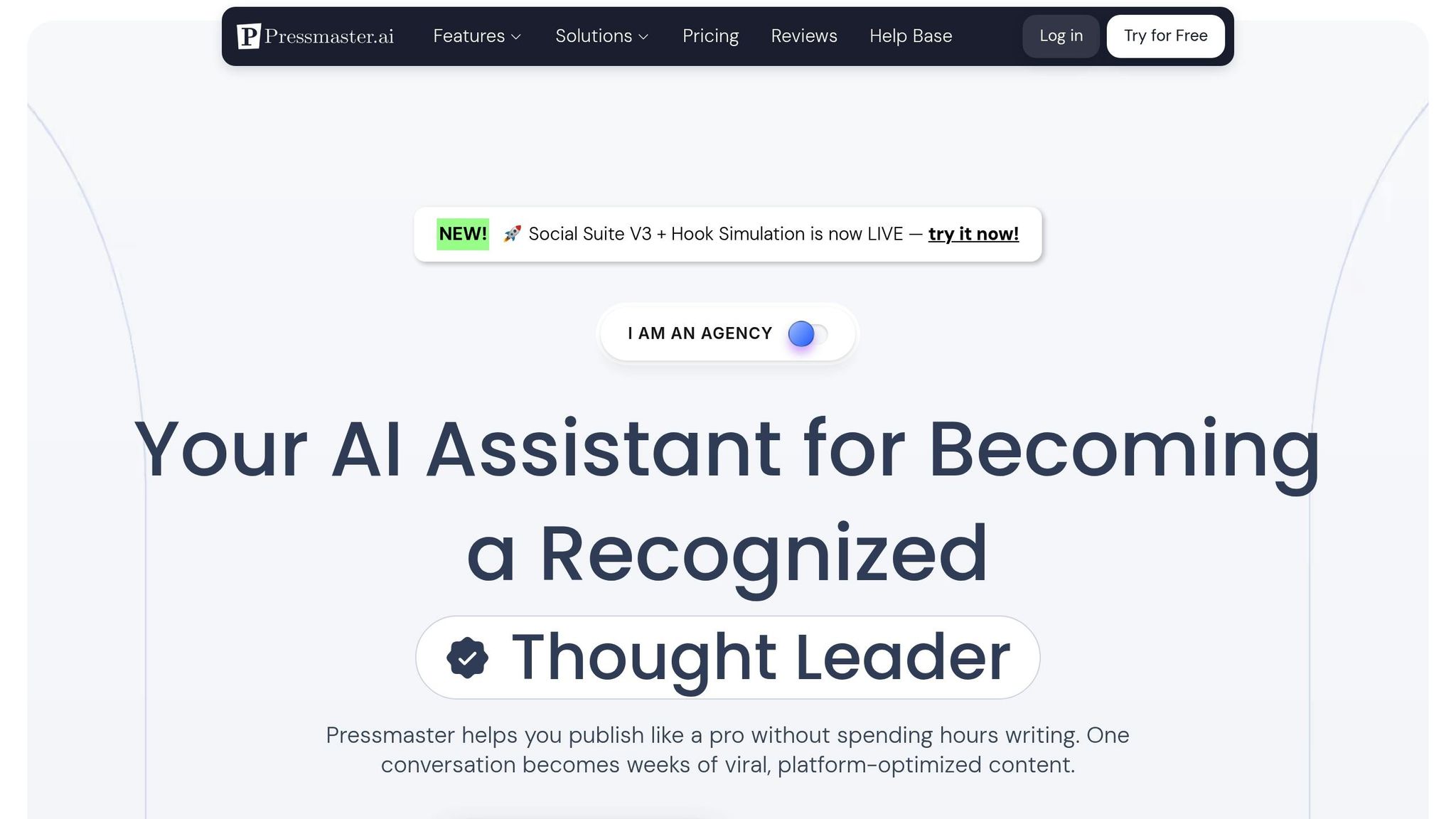
Pressmaster.ai brings together tools that help marketers create, distribute, and analyze content with measurable results. With over 1,400 thought leaders and 150 agencies relying on it, the platform has delivered impressive outcomes, such as a staggering 10,643% boost in post impressions and a 24% increase in followers within just one week [1]. These numbers underline its ability to make a real impact.
Here’s a closer look at how its features contribute to a powerful, streamlined content strategy.
Tools That Make Content Creation Smarter
Trendmaster is the standout feature for marketing teams. It scans over 500,000 data sources daily to predict industry trends 3–4 weeks in advance [1]. Each alert includes customized content ideas, helping you stay ahead while ensuring your messaging aligns perfectly with your goals.
Brand voice replication and plagiarism detection with fact-checking work hand-in-hand to keep your content authentic. With AI ensuring consistency and a triple-check system for originality and accuracy, your brand remains credible even as production scales [1].
The AI Strategizer takes your content planning to the next level. Drawing from over 1 million viral articles and proven frameworks, it suggests content angles that go beyond the ordinary, helping you connect with your audience in meaningful ways [1].
For marketers needing expert insights, external interview capabilities simplify the process. Share a single link to gather responses from busy executives or specialists. The AI then adapts questions based on their answers and transforms the conversation into articles ready for publication [1].
"My first posts with Pressmaster were incredible. 10,643% increase in post impressions and 24% increase in followers in less than a week. Amazing results!" – Wesley Pitts, Founder [1]
Tools for Publishing and Analytics
Pressmaster.ai doesn’t stop at creation - it also streamlines distribution and analytics to round out the content cycle. Multi-channel distribution automatically formats and publishes your content across platforms like WordPress, Wix, Medium, Webflow, and major social media channels [1]. This ensures consistent messaging without the extra workload.
The Social Suite takes one article and turns it into over 15 platform-specific posts, using insights from 50,000 viral posts to optimize each one [1]. This makes it easy to maintain a strong presence across multiple platforms.
With newsroom creation, businesses can set up a content hub in under an hour. These SEO-optimized spaces help Google index content faster, turning your newsroom into a B2B sales asset. Some agencies have seen their cold email close rate jump from 8% to 21% after integrating a Pressmaster-powered newsroom [1].
"In ONE day we gained over 400 followers for our Business LinkedIn since we started using Pressmaster." – Ati Dalgaard, Founder [1]
The unified analytics dashboard brings all your performance metrics into one place, making it simple to adjust strategies in real time. For agencies managing multiple clients, features like multiple workspaces and white-label solutions ensure every report and piece of content reflects the client’s branding [1].
| Feature Category | Key Tools | Primary Benefit |
|---|---|---|
| Content Creation | Trendmaster, Brand Voice, AI Strategizer | Stay ahead with engaging, relevant ideas |
| Quality Control | Plagiarism Detection, Fact-Checking, AI Detector | Ensure credibility and originality |
| Distribution | Multi-Channel Publishing, Social Suite, Newsroom | Reach audiences with consistent messaging |
| Analytics | Unified Dashboard, Performance Tracking | Make informed, data-driven decisions |
Conclusion: Reaching Marketing Goals with AI Content
AI-driven content creation has become a cornerstone of modern marketing. With projections showing that 96% of companies will use generative AI for content creation by 2025[2], the conversation has shifted from debating its adoption to understanding how to use it effectively for tangible results. This ties back to earlier discussions on setting clear marketing goals and ensuring alignment with your brand’s voice.
Platforms like Pressmaster.ai don’t replace strategic thinking - they enhance it. By blending AI's ability to scale with human oversight, marketing teams can focus on creativity, strategic planning, and building relationships. The result? Greater efficiency and impact.
Businesses leveraging AI have reported up to a 30% boost in engagement and a 70% reduction in production time[4]. This consistency strengthens brand identity across all content formats. Additionally, automated multi-channel distribution now enables seamless publishing across blogs, social media, and email platforms without the need for manual intervention[2].
AI tools also bring valuable insights to the table. Built-in analytics dashboards make it easier to measure content performance and refine strategies. This creates a feedback loop where each piece of content becomes more precise and effective over time.
For companies that succeed with AI, the key lies in treating it as a strategic partner rather than just an automation tool. They set clear marketing goals, tailor AI outputs to reflect their unique brand identity, and continuously analyze performance data to refine their approach. This balanced approach combines the speed and scalability of AI with the creativity and strategic depth that only humans can provide.
As highlighted throughout, the combination of human strategy and AI automation is the foundation of effective content marketing today. In an increasingly crowded content landscape, businesses that consistently produce relevant, high-quality material will stand out. Tools like Pressmaster.ai make this possible by handling the heavy lifting while ensuring every piece aligns with your brand’s objectives.
The future belongs to companies that adopt AI thoughtfully - using it to amplify their strategic vision rather than replacing it. When implemented with care, AI-powered content creation evolves from a simple productivity tool into a game-changing advantage that delivers measurable results.
FAQs
How can I make sure AI-generated content reflects my brand's unique voice and style?
Pressmaster.ai is built to match your brand's unique voice and style. It takes the time to understand your preferences, values, and how you communicate, crafting content that truly reflects your brand's personality.
The result? Consistent messaging that connects with your audience and aligns seamlessly with your marketing objectives.
How can I set and track clear marketing goals when using AI for content creation?
To set and track clear marketing objectives using AI tools, start by establishing SMART goals - that means your goals should be specific, measurable, achievable, relevant, and time-bound. For instance, you could aim to boost website traffic by 20% within three months or secure 50 qualified leads each month through blog posts.
After defining your goals, turn to AI tools for data analysis and progress tracking. These tools can offer detailed insights into audience behavior, content performance, and conversion rates. Use this data to fine-tune your strategy, ensuring your content stays aligned with your marketing objectives.
Lastly, make it a habit to review your results regularly. This ongoing evaluation helps you determine how well your AI-powered efforts are working and allows you to improve your approach to meet your goals effectively.
How can AI trend analysis help me create content that connects with my target audience?
AI trend analysis keeps you in the loop by spotting new topics and shifting audience interests as they happen. With its ability to sift through massive amounts of data, AI identifies trends that are likely to gain traction, giving you the chance to craft content that’s both timely and engaging.
By staying tuned to what your audience cares about, you can deliver messages that hit the mark, helping you build stronger connections and achieve meaningful outcomes in your marketing efforts.
Related Blog Posts








Sign Up for our Pressmaster Newsletter
Sign up for our Pressmaster.ai newsletter to get instant alerts on trending topics, ensuring you stay ahead in your field with the latest insights and updates.


.avif)
.png)

.avif)


7 Viral Patterns That Drove 10,643% Growth
Turn natural conversations into content gold, make every insight count, and drive real conversations.

Please fill out the form to get our Viral Cheat Sheet


How to Become a Thought Leader in 6 Easy Steps
Increase your visibility, establish authority, and conquer your market with minimal effort.

Please fill out the form to get our PDF Checklist
