
Smart AI Content Strategy Tips to Boost Your SEO and Save Hours Each Week
AI is transforming content creation and SEO, making it faster and more efficient. Here’s what you need to know:
- Save Time: AI tools cut manual work by up to 50%, handling keyword research, content planning, and optimization in minutes.
- Boost SEO: Businesses using AI report up to 30% more organic visibility and faster content production.
- Stay Ahead: AI identifies trends early, helping you create timely, search-optimized content that resonates with your audience.
- Scale Effortlessly: Automate repetitive tasks like formatting, metadata generation, and multi-platform distribution while maintaining quality.
- Track Performance: AI-powered dashboards consolidate metrics, making it easier to refine your strategy.
Tools like Pressmaster.ai streamline workflows, from spotting trends to automating content creation and distribution. Whether you’re managing a blog, social media, or press releases, AI lets you focus on strategy while saving hours every week.
Steal My AI SEO Strategy That Got My Site 55K Visitors/ Month
AI Content Creation: Building Better SEO
Creating high-ranking content used to demand hours of keyword research and competitor analysis. Thanks to AI, this process has become faster and more precise, turning content creation into a data-driven strategy. With AI tools, content creators can now produce SEO-optimized material more efficiently than ever before.
Faster Keyword Research and Topic Ideas
In the past, keyword research involved painstakingly analyzing search volumes, competition levels, and related terms one by one. Today, AI tools powered by machine learning and natural language processing (NLP) can instantly analyze massive datasets, identify search trends, and group related keywords by intent. This automated process not only saves time but also uncovers keyword opportunities that manual methods might overlook.
AI platforms go beyond just keywords - they analyze user queries, competitor strategies, and trending topics to suggest content ideas tailored to audience needs. Instead of brainstorming topics from scratch, you receive suggestions based on real search behavior. These platforms can even generate lists of high-potential keywords, including long-tail phrases that would otherwise take hours to discover.
By organizing semantically related keywords, AI also helps you plan content that covers multiple search intents. For example, rather than creating separate articles on "email marketing", "email automation", and "email templates", AI might suggest combining them into a detailed guide that addresses all these topics cohesively.
AI’s predictive capabilities don’t stop there. It can spot emerging trends, forecast traffic potential, and even highlight shifts in user behavior or search engine algorithms. This allows you to capitalize on trending topics before they peak, giving you a competitive edge.
Take Pressmaster.ai’s Trendmaster feature as an example. This tool scans over 500,000 sources to identify "hot topics" and trends with viral potential, removing the guesswork from content ideation. As one user shared:
"Pressmaster lets me turn internet content into full articles or social posts faster than ever. It's been a game-changer for covering news and politics, especially with Trendmaster and the pin feature. I use it daily."
- Cameron C., Creative Director [5]
These insights are just the starting point for optimizing content even further with AI.
Using AI for Better Search Optimization
AI doesn’t just help with keyword research - it also fine-tunes content structure to align with user behavior and search engine preferences. Modern AI tools optimize content by focusing on natural language trends, semantic relevance, and comprehensive topic coverage [1]. They can review drafts for factors like keyword density, metadata, readability, and related concept integration, providing instant feedback to improve performance.
What sets AI apart is its ability to understand context. With the rise of voice search, AI-powered NLP ensures your content is structured to answer conversational queries effectively. For instance, if someone asks, "How can I improve email open rates?" AI ensures your content delivers a clear, concise response.
AI also enhances content by suggesting subtopics or FAQs to make your material more thorough and engaging. For example, when writing about social media marketing, AI might recommend including sections on platform-specific strategies, content scheduling, or analytics tracking. It even handles smaller details, like recommending alt text for images or refining anchor text placement, which can improve both search visibility and user engagement.
Creating Modular, Search-Friendly Content
Once your keywords and structure are optimized, the next step is to organize your content in a way that’s easy for both users and search engines to navigate. Search engines increasingly value modular, answer-focused content, and AI excels at breaking down material into clear subheadings and logical sections. This approach not only improves user experience but also boosts your chances of being featured in snippets or AI-generated summaries.
Using clear subheadings, bullet points, and concise answers enhances readability while making your content easier for search engines to crawl. Features like structured data (Schema markup) and well-placed internal links further improve how search engines understand and present your content.
Businesses leveraging AI for SEO report up to 30% higher organic visibility and produce content 20–50% faster [1]. This combination of speed and optimization gives you a competitive edge, enabling you to create content that not only ranks well but also connects meaningfully with your audience.
Practical Tips to Save Time and Improve SEO with AI
AI's real strength in content strategy lies in its ability to take over repetitive tasks, leaving you free to focus on strategy and creativity. By automating key processes, you can keep up a steady content schedule, stay on top of trends, and get your message out on multiple platforms - without overwhelming your team.
Automating Content Planning and Writing
Content planning used to mean hours of brainstorming to find topics your audience would care about. AI flips this on its head by analyzing keyword trends, audience behavior, and even competitor activity to suggest topics and the best times to publish. Tools like these can generate topic clusters, spot content gaps, and let you plan months of content with minimal effort [9][6].
To make the most of this, link your content management system with AI tools that can create editorial calendars based on search trends and seasonal patterns. These tools can even analyze when your audience is most engaged, helping you decide the best times to publish.
For writing, AI tools can draft content based on structured outlines while keeping your brand's voice intact. For instance, Pressmaster.ai allows you to upload your brand guidelines, so the drafts it produces align with your style [9][6]. Training the AI with examples of your existing content ensures it mirrors your tone, style, and perspective accurately.
One user, Thomas Preiss, shared his experience:
"The ability to craft articles for blog posts, social media etc is incredible. Once your brand voice is in there it's amazing how close each article gets to the way I would write. Then the AI interviews are amazing. Like a real person is grilling me in my points. Love it!" - Thomas Preiss, Sales Development Coach [5]
To get the best results, set clear guidelines for human review to maintain quality and compliance. Automate tasks like keyword research, outline creation, and metadata generation [9][6][1], and fine-tune the AI settings regularly to keep them aligned with your brand.
Once you've got automated planning in place, you can use AI to uncover the most timely and engaging topics.
Using Trend Analysis for Current Topics
Creating content around trending topics can be the difference between going viral and getting ignored. AI-powered tools scan huge datasets - like search queries, social media chatter, and news outlets - to identify emerging trends before they hit the mainstream [6][1][8].
Pressmaster.ai’s Trendmaster feature, for example, monitors over 500,000 sources to spot trends with viral potential and suggests angles tailored to your audience [5]. By jumping on trends early, you can create content that captures peak interest, boosts organic visibility, and positions your brand as a thought leader.
Here’s a real-world example: A SaaS company used Trendmaster to identify a surge in searches for a new compliance regulation. By quickly publishing a detailed guide, they landed on the first page of Google in days, saw a 40% boost in organic traffic for that keyword cluster, and established authority in a competitive space [8].
Pair these AI-identified trends with your expertise to ensure your content not only rides the wave of popularity but also delivers genuine value to your audience.
Easy Multi-Platform Content Distribution
Creating great content is only half the battle - getting it in front of the right eyes is just as important. In the past, this meant hours of manual formatting, scheduling, and posting across platforms. AI-powered distribution tools now handle all of that, formatting and publishing your content across multiple channels in one go [1].
These tools optimize post timing based on audience data and tailor the messaging for each platform. For example, one article could automatically be turned into a LinkedIn post, a Twitter thread, an Instagram carousel, and an email newsletter - each customized to fit the platform’s style and audience.
The time savings are massive. Teams managing multiple channels report saving hours every week by automating these tasks. Emmy W., a Fractional CMO, shared her experience:
"Pressmaster drastically cuts my content time. It captures my voice, finds trending topics, and publishes everywhere, blog, socials, all done in under 30 minutes. Total game-changer." - Emmy W., Fractional CMO & Agency Owner [5]
To make this work, connect your content management system and social accounts to an AI distribution tool. Set up templates for each platform, define posting schedules based on analytics, and regularly review performance metrics to refine your approach [1]. Always review AI-generated posts to ensure they align with your brand before they go live.
According to HubSpot, 90% of respondents say AI tools significantly reduce the time spent on manual tasks while increasing efficiency [10]. This streamlined process not only boosts SEO but also frees up time for more strategic work.
Getting More Done with Pressmaster.ai
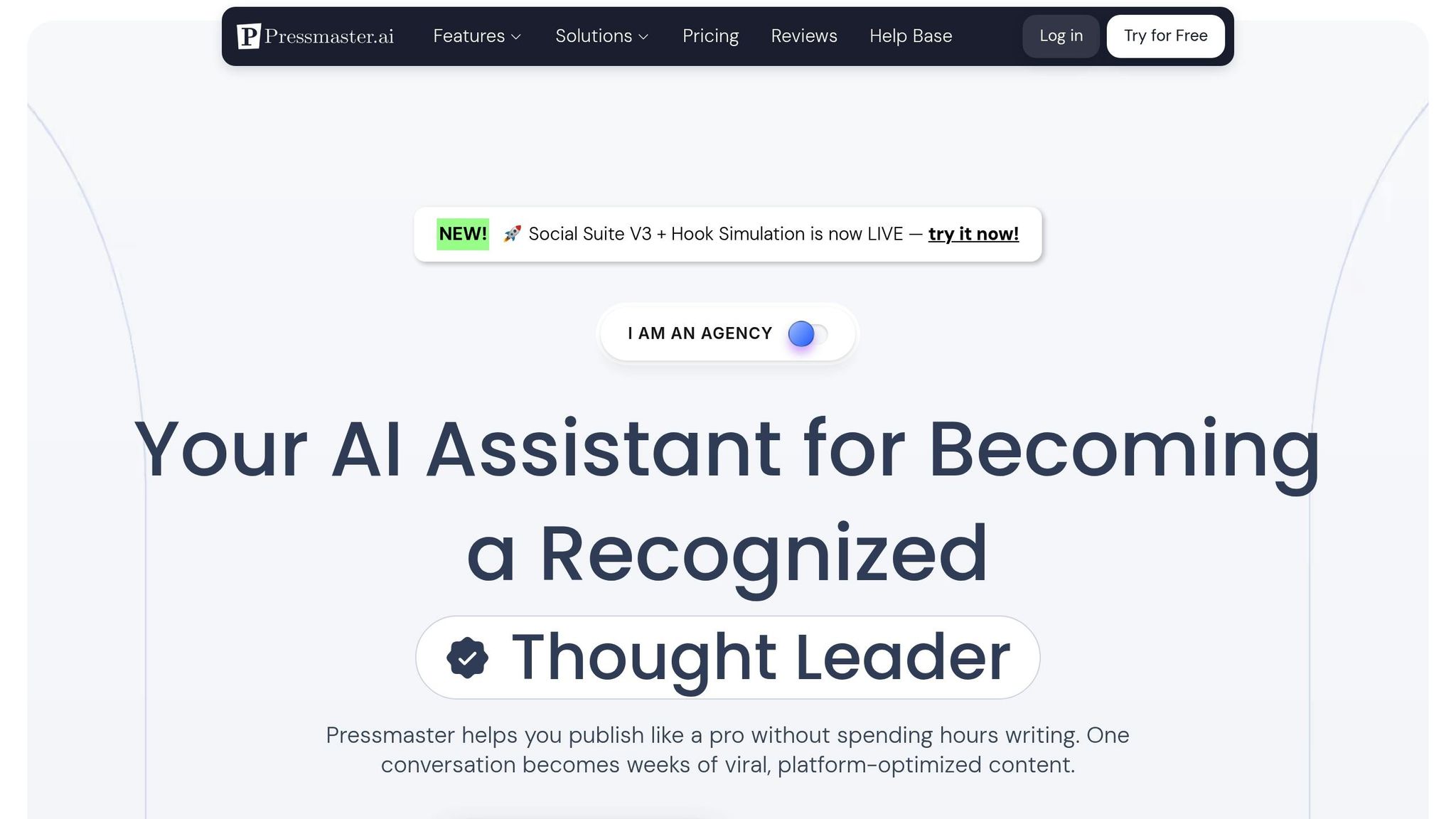
Imagine turning a mountain of tasks into a streamlined morning routine. That’s what Pressmaster.ai offers - a one-stop solution to simplify your content workflow while improving your search rankings. Its modular design lets you choose features that fit your needs, whether you’re a solo entrepreneur or juggling content for multiple clients. Let’s explore how Trendmaster helps you stay ahead of industry shifts.
Trendmaster: Spotting Industry Changes Early
Staying ahead of trends isn’t about luck - it’s about having the right insights at the right moment. Trendmaster analyzes industry data and audience behavior to uncover content opportunities that resonate with your readers. This means you can create content that aligns with peak search interest before your competitors even notice the trend.
Each alert comes with tailored suggestions, taking the guesswork out of crafting trend-based content. With its predictive analytics, Trendmaster helps you stay proactive by anticipating changes in search algorithms and user behavior, giving your SEO strategy a timely edge.
While Trendmaster keeps you ahead of trends, Pressmaster.ai’s AI tools ensure your content remains true to your brand’s voice.
AI Content Creation Tools
Balancing SEO with an authentic brand voice used to be tricky. Not anymore. Pressmaster.ai’s content creation tools analyze your brand guidelines, past content, and audience preferences to produce drafts that sound like you while meeting SEO requirements. Using advanced natural language processing, the system seamlessly incorporates relevant keywords, semantic phrases, and structured metadata. Plus, built-in plagiarism detection and originality scoring ensure your content aligns with Google’s standards for helpful, reader-focused material.
The platform replicates your brand voice through AI interviews and by analyzing your existing content. This allows you to scale content production without losing the tone that connects with your audience. From automatic keyword research to outline creation and metadata generation, the tools free up your time to focus on adding your unique perspective.
Here’s an example: A mid-sized e-commerce company used Pressmaster.ai to automate its content creation process. Within three months, they cut their manual writing time by 75% and saw a 30% boost in organic search traffic[4]. The platform’s ability to adapt content for various channels expanded their reach even further. And with integrated fact-checking and AI detection, every piece is verified for accuracy, originality, and brand consistency.
Social Suite and Newsroom Automation
Pressmaster.ai doesn’t stop at content creation - it also simplifies distribution. The Social Suite automatically generates platform-specific posts from your main content, scheduling and publishing them across all channels. By analyzing engagement patterns from over 50,000 viral posts, it optimizes each piece for platforms like LinkedIn, Twitter, Instagram, and email newsletters - maximizing engagement with minimal effort.
The system also determines the best posting times based on audience data in U.S. time zones, ensuring your content lands when your audience is most active. Meanwhile, Newsroom automation tools handle SEO for distributed content by refining headlines, optimizing metadata, and creating internal links that improve search engine rankings. These tools maintain a polished, professional look, adhering to U.S. spelling and style conventions.
For press releases and thought leadership articles, the Newsroom simplifies creation and distribution while maintaining the high standards that build brand authority. The result? Better search rankings and the credibility that Google values.
Measuring Results and Improving Your AI Content Strategy
Crafting smarter content is just the beginning. The real power lies in understanding what resonates with your audience and refining your strategy based on solid data. Without proper measurement, you miss out on opportunities to improve SEO and overall efficiency.
Tracking SEO and Engagement Metrics
Unified dashboards make it easier to turn scattered data into actionable insights. Modern AI tools bring together information from multiple platforms into a single, streamlined view[1][2]. This saves time and provides a complete picture of how your content is performing.
Focus on metrics like search rankings, organic traffic, conversion rates, time spent on the page, and bounce rates[1][3]. Additionally, tracking how often AI tools like ChatGPT and Perplexity reference your content can offer valuable insights into how these platforms influence content discovery[1][3].
For example, Pressmaster.ai’s dashboard consolidates performance data for real-time analysis. You can quickly identify which articles are driving the most organic traffic, which social media posts are generating engagement, and how press releases are performing across various outlets. The platform even tracks AI crawler behavior, giving you a glimpse into which content types and structures are favored. This helps you fine-tune your strategy for both traditional search engines and AI-generated responses.
These insights provide a foundation for making meaningful adjustments.
Using Data to Make Strategic Adjustments
Data is only valuable if it leads to action. The best AI content strategies rely on continuous iteration based on performance insights. For instance, if certain topics consistently perform well or engagement drops for specific post types, it’s a signal to tweak your approach[1][7].
Performance metrics can reveal which topics, keywords, and content formats resonate most with your audience[1][7]. Conversion data, in particular, can help you target more profitable audience segments.
The key is blending automated insights with human judgment. While AI can identify trends and suggest optimizations, human oversight ensures the content maintains quality and avoids issues like AI-generated inaccuracies or "hallucinations"[7].
Pressmaster.ai takes this a step further by using predictive analytics to anticipate shifts in search algorithms and user behavior. By analyzing your content’s performance alongside broader industry trends, the platform can recommend topics and angles that are likely to succeed - keeping your strategy ahead of the curve.
A/B testing is another critical component. Regularly comparing AI-generated content with manually created benchmarks helps identify what works best for your audience. This approach allows the data to guide your decisions, enabling marketers to make smarter, more targeted adjustments.
Manual vs. AI Workflows: Time and Results Comparison
Here's a clear breakdown of how manual and AI-assisted workflows compare:
| Workflow Type | Time to Produce Content | SEO Performance (Traffic/Rankings) | Efficiency/Scalability |
|---|---|---|---|
| Manual | 4–8 hours per article | Baseline | Limited by team size |
| AI-Assisted | 1–2 hours per article | +20–40% organic traffic | High, scalable |
| Fully Automated AI | <1 hour per article | Variable (requires oversight) | Maximum, but needs quality control |
Companies that adopt AI-driven SEO automation report cutting manual workloads by up to 50% for tasks like keyword research, content optimization, and reporting[1]. Many also see a 20–40% boost in organic traffic thanks to AI-optimized workflows.
AI tools can further enhance content by improving structure, optimizing anchor text placement, and refining internal linking based on user behavior patterns. These adjustments lead to higher engagement and better SEO performance[1].
Looking ahead, experts predict that as AI-powered answer engines grow, the focus will shift from driving traffic to improving conversion quality and showcasing expertise[7]. Brands that build strong measurement frameworks - tracking both traditional metrics and AI-specific signals - will be well-positioned to succeed in this evolving landscape.
Conclusion: Growing SEO and Efficiency with AI
AI-powered content strategies are proving to be game-changers for both improving search visibility and streamlining workflows. According to recent studies, 83% of marketers have reported increased productivity, while 84% say they can produce high-quality content faster - saving over five hours each week[11][1].
This shift to AI-assisted workflows isn’t just about working faster; it’s about gaining a strategic edge. Search engines increasingly reward websites that consistently publish high-quality content demonstrating expertise and authority. By integrating AI into content creation processes, businesses can achieve the scalability needed to meet these demands without compromising quality.
The rise of Semantic SEO and predictive analytics is reshaping how content strategies are developed. Modern AI tools now analyze topical relevance, entity relationships, and contextual depth, moving beyond the outdated focus on exact keyword matches[12]. This evolution allows content creators to anticipate algorithm changes and adapt to shifts in user behavior, giving them a clear advantage over competitors who stick to older methods.
AI tools today are also capable of producing content at scale while maintaining a consistent tone and style. Unlike earlier AI systems, which often produced generic or robotic-sounding text, newer platforms can learn and replicate your brand’s unique voice. This ensures that even large-scale content production remains aligned with your messaging.
Take Pressmaster.ai, for example. This platform offers a suite of AI-powered tools designed to support sustainable growth in PR and content marketing. Its Trendmaster feature analyzes over 500,000 sources daily to identify trends weeks before they gain traction. Meanwhile, its AI-driven content creation tools produce voice-matched articles that perform well in search rankings. The Social Suite optimizes content for each platform’s algorithm, and automated newsroom tools ensure consistent publishing across channels.
For businesses looking to embrace this transformation, start by identifying your most time-intensive tasks - like keyword research, content ideation, or distribution. Then, leverage AI tools to handle these repetitive processes while keeping your team focused on refining strategies that boost search rankings and audience engagement. Companies that adopt AI now will position themselves for long-term success as search engines continue to evolve and the demand for high-quality content grows.
FAQs
How can AI tools help improve my keyword research and content planning?
AI tools have the power to revolutionize how you approach keyword research and content planning. By taking over time-consuming tasks and offering insights backed by data, these tools help you work smarter, not harder. They sift through massive amounts of search data to pinpoint keywords with potential, highlight trending topics, and propose content ideas that resonate with your audience.
On top of that, AI can forecast which keywords are most likely to boost your traffic, letting you focus on the ones that matter most. It also simplifies content planning by creating outlines, suggesting formats, and fine-tuning for on-page SEO. The result? You save hours each week while crafting content that matches both search intent and your audience’s expectations.
How can I use AI tools in my content strategy while keeping my brand's unique voice intact?
To keep your brand's voice distinct while using AI tools, opt for platforms that can align with your tone and messaging style. Prioritize solutions that let you customize and train the AI based on your existing content. This way, the generated content stays true to your identity and connects with your audience.
It's also important to carefully review and tweak AI-generated content to ensure it reflects your brand's values and messaging. By blending the speed and efficiency of AI with your personal input, you can save time without compromising on authenticity.
How can AI help spot and take advantage of trends before they go mainstream?
AI tools have the ability to sift through massive amounts of data from industries, social platforms, and search trends, uncovering patterns and emerging topics. By identifying what’s likely to connect with your audience, these tools help you craft content that’s timely and engaging - getting ahead of trends before they hit their peak.
This forward-thinking strategy doesn’t just improve your SEO by targeting trending keywords; it also establishes your brand as a leader in your field, all while cutting down the time and effort spent on manual trend analysis.
Related Blog Posts








Sign Up for our Pressmaster Newsletter
Sign up for our Pressmaster.ai newsletter to get instant alerts on trending topics, ensuring you stay ahead in your field with the latest insights and updates.


.avif)
.png)

.avif)


7 Viral Patterns That Drove 10,643% Growth
Turn natural conversations into content gold, make every insight count, and drive real conversations.

Please fill out the form to get our Viral Cheat Sheet


How to Become a Thought Leader in 6 Easy Steps
Increase your visibility, establish authority, and conquer your market with minimal effort.

Please fill out the form to get our PDF Checklist
