
The Evolution of AI in Marketing: What Every Brand Needs to Know
AI is transforming marketing. It's not just automating tasks - it’s helping brands connect with audiences in smarter ways. From creating personalized content to predicting customer behavior, AI has become essential for staying competitive. Here’s what you need to know:
AI isn’t replacing human creativity - it’s making marketing smarter, faster, and more precise. The question isn’t whether to use AI, but how effectively you can integrate it into your strategy.
The Evolution of AI in Marketing: Key Milestones
The shift from manual marketing methods to AI-powered strategies has transformed the marketing landscape, driven by both technological progress and growing consumer demands. By tracing this evolution, brands can better understand current capabilities and anticipate future developments. Below are key milestones that highlight how marketing has advanced from basic automation to sophisticated, real-time AI solutions.
From Manual Marketing to Automation
Back in the 1990s and early 2000s, marketing was a labor-intensive process. Teams relied on spreadsheets for tracking customer data and analyzed campaign results only after they were completed. The mid-2000s introduced marketing automation platforms, which brought tools like automated email workflows and lead scoring. While these platforms still required significant manual setup, they represented a step toward more efficient processes.
Early customer relationship management (CRM) systems laid the groundwork for automation by tracking interactions and triggering basic responses. However, these systems were reactive, handling tasks only as programmed, without predictive capabilities.
A major leap came with the rise of machine learning. Unlike rigid, rule-based systems, machine learning algorithms could analyze data patterns and make decisions in real time. This ushered in a new era of intelligent marketing automation, where tools could adapt and improve without constant human input.
Major Advances in AI Technology
The early 2010s saw significant progress in natural language processing (NLP), enabling computers to understand human language. This allowed marketers to analyze customer feedback, monitor social media conversations, and even generate content that resonated with audiences.
Deep learning expanded AI's ability to process unstructured data, such as text, images, and videos, uncovering valuable insights. Marketers could now analyze customer sentiment across multiple channels and detect patterns that might have otherwise been missed.
The launch of generative AI models like GPT-3 in 2020 marked another turning point. These models made it possible to create human-like text, revolutionizing content creation.
Advancements in computer vision allowed AI to analyze visual content, making brand monitoring on social media more effective. Moreover, real-time data processing - fueled by cloud computing - enabled campaigns to respond quickly to shifts in customer behavior.
These technological breakthroughs have laid the foundation for today’s highly personalized and efficient marketing strategies.
AI Adoption in U.S. Marketing
In the United States, businesses quickly embraced AI-driven marketing tools. E-commerce giants like Amazon led the way, using recommendation engines to deliver personalized shopping experiences, which boosted customer engagement and revenue.
The financial services sector also adopted AI early, applying it to customer segmentation and fraud detection. Meanwhile, the software-as-a-service (SaaS) industry integrated AI-powered tools, making advanced marketing automation accessible to businesses of all sizes. Major consumer brands followed, leveraging AI to optimize advertising budgets and target specific audience segments with precision.
The COVID-19 pandemic accelerated this trend. As traditional marketing channels were disrupted, companies with agile AI tools were better equipped to adapt to rapid changes in consumer behavior and maintain strong engagement.
Today, AI is no longer just a competitive edge - it’s a key part of modern marketing strategies. Many U.S. marketing leaders now rely on AI to drive their operations, reflecting the technology’s evolution into an essential tool. These milestones illustrate how AI has transformed marketing and set the stage for its growing role in public relations and automation.
Core Applications of AI in Marketing and PR Automation
AI has transitioned from being a futuristic concept to a practical tool delivering real results. Today, it tackles real-world business challenges like producing consistent content at scale and predicting the success of marketing campaigns. By understanding its applications, brands can pinpoint where AI can amplify their marketing efforts.
Personalized Content Creation
AI has revolutionized content creation, making it faster and more consistent. From press releases to social media updates, AI tools can craft tailored content that aligns with a brand’s voice while adapting to various platforms and audiences. This eliminates the need to start from scratch each time, saving time without compromising quality.
Modern AI tools analyze a brand's existing materials to grasp its tone, style, and messaging. This ensures that every piece of content feels authentic and on-brand. One of the biggest hurdles in scaling content production - keeping consistency across different writers and platforms - is now much easier to overcome.
AI excels at producing routine content like product launches, event announcements, and industry updates. It can generate multiple versions of the same message, such as formal press releases, conversational social media posts, or in-depth blog articles, each optimized for its specific channel.
The ability to replicate brand voice has grown significantly. AI systems can identify communication patterns through existing materials or even direct input from team members, ensuring that the brand's personality shines through.
AI also offers a distinct edge for time-sensitive content. When trends emerge or breaking news hits, brands can quickly craft relevant content to position themselves as thought leaders. In today’s fast-paced media environment, being among the first to comment on key issues can significantly boost engagement.
Predictive Analytics and Market Insights
AI's capacity to process massive datasets has transformed how brands understand their audiences and anticipate future trends. Predictive analytics powered by AI helps brands make informed decisions with greater confidence.
One standout application is trend identification. AI systems can scan thousands of data sources daily, spotting emerging topics and conversations before they gain widespread traction. This allows brands to create content around trends while they’re still gaining momentum, rather than jumping in after the buzz has faded.
AI also shines in customer behavior prediction. By analyzing past interactions, purchase histories, and engagement patterns, it can forecast what content will resonate with specific audience segments. This insight helps marketing teams focus their efforts on campaigns with a higher likelihood of success.
Another powerful feature is content performance forecasting. AI can predict how well a piece of content will perform by analyzing factors like topic relevance, posting time, audience behavior, and competitor activity. This allows teams to prioritize impactful content and make adjustments on the fly.
Additionally, market sentiment analysis provides a deeper understanding of public opinion. AI can monitor social media, news, and online discussions to gauge how audiences feel about brands, competitors, and industry topics. This enables brands to respond quickly to issues or capitalize on opportunities for engagement.
These insights enable marketing teams to plan and execute campaigns with precision and agility.
Automated Distribution and Campaign Management
Managing content across multiple channels has become increasingly complex, making automation a necessity. AI-powered systems streamline the process, handling technical tasks while optimizing content for each platform’s requirements.
Smart scheduling is one such feature, using AI to determine the best times to post on various platforms based on audience engagement data. This ensures content reaches the right people at the right time.
Platform optimization takes automation further by adapting content for different channels. A single piece can be transformed into a LinkedIn article, a Twitter thread, an Instagram post, or a Facebook update, each tailored to the platform’s unique audience and format. This eliminates the need for manual reformatting while ensuring high performance across channels.
With performance tracking, AI consolidates analytics from multiple platforms into a single dashboard. This makes it easy for marketing teams to identify successful strategies and refine their approach without juggling data from various sources.
AI also facilitates campaign orchestration, coordinating complex, multi-touch campaigns across email, social media, press, and content marketing. It can trigger follow-up actions based on audience behavior, tweak messaging based on engagement levels, and adjust campaign timing to maximize impact.
Even press distribution benefits from AI. It can identify the most relevant journalists and media outlets for a story, personalize outreach messages, and track coverage results. This targeted approach improves efficiency and response rates.
How Pressmaster.ai Changes PR Automation
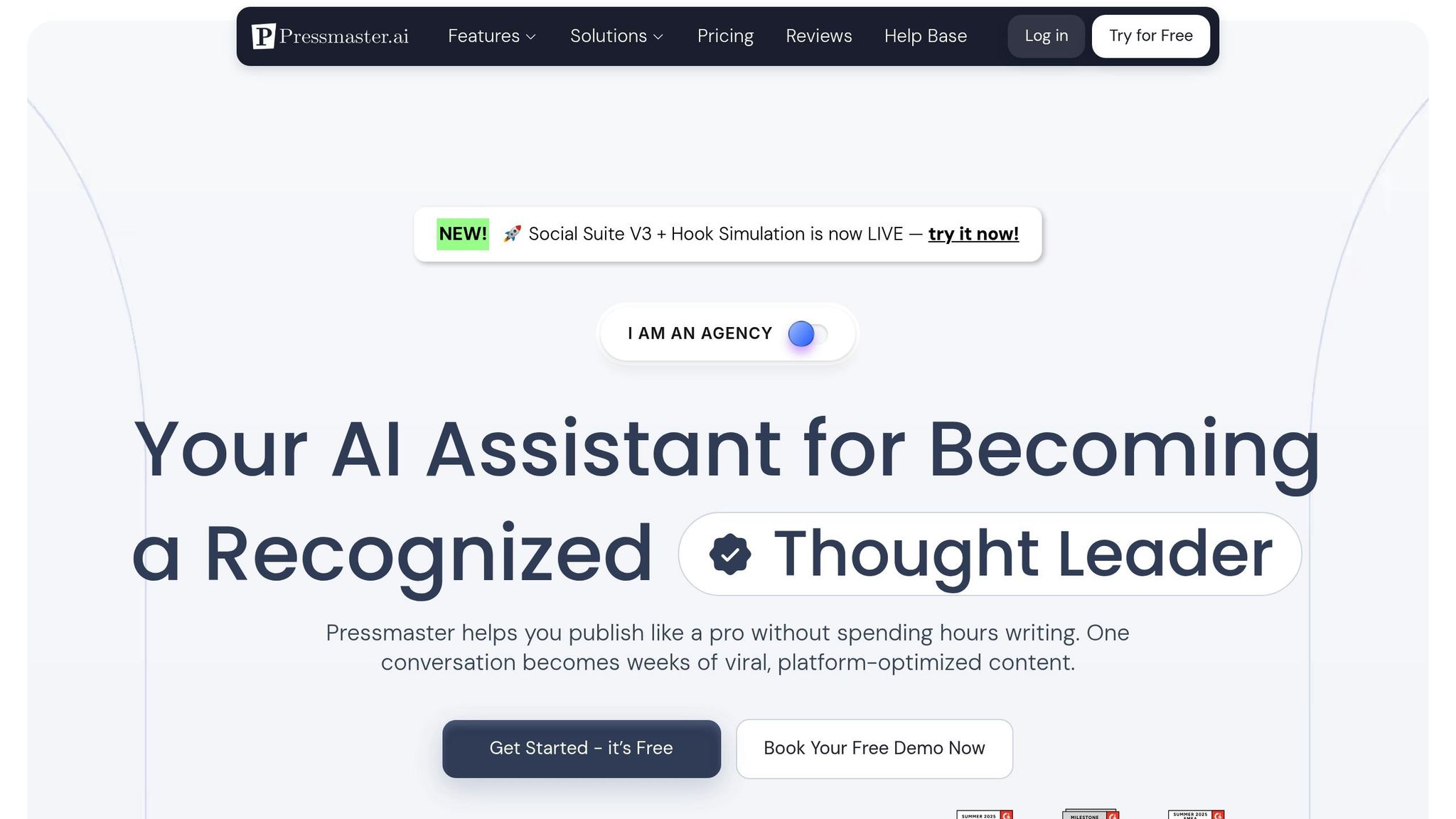
Pressmaster.ai offers practical AI-driven tools that U.S. businesses can put to use right away, turning theoretical possibilities into tangible results. The platform tackles key challenges marketing teams face daily: producing consistent content, staying relevant in a fast-paced market, and managing distribution across various channels. Here's how Pressmaster.ai streamlines PR automation, taking it from idea to execution.
AI-Powered Content Creation and Distribution
Pressmaster.ai reimagines the content creation process by transforming simple conversations into fully developed marketing campaigns. By analyzing your communication style and writing samples, the platform ensures your content retains its unique tone and professional polish.
With this tool, users can turn raw ideas into finished content in just 5–10 minutes [1]. This efficiency allows teams to spend more time on strategy and building relationships, rather than getting bogged down by the mechanics of writing.
The Social Suite feature takes automation a step further. After creating an article, the system generates over 15 platform-specific social posts, each tailored for maximum engagement. Drawing insights from more than 50,000 viral posts, it optimizes content for platforms like LinkedIn, Twitter, Instagram, and Facebook - eliminating the need for manual reformatting.
Pressmaster.ai also simplifies press distribution. For $299, the platform guarantees placements in more than 3,000 media outlets, with users typically seeing over 400 syndications [2]. Achieving this level of media coverage would traditionally require a hefty PR budget and extensive networking.
To make things even easier, the platform integrates seamlessly with WordPress, Wix, Medium, Webflow, and social media channels. A single dashboard lets marketing teams manage their content without juggling multiple tabs or manually transferring content between systems.
Trend Analysis and Insights
Pressmaster.ai doesn’t stop at content creation - it also helps users stay ahead of the curve with its trend analysis capabilities. The Trendmaster feature scans over 500,000 data sources daily, identifying emerging topics weeks before they hit the mainstream. This gives businesses a head start in crafting timely, relevant content strategies.
But Trendmaster does more than flag trends; it provides actionable insights. Instead of broad trend alerts, users receive tailored recommendations on how to approach these topics in ways that resonate with their audience. This guidance eliminates the need for extensive research, enabling marketing teams to focus on creating content that drives engagement and builds connections.
Practical Tips for Implementing AI in Marketing
Integrating AI into your marketing strategy isn’t just about signing up for the latest platform. For U.S. businesses, success hinges on careful preparation - ensuring your data is ready, your team understands the tools, and your practices align with regulations. Here's how to set yourself up for success.
Preparing Your Data and Team
AI thrives on clean, well-organized data. Before diving in, take the time to audit your customer data, analytics, and content metrics. This means eliminating duplicates, standardizing formats, and ensuring all data sources are properly connected. The more accurate and comprehensive your data, the better AI tools can perform.
Your team also needs to be ready. Host training sessions to show how AI can streamline tasks like content formatting and social media scheduling, freeing up time for high-level strategy and building customer relationships.
Set clear workflows before deploying AI tools. Decide who will review AI-generated content, how brand guidelines will be upheld, and which team members will handle specific parts of the AI process. This ensures a smooth rollout and consistent results.
To avoid overwhelming your team, start small. Many successful businesses begin with straightforward applications like content creation or automating social media posts. Once those processes are running smoothly, you can explore more advanced uses, such as predictive analytics. With your data and team ready, the next step is to protect your brand's voice.
Maintaining Brand Voice and Authenticity
AI-generated content has a reputation for sounding generic if left unchecked. To avoid this, provide your AI tools with high-quality examples of your brand's tone and style. Share past blog posts, email campaigns, or social media content that resonated with your audience.
During the first few months, review and refine AI outputs regularly. Look for any language or tone that doesn’t align with your brand personality and offer feedback. Most AI platforms improve over time as they learn from your corrections.
Human oversight is key for customer-facing content. While AI can draft press releases or social media posts in record time, having a team member review each piece ensures it meets quality standards and aligns with current trends or market conditions.
Before rolling out AI-generated content on a large scale, test it with smaller audience segments. Track engagement, comments, and feedback to gauge how your audience responds. This trial phase helps identify any necessary adjustments before fully committing to AI-driven content.
Once your brand voice is secure, it’s time to focus on compliance with regulations.
Compliance with U.S. Regulations
Data privacy is a cornerstone of AI marketing. Make sure your tools comply with state laws like California’s Consumer Privacy Act (CCPA) and Virginia’s Consumer Data Protection Act (VCDPA). Update your privacy policies to clarify how customer data is used in your AI processes.
Transparency is becoming increasingly important. The Federal Trade Commission (FTC) expects businesses to disclose when AI significantly influences customer interactions or purchasing decisions. Consider adding a clear statement about AI usage in your marketing materials or website footer.
When using AI for email campaigns, ensure compliance with the CAN-SPAM Act. This means maintaining proper opt-in records and honoring unsubscribe requests automatically, regardless of whether emails are created by humans or AI.
AI-generated advertising must also meet truth-in-advertising standards. The FTC requires all claims to be accurate and substantiated. Review AI-created ads and promotional content carefully to ensure they meet these requirements before publication.
Finally, document your AI processes thoroughly. Keep records of how your tools make decisions on content creation, audience targeting, and campaign optimization. This documentation not only demonstrates your commitment to ethical AI use but also prepares you for any potential regulatory inquiries.
Conclusion: Using AI for Marketing Success
The marketing world in the U.S. has undergone a profound transformation, with AI now playing a key role in helping brands stay ahead of the competition. By using tools that deliver personalized content and predictive insights, businesses are finding new ways to connect with their audiences.
The trends we've discussed highlight a clear pattern: companies adopting AI-driven solutions are seeing tangible benefits. From automating repetitive tasks to ensuring consistent and targeted messaging, AI is proving to be a game-changer. However, achieving success with AI requires more than just technology - it demands thoughtful preparation and a strategic approach.
To make AI work for your business, focus on a few essentials: organize your data, train your team, and stay compliant with U.S. regulations. Above all, keep your brand's voice genuine. AI should enhance your messaging, not dilute its quality.
For those just starting out, taking small steps is key. Test AI tools thoroughly, refine your approach, and scale up gradually. Many successful businesses are proving that AI doesn’t replace human creativity - it amplifies it. They’ve built workflows where automation handles the heavy lifting, while human oversight ensures everything stays on track.
Looking ahead, the divide between businesses using AI and those sticking to traditional methods will only grow. The technology is advancing rapidly, delivering better results and offering competitive advantages that are hard to ignore. For U.S. brands aiming to secure market share and foster strong customer relationships, the real question isn’t whether to use AI - it’s how quickly and effectively you can put it to work.
As we approach 2025, the key to marketing success lies in aligning AI with your specific goals and audience. The tools are ready, the strategies are clear - it’s time to take action.
FAQs
How can small businesses start using AI in their marketing without spending a lot of money?
Small businesses can tap into AI for marketing by using budget-friendly and user-friendly tools that simplify tasks like content creation, managing social media, and running email campaigns. Many AI platforms provide free or low-cost options, making them a viable choice even for businesses with limited resources.
By automating time-consuming tasks - like scheduling posts, analyzing customer data, or tailoring email campaigns - businesses can free up valuable time to concentrate on bigger-picture strategies. These tools not only boost efficiency but also improve customer interaction, offering a more tailored experience without the need for a hefty financial commitment.
Starting with smaller implementations and gradually expanding as results show promise is a smart way to adopt AI while keeping expenses under control.
What challenges might brands face when using AI in marketing, and how can they address them?
Using AI in marketing opens up exciting opportunities, but it does come with its share of challenges. Some common risks include relying too heavily on automation, which can lead to messaging that feels generic or disconnected. There are also concerns about data privacy, security vulnerabilities, and ethical issues, like biases embedded in AI algorithms.
To tackle these challenges, brands should ensure human oversight plays a key role in keeping messaging consistent with their values and tone. Establishing strong data governance policies can protect customer information, while routine audits of AI outputs can help identify and reduce bias, promoting fairness. By blending the efficiency of AI with careful human input, brands can take advantage of AI's potential while keeping risks in check.
How does AI help ensure marketing practices comply with data privacy laws like CCPA and VCDPA?
AI plays a key role in helping businesses stay compliant with data privacy laws like the California Consumer Privacy Act (CCPA) and the Virginia Consumer Data Protection Act (VCDPA). It does this by utilizing advanced tools and processes specifically designed to protect consumer data. Some examples include automated decision-making technologies (ADMT) that streamline compliance efforts and regular cybersecurity audits to identify vulnerabilities and address them proactively.
By focusing on transparency, accountability, and data protection, AI systems ensure that marketing strategies not only adhere to legal standards but also respect consumer rights and safeguard sensitive information. This approach helps businesses maintain trust while meeting regulatory obligations.
Related Blog Posts







Sign Up for our Pressmaster Newsletter
Sign up for our Pressmaster.ai newsletter to get instant alerts on trending topics, ensuring you stay ahead in your field with the latest insights and updates.


.avif)
.png)

.avif)


7 Viral Patterns That Drove 10,643% Growth
Turn natural conversations into content gold, make every insight count, and drive real conversations.

Please fill out the form to get our Viral Cheat Sheet


How to Become a Thought Leader in 6 Easy Steps
Increase your visibility, establish authority, and conquer your market with minimal effort.

Please fill out the form to get our PDF Checklist
