
Understanding Hook Simulation in Pressmaster: A Deep Dive
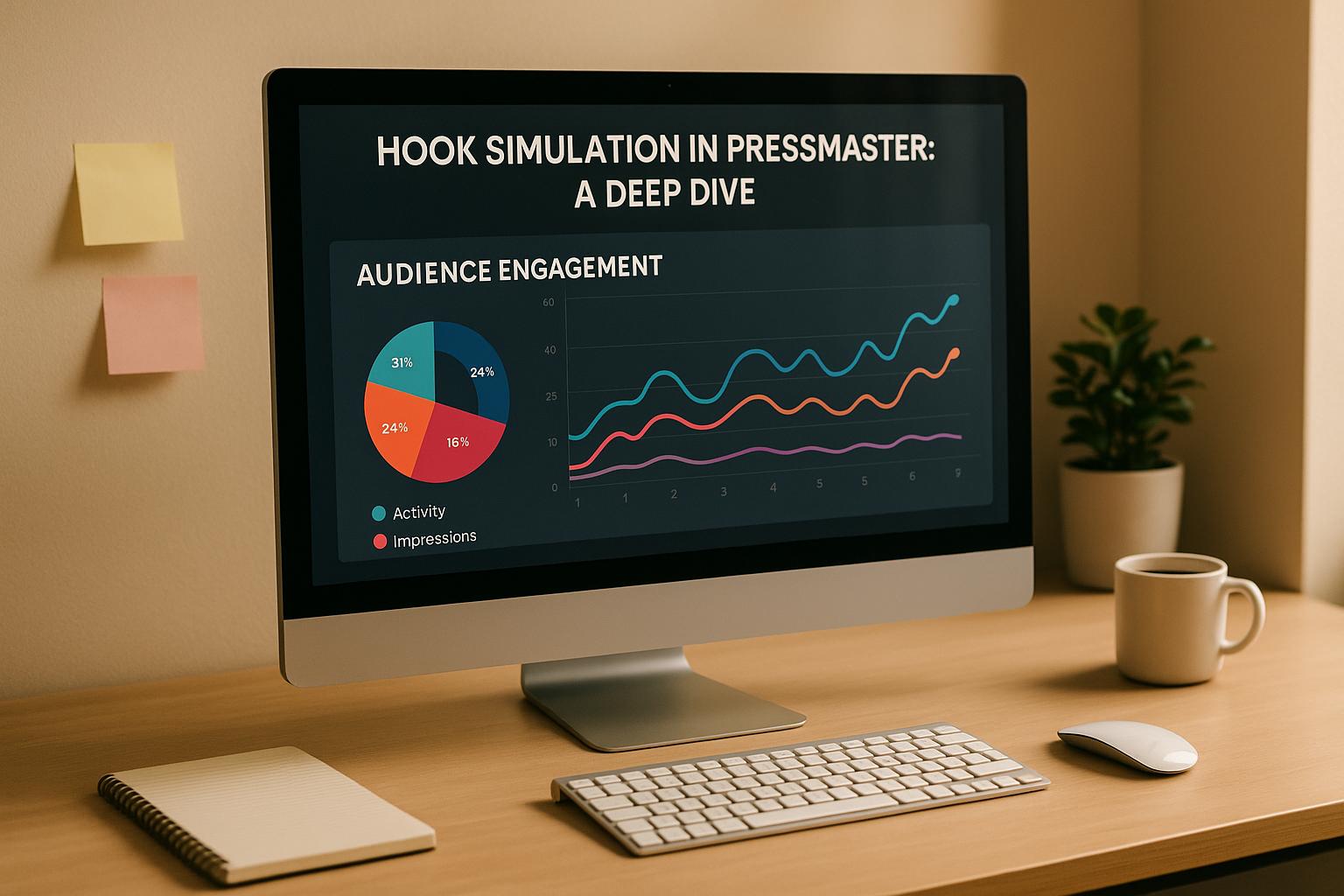
Hook simulation in Pressmaster is an AI-powered tool that helps PR professionals test and refine their messaging before launching campaigns. It predicts audience reactions to content hooks - those attention-grabbing opening lines - by analyzing emotional triggers, clarity, and relevance. This ensures your message resonates with your target audience and maximizes engagement.
Key Takeaways:
- What It Does: Tests and scores hooks to predict how well they'll perform.
- Why It Matters: Grabs attention quickly, crucial in today’s fast-paced media landscape.
- How It Works: Uses AI to analyze audience behavior, emotional triggers, and platform trends.
- Benefits: Saves time, improves campaign effectiveness, and provides data-driven insights.
- Features: Generates multiple hook variations, scores them, and integrates seamlessly with tools like Social Suite and Trendmaster.
By leveraging hook simulation, you can optimize your PR campaigns, ensuring they connect with audiences and drive results.
How Hook Simulation Works in Pressmaster

Pressmaster’s hook simulation engine uses AI to predict audience reactions and optimize content before it goes live. By analyzing key factors like emotional triggers and scrolling behavior, the system helps you fine-tune your content for maximum impact.
Creating and Testing Hooks
The Hook Engineering & Performance Simulation feature in Pressmaster allows you to craft hooks with precision by simulating audience responses [3]. When you input your initial idea or topic, the tool generates multiple hook variations, each tailored to grab attention effectively.
The Hook and Angle feature takes audience preferences and campaign goals into account to create hooks that resonate [4]. For instance, research indicates that LinkedIn posts with sentences under 12 words perform 20% better. Pressmaster uses this insight to shape its hook suggestions [2].
Each hook is then scored based on predicted effectiveness [4]. Factors like emotional appeal, clarity, and relevance are evaluated to help you identify the most impactful option for your campaign [1]. A strong opening line can increase reader retention by up to 30%, and Pressmaster pinpoints the elements that contribute to this success [2].
To develop hooks effectively with Pressmaster, you’ll follow a few key steps: define clear audience and campaign objectives, generate multiple hook options, refine the AI-generated suggestions to match your tone, test different approaches systematically, and analyze performance data to guide future strategies [2].
These simulation scores also contribute to predictions about how your overall campaign will perform.
Predicting Campaign Results
Pressmaster’s prediction engine uses advanced data analysis to forecast engagement and campaign outcomes, empowering you to make informed decisions. By monitoring real-time data from over 500,000 sources, it identifies market trends and audience behavior patterns. The tool even detects emerging topics 3–4 weeks before they become mainstream, helping you align your campaigns with what’s next.
Here’s an example of this in action: In July 2025, Coldwell Banker Premier used Pressmaster to transform industry data into thought leadership. By tracking sentiment across those 500,000 sources, they quickly adapted to local market shifts and anticipated potential PR challenges, staying ahead in a competitive market [Source: Pressmaster.ai, 2025].
Pressmaster’s simulation results are continually refined [2]. The system compares predicted outcomes with actual performance, improving its accuracy over time. The more you use it, the better it gets at understanding your audience and what works in your specific industry.
Using Hook Simulation in PR Campaigns
Hook simulation leverages data-driven insights to test and refine your messaging strategy before launch. By offering predictive analysis, it reshapes how PR professionals create and execute campaign messaging.
Crafting Stronger Messages
Pressmaster's hook simulation uses AI to pinpoint which message elements will strike a chord with your audience. This helps you design hooks that immediately connect with your target demographic.
"People will forget what you said, people will forget what you did, but people will never forget how you made them feel." - Maya Angelou [6]
The tool evaluates various components - like statistical highlights, storytelling, thought-provoking questions, and time-sensitive appeals - to ensure each element maximizes its impact. For instance, narrative elements are fine-tuned to evoke emotional responses, while statistical data is carefully calibrated to inform without overwhelming [5] [7]. All insights are drawn from reliable studies, ensuring your messaging is both impactful and credible [5].
These optimized messages set the stage for deeper and more measurable audience engagement.
Boosting Audience Engagement
Hook simulation sharpens your strategy by identifying key psychological triggers that capture and maintain attention [8]. It helps you refine your Unique Selling Proposition (USP), presenting it in a way that grabs attention instantly, without requiring lengthy explanations [8].
Through systematic A/B testing, the tool fine-tunes hooks to maximize engagement, generating insights that guide future campaigns [8]. It also assesses how your hooks perform across various platforms, ensuring consistency in messaging that resonates with your audience [8].
By testing different tones and approaches, hook simulation fosters genuine connections, encouraging customer loyalty and repeat interactions.
Smarter Campaign Planning and Analysis
Hook simulation supports both the planning and evaluation stages of your campaigns. During the planning phase, it provides predictive insights, helping you identify the most promising message angles before committing significant resources.
The tool also optimizes the timing and integration of your hooks, ensuring key insights are revealed at the perfect moment to maximize impact [7]. It evaluates whether your hooks effectively bridge the gap between grabbing attention and driving meaningful engagement, focusing on delivering tangible results rather than just awareness [7].
Post-campaign, comparing actual outcomes to simulation predictions offers valuable lessons for future efforts, helping refine strategies and improve results over time.
Benefits of Hook Simulation
Let's take a closer look at how hook simulation can directly boost campaign results. By analyzing patterns from thousands of viral posts, this tool helps organizations craft messages that truly connect with their audience. The result? Content that's optimized for specific platforms and built on frameworks that deliver measurable business outcomes [9]. These benefits translate into stronger audience engagement and better overall performance.
Higher Audience Engagement
When hook simulation strategies are applied, key metrics often show a noticeable uptick. For example, fine-tuning sentence structures and optimizing hooks can significantly enhance engagement. Research shows that capturing high engagement within the first 60 minutes of publishing can amplify content reach by as much as 15% [2]. Additionally, the tool's ability to adapt to a brand's unique tone and style ensures content remains consistent and relatable across all channels [9]. Beyond the numbers, real-world experiences further validate these results.
Customer Success Stories
Real-world feedback underscores the effectiveness of hook simulation in transforming PR campaigns:
"Pressmaster isn't just a writing tool, it's a thinking partner. It interviews you like a real journalist, captures your unique voice and ideas, and then executes content creation based on best practices."
- Pressmaster.ai [9]
"Our customers describe it as having a tool that helps them translate their ideas and expertise into impactful content and distributes it everywhere, without any of the hassle. The emotional intelligence provided by Hume's EVI has been crucial in making users feel heard and understood, leading to more authentic and impactful content."
- Raoul Plickat, CEO of Pressmaster.AI [10]
These testimonials highlight how hook simulation not only boosts engagement but also helps brands maintain an authentic voice that resonates with their audience. The combination of strategic insights and emotional intelligence makes it a powerful tool for creating meaningful connections.
Adding Hook Simulation to Your Pressmaster Workflow
Integrating hook simulation into your daily PR workflow can take your content strategy to the next level. This feature works smoothly within Pressmaster's ecosystem, connecting content creation, distribution, and analytics into one streamlined process. The result? You save time and see better results.
Content Creation and Distribution
Hook simulation becomes part of your workflow right from the start. As you draft an article or press release, the simulation engine analyzes your text and suggests hooks based on daily data sources [11].
With the Social Suite, these hooks are transformed into platform-specific content. Once you select the top-performing hook from the simulation results, the system generates over 15 variations tailored for different social media platforms. These variations are crafted using engagement patterns drawn from more than 50,000 viral posts [11].
The Trendmaster tool takes this a step further by identifying emerging topics weeks before they gain widespread attention. Pairing hook simulation with Trendmaster allows you to craft not only engaging messages but also time them perfectly to align with trending topics [11]. The simulation engine can even test hooks against these trends, predicting which ones will resonate most as the topic gains traction.
Team collaboration features ensure that everyone involved can review and approve simulated hooks before they’re published. This is a game-changer for agencies managing multiple clients, as it helps maintain a consistent brand voice across different accounts [3]. The platform also learns from your brand's unique style and past content to improve its suggestions over time.
With content creation and distribution seamlessly integrated, it’s worth comparing this efficient process to traditional manual methods.
Hook Simulation vs. Manual Methods
Here’s how AI-driven hook simulation stacks up against traditional manual approaches:
| Feature | Hook Simulation (AI) | Manual Methods |
|---|---|---|
| Time Investment | 5–10 minutes per campaign | Several hours |
| Data Foundation | 500,000+ daily sources | Limited, anecdotal |
| Performance Prediction | Simulated audience testing with scoring | Guesswork, intuition |
| Consistency | High across all campaigns | Variable, team-dependent |
| Emotional Analysis | Automated trigger identification | Manual, less precise |
| Trend Integration | Real-time updates | Manual research required |
| Collaboration | Built-in review and approval | Fragmented across tools |
| Feedback System | Visual, quantitative scoring | Subjective, qualitative |
Traditional methods often rely on brainstorming sessions, intuition, and subjective feedback. These processes can take hours per campaign and lack the precision of data-driven approaches.
With hook simulation, audience reactions are modeled by analyzing emotional tone and engagement predictions. Each hook is scored quantitatively, taking the guesswork out of the process [12] [13] [3]. This means you can confidently select hooks that are statistically more likely to succeed.
Efficiency skyrockets with simulation. Instead of creating multiple versions and waiting for real-world feedback, you can test dozens of hook variations in minutes. The top-scoring hooks are ready to go before your content even goes live.
Post-publication tracking adds another layer of improvement. The analytics dashboard shows how simulated hooks actually performed, creating a feedback loop that sharpens the simulation engine’s accuracy for your audience and industry. Regularly reviewing these results helps refine your messaging strategy and boosts future performance [12] [13].
For larger teams or agencies, the collaborative features are a major advantage. Multiple users can access simulation results, compare strategies, and make data-driven decisions. This eliminates the back-and-forth debates that often slow down creative processes, ensuring decisions are backed by predictive analytics rather than personal opinions.
Conclusion
Hook simulation takes the guesswork out of PR messaging, replacing it with a precise, data-driven approach. By analyzing over 500,000 sources daily, this AI-powered tool provides actionable, data-backed hook options. Building on earlier sections, it’s clear how this technology enhances every step of your PR workflow.
Instead of relying on manual brainstorming or trial-and-error testing, hook simulation generates and scores variations based on predicted audience reactions. This means PR teams can make decisions rooted in quantitative insights that reflect real-world responses. The result? Streamlined processes and more effective campaigns.
Hook simulation also integrates seamlessly with tools like Social Suite and Trendmaster, aligning hook testing with current trends and distribution strategies. This ensures that your hooks are both timely and tailored to specific platforms, covering everything from initial testing to final content rollout.
Its collaborative features address a common pain point in PR workflows: subjective debates over messaging. By offering objective scoring systems, teams can make faster decisions and feel more confident about campaign launches.
Key Points
The advantages of hook simulation are immediate and measurable. It cuts down planning time, enhances campaign consistency, and provides quantitative results that back up your decisions.
What sets Pressmaster's solution apart is its ability to combine multiple data streams with continuous learning. By factoring in trending topics and platform-specific engagement patterns, it ensures your messages are not only well-crafted but also well-timed and targeted.
For organizations looking to scale their PR efforts without compromising quality, hook simulation offers a clear solution. It handles the heavy lifting of data analysis while preserving your brand’s voice, allowing teams to focus on strategic creativity instead of repetitive testing.
This shift from manual methods to AI-powered tools isn’t just about saving time - it’s about unlocking new creative possibilities. With less effort spent on testing and more on planning, PR campaigns can achieve a whole new level of impact.
FAQs
How does Pressmaster's hook simulation predict how audiences will respond to content hooks?
Pressmaster's hook simulation leverages advanced analytics to analyze how different audience groups respond to various content hooks. By pinpointing the hooks that connect best, it allows you to tailor messages to match your audience's preferences and interests.
This tool offers practical insights by showcasing the most effective hooks, helping you refine engagement strategies and boost the success of your PR campaigns.
What factors does Pressmaster use to evaluate the effectiveness of a hook?
Pressmaster measures how effective a hook is by looking at several important factors: audience engagement, emotional impact, clarity, and how well it aligns with your brand's message. To do this, it uses more than 45 performance indicators to generate a detailed score.
This scoring system is designed to predict how well a hook will resonate with your audience and help you reach your campaign goals. It ensures your PR strategies make a strong impression and stay focused on your objectives.
How does using hook simulation improve the success of PR campaigns?
Integrating hook simulation into your PR workflow can change the way you craft campaigns by helping you design messages that genuinely resonate with your audience. This tool allows you to anticipate how well your content will engage your target audience, giving you the chance to tweak your strategy before it goes live.
What’s more, hook simulation offers insights for making real-time adjustments based on simulated audience feedback. This means you can fine-tune your messaging to boost engagement, achieve better results, and get the most out of your investment. Many users have found this approach leads to more impactful campaigns and stronger audience connections, which, in turn, can elevate brand reputation and visibility.
Related posts





Sign Up for our Pressmaster Newsletter
Sign up for our Pressmaster.ai newsletter to get instant alerts on trending topics, ensuring you stay ahead in your field with the latest insights and updates.


.avif)
.png)

.avif)


7 Viral Patterns That Drove 10,643% Growth
Turn natural conversations into content gold, make every insight count, and drive real conversations.

Please fill out the form to get our Viral Cheat Sheet


How to Become a Thought Leader in 6 Easy Steps
Increase your visibility, establish authority, and conquer your market with minimal effort.

Please fill out the form to get our PDF Checklist
