
How to Use AI for Writing Content That Improves Engagement and Conversions

AI tools can help you create content that grabs attention, connects with your audience, and drives results. Here's how:
- Define Your Brand Voice: Train AI with examples of your best work to ensure your tone is consistent and aligned with your brand.
- Understand Your Audience: Use AI for social listening and analyzing customer behavior to uncover their needs and preferences.
- Generate Content That Converts: Guide AI with clear prompts to produce engaging copy while adding a human touch for emotional depth.
- Spot Trends Early: AI can identify trending topics weeks in advance, helping you stay ahead with fresh angles.
- Optimize for Search and Conversions: Use AI to cluster keywords, improve internal linking, and create assets that drive traffic and action.
- Automate Publishing: Distribute content across multiple platforms with AI tools, saving time and ensuring consistent formatting.
- Track Performance: Use AI analytics to monitor engagement, identify content gaps, and refine your strategy based on data.
AI simplifies and speeds up content creation, but human oversight is key to maintaining quality and authenticity. Start by combining AI's efficiency with your creativity to create content that delivers results.
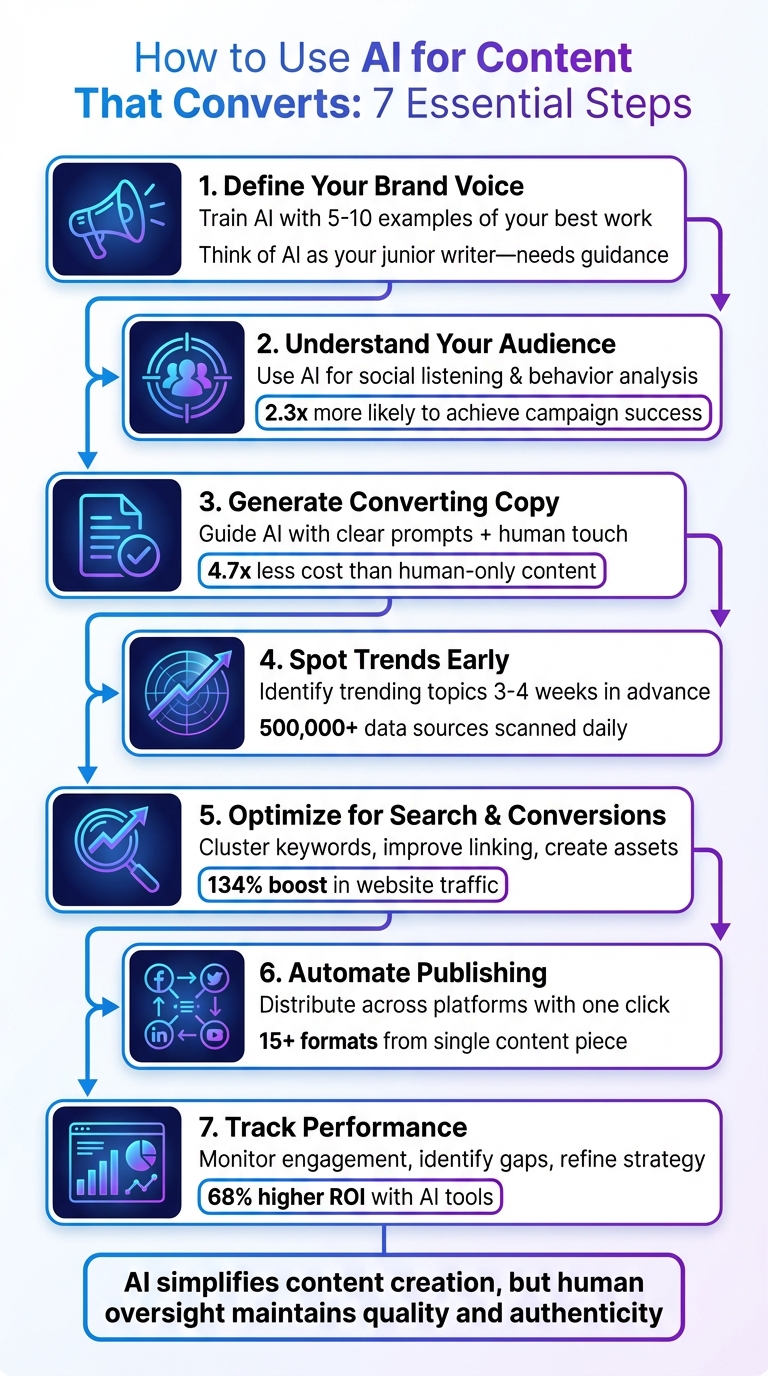
7-Step AI Content Strategy Framework for Higher Engagement and Conversions
FREE AI Content Writing Masterclass (Full Breakdown)
1. Define Your Brand Voice and Know Your Audience
To create content that resonates, you need two things: a clearly defined brand identity and a deep understanding of your audience. Without these, even the most advanced AI tools will churn out content that feels bland and impersonal.
1.1 Set Up Your Brand Voice with AI
Think of AI as your junior writer - it has potential but needs guidance. It’s capable of producing great ideas, but only when you provide clear instructions and ongoing feedback.
"I've found the biggest shift by thinking of myself as a copy chief and AI as a junior writer. It has fantastic ideas but needs strong guardrails, constant feedback, and clear direction." - Erin Pennings, Writer and Strategist [4]
Start by feeding AI examples of your best work. Share 5–10 standout pieces - like emails that got replies, social posts that sparked engagement, or landing pages that converted. AI will analyze these to identify patterns in your tone, word choice, and style [4][5].
In 2024, content expert Erika Heald used GPT-4o to document the voice for "Erika's Gluten-Free Kitchen." By providing the site’s URL and targeted prompts, the AI created a five-attribute brand voice chart: Personal, Informative, Creative, Supportive, and Authentic. Each attribute came with specific "Do's" and "Don'ts" for consistency [5].
Tools like Pressmaster.ai let you save these voice profiles and apply them to new content automatically. The trick is to be precise. Instead of calling your tone "professional", describe it as "authoritative yet approachable, like a trusted mentor simplifying complex ideas over coffee."
A quick tip: read AI-generated content out loud. If it sounds stiff or awkward, it needs a human touch. While AI can structure content, only humans can add the emotional depth that makes it memorable.
"The biggest mistake I see is when people expect AI to find their voice. It won't. You have to hand it your rhythm. If you do that, it's a solid tool." - Riley Westbrook, Co-founder, Valor Coffee [4]
Once your brand voice is crystal clear, you can turn your focus to understanding your audience.
1.2 Find Out What Your Audience Wants
Defining your voice is just the start. To truly connect, you need to align your message with what your audience cares about most. This means digging into their motivations, pain points, and questions. AI can help uncover these insights, shaping your content strategy to meet their needs.
Social listening is one way to do this. AI tools can monitor conversations on platforms, scanning hashtags, comments, and mentions in real time. This helps you spot trends, shifts in sentiment, and emerging interests. It can also reveal patterns in customer behavior that might otherwise slip through the cracks [7][8][9][10]. In fact, marketing teams that use AI are 2.3 times more likely to achieve success in their campaigns [10].
Take Carlos Gil, for example. In 2024, the owner of The Hype Section used AI to segment email lists and personalize outreach based on customer behavior. The results? A 35% increase in email open rates and a 50% jump in social media interactions [10].
Here’s a practical tip: analyze industry conversations to pinpoint what your audience wants and what might hold them back [2]. AI-driven lead scoring can also help prioritize potential customers by tracking how they interact with your website and content [6].
When you combine a well-defined brand voice with a deep understanding of your audience, you create content that doesn’t just grab attention - it delivers real results for your business.
2. Use AI to Create Content That Converts
Now that you’ve established your brand voice and understand your audience (as outlined in Section 1), it’s time to let AI turn those insights into content that drives action. The aim isn’t just to churn out more material - it’s about crafting pieces that grab attention, resonate with your audience, and lead them to act.
2.1 Generate Copy That Gets Attention
AI can write quickly, but its real strength lies in how you guide it. A 2025 Semrush survey found that 35.8% of marketers use AI for drafting content, while 23.5% rely on it for brainstorming topics [1]. A smart approach is to write the first 10% of your project yourself - this sets the tone and ensures your voice is clear before AI takes over [2].
Before drafting, test your ideas by challenging AI with tough prompts that highlight weak spots or generic concepts [12]. Once your idea is solid, use AI to create engaging openings and maintain a seamless flow.
Here’s an interesting stat: AI-generated content costs about 4.7 times less than content created by humans [12]. But saving money is pointless if the content doesn’t deliver. The trick? Feed AI with unique materials it can’t come up with on its own. For example, upload customer interviews, call transcripts, or podcasts so AI can extract original quotes and insights [2][12].
"The best writers think like producers now. They ask themselves: how can I make this concept visual? How can I show instead of tell? AI makes that possible without becoming a design expert." - Chris Hanna, Senior Editor, Backlinko [2]
Always review AI-generated drafts before publishing. As Elie Berreby, Senior SEO Strategist at Semking, warns: "AI-generated content is one of the fastest ways to drive a financial brand off a cliff [if not reviewed by humans]" [12]. Use prompts that help AI flag jargon or overly complex sentences, then simplify for clarity [11].
Once you’ve mastered attention-grabbing copy, the next step is tailoring that creativity to different audience groups.
2.2 Create Personalized Content for Different Audiences
Generic content doesn’t convert. Today’s audiences expect tailored messages that address their specific needs, challenges, and where they are in the buyer’s journey. AI makes this level of personalization scalable without needing a massive team.
Start by diving deep into your audience segments. AI can analyze sources like Reddit threads, customer support tickets, or sales call transcripts. Export these conversations and prompt AI to categorize them by desires, pain points, and objections [2]. This gives you raw, unfiltered insights straight from your audience.
"The biggest benefit has been how much faster we can repurpose knowledge from inside the company into customer-facing content. Instead of relying only on subject matter experts' limited time, AI helps us capture their expertise and scale it." - Dirk Alshuth, CMO, Emma [1]
You can also automate workflows to repurpose a single piece of content across platforms. For example, a blog post can be transformed into LinkedIn posts, Twitter threads, email newsletters, and Instagram captions - each optimized for its specific audience and format [12]. AI tools can generate these platform-specific versions while fine-tuning for engagement.
The key is consistency: adapt the format and tone for each platform, but ensure your core message remains clear and compelling.
Once your content resonates with your audience, it’s time to make it easy to find and action-oriented.
2.3 Optimize Content for Search and Conversions
Creating excellent content is only half the battle. If people can’t find it - or if it doesn’t inspire action - you’re missing out. AI can help fine-tune your content for both visibility and conversions.
Use a triple-optimization framework: balancing traditional SEO with Answer Engine Optimization (AEO) for voice assistants and Generative Engine Optimization (GEO) to align with how AI models reference content [3][13]. This is critical because Google’s AI Overviews have reduced click-through rates by 15% to 35% in some cases [13].
Start by clustering keywords. AI can group related keywords by search intent, enabling a single page to rank for multiple terms while building topical authority. Study the top-ranking posts for your topic, identify patterns, and then use AI to create a fresh angle that stands out [11][1][2].
Take HubSpot’s 2024 example: they faced declining blog traffic due to Google’s AI Overviews. By using Smart Content and AI SEO tools to cluster high-intent keywords, they saw a 134% boost in website traffic and a 107% rise in inbound leads over six months [3].
AI also helps with internal linking. Use it to scan your site for opportunities to distribute page authority and make your content easier for search engines to navigate [11].
Beyond text, consider using AI to create interactive assets like profitability calculators, SEO tools, or smart checklists. These tools turn passive readers into active leads. In fact, 68% of companies report higher returns on content marketing after implementing AI tools [3]. The brands seeing the best results are those using AI not just to produce content, but to create smarter, more engaging assets that work for both search engines and human readers.
3. Spot Trends and Pick Topics That Perform
Stay ahead in your content strategy by using AI to identify and act on industry trends before they hit the mainstream. Timing is everything - it’s what sets reactive content apart from content that leads the conversation.
3.1 Track Industry Trends Before They Peak
Relying on manual research to spot trends often leaves you playing catch-up. AI changes the game by analyzing massive amounts of data faster than any human team ever could.
Take Pressmaster.ai's Trendmaster, for example. It scans over 500,000 data sources daily, uncovering major industry shifts 3-4 weeks before they become widely known. Even better, it delivers alerts with tailored suggestions for angles that resonate with your audience. This means you’re not just jumping on trends - you’re shaping the narrative in ways that matter to your readers.
The challenge lies in separating the noise from the real opportunities. Not every viral sensation deserves your attention. AI excels at this by analyzing sentiment, engagement trends, and how long a topic stays relevant. For instance, if a topic generates a lot of buzz but only shallow engagement, it’s probably not worth pursuing. On the other hand, if discussions grow deeper and sustain interest over time, that’s your cue to act.
This kind of proactive trend tracking pairs perfectly with earlier AI strategies for precise content creation and audience targeting.
Here’s how AI supercharges trend analysis:
| AI Function in Trend Analysis | How It Helps Your Content Strategy |
|---|---|
| Data Scanning | Spots trends 3-4 weeks before they peak |
| Sentiment Analysis | Identifies the emotional tone for your content |
| Noise Filtering | Pinpoints lasting trends, skipping short-lived fads |
| Content Gap Detection | Highlights unexplored angles within trending topics |
| Performance Simulation | Predicts engagement metrics before publishing |
The use of AI in this space is growing fast. In 2024, 78% of organizations reported using AI, up from 55% in 2023 [15]. Additionally, three out of five organizations now rely on data analytics to fuel innovation [16]. The brands leading in content marketing aren't just producing content faster - they’re producing it smarter by knowing what to write about before anyone else.
Once you’ve identified the trends, the next step is to craft a perspective that makes your content stand out.
3.2 Find New Angles on Popular Topics
Spotting trends is just the beginning. To truly capture attention, your content needs a fresh angle. If you’re echoing the same points as everyone else, you’ll fade into the background. This is where AI becomes indispensable.
Start by using AI to uncover content gaps. Have it analyze top-ranking articles on a trending topic, then flag any subtopics or viewpoints that competitors haven’t explored. This is your chance to offer something different. For example, if everyone is talking about the benefits of a new technology, you could focus on its challenges, costs, or practical applications - areas others might have overlooked.
You can also use AI to pressure-test your ideas. Ask it to critique your concepts, pointing out overused angles, weak logic, or areas lacking originality. This helps you refine your approach before investing time in creating the content [12].
"AI can help you get past the blank page by suggesting topics, story angles, keywords for SEO, and headline variations. It's a quick way to explore options and keep your content calendar full." - Mateusz Makosiewicz, Marketing Researcher, Ahrefs [12]
Another strategy is to feed AI tools with research, customer feedback, or industry reports and ask them to summarize unexpected insights or patterns. These insights can inspire fresh angles that competitors might miss because they don’t have access to your unique data [12].
Don’t overlook the importance of sentiment monitoring around a trend. Is the conversation heated, informative, or skeptical? This can guide how you position your content. For example, if sentiment is skeptical, a myth-busting piece might perform well. If it’s enthusiastic, a practical how-to guide could attract more readers.
Finally, headlines matter - a lot. AI can help you craft headlines that grab attention. For instance, headlines using words like "you" or "your" can boost social shares by 50%, and AI-optimized headlines have been shown to improve click-through rates by up to 20% [17]. Use AI to generate multiple headline options and test them to find what resonates best with your audience.
4. Publish Content Across Multiple Platforms
Creating great content is only half the battle - it also needs to reach your audience without unnecessary hassle. Manually posting across platforms can eat up hours of your time. Between reformatting content, resizing images, scheduling posts, and tracking performance, it’s easy to feel overwhelmed. That’s where AI steps in to simplify the process.
4.1 Automate Publishing to Multiple Channels
Forget about tedious copy-pasting. AI-powered tools now allow you to manage content distribution from a single dashboard. With just one click, you can publish content to platforms like WordPress, Wix, Medium, LinkedIn, Instagram, and X (formerly Twitter). These tools handle the technical details, so you don’t have to.
Take Pressmaster.ai's Social Suite as an example. It transforms a single blog post into over 15 platform-ready formats. That one article can become a LinkedIn post, an Instagram carousel, a Twitter thread, and even an email newsletter - all formatted and scheduled automatically.
The time savings here are massive. Tasks that used to take hours can now be completed in minutes. For instance, in 2024, Sprout Social reported saving 72 hours per quarter on performance reporting alone by integrating AI into their workflows [7]. Add in the time saved on formatting and scheduling, and the efficiency gains grow exponentially.
Here’s how AI changes the game for content distribution:
| Feature | Manual Publishing | AI-Automated Publishing |
|---|---|---|
| Formatting | Adjust manually for each platform | Automatic resizing and tone adjustments |
| Scheduling | Enter posts one by one | Optimized scheduling based on engagement data |
| Repurposing | Rewrite content for every channel | Automatically create 15+ formats from one source |
| Tracking | Metrics scattered across platforms | Centralized analytics dashboard |
| Speed | Takes hours or days | Done in minutes |
AI also takes the guesswork out of timing. It analyzes engagement data to determine the best times to post. For example, LinkedIn might perform best during business hours, while Instagram peaks in the evening. Instead of juggling schedules manually, AI ensures your posts go live when your audience is most active.
When choosing a platform, look for one that integrates with your existing tools and handles details like character limits, hashtags, and image dimensions. Let AI handle the heavy lifting of formatting and posting, while your team focuses on fine-tuning the content to match your brand voice.
4.2 Adjust Content for Each Platform
Once your content is distributed, it’s important to tailor it for each platform. Posting the same content everywhere doesn’t work - each platform has its own style and audience preferences. LinkedIn users expect professional insights and long-form posts, Instagram thrives on visuals with short, engaging captions, and X (formerly Twitter) requires concise, timely updates. AI helps adjust your message so it resonates on each platform.
This adaptation goes beyond trimming text. AI can tweak tone, structure, and visuals to suit the platform’s unique needs. For example, a detailed blog post could become a carousel on Instagram, a thought-provoking LinkedIn post, and a punchy thread on X - all while staying true to your brand identity.
Consistent branding across platforms isn’t just a nice touch - it’s essential. Studies show that consistent branding can boost revenue by 10% to 33% [18]. However, there’s a catch: 77% of consumers say they can spot AI-generated content, which can erode trust if the tone feels off [18]. That’s why training AI tools to reflect your brand voice is so important. By incorporating your preferred language, metaphors, and examples, you can ensure your content feels authentic.
Interestingly, only 23% of marketers use their brand voice guidelines to train AI tools, despite 64% having documented guidelines [18]. This gap represents a missed opportunity to refine AI-generated content for platform-specific audiences.
HubSpot offers a great example of how this strategy can pay off. In 2024, they used AI-driven content clustering to counter traffic losses caused by Google’s AI Overviews. Over six months, Marketing Hub customers saw a 134% increase in website traffic and a 107% boost in inbound leads [3]. Their success came from optimizing content for multiple discovery channels, including traditional search, voice assistants, and AI-powered engines.
AI also handles technical adjustments like resizing images, changing resolutions, and converting file formats - all in seconds. What used to take a designer hours now happens instantly, freeing up your team to focus on strategy instead of execution.
With tools like Pressmaster.ai, managing multi-platform publishing becomes effortless. From a single hub, you can format and publish content to platforms like Webflow, Blogger, WordPress, Medium, and more. Plus, the unified analytics dashboard provides valuable insights, helping you refine your strategy based on real performance data.
The result? Your content reaches a broader audience, in the right format, at the right time - without adding extra work to your plate.
5. Track Performance with AI Analytics
Once you've optimized your content and developed tailored publishing strategies, the next step is tracking performance. Publishing is just the beginning - true success comes from understanding what works and what doesn’t. AI analytics tools simplify this process by gathering data from multiple platforms into one centralized dashboard. Instead of juggling Google Analytics, social media insights, and email reports, you can view engagement rates, click-throughs, and conversions all in one place.
Take Pressmaster.ai's unified analytics dashboard, for example. It consolidates metrics from across platforms, giving you a clear picture of your content’s performance. You can quickly identify which articles are driving sign-ups, which social posts are getting shared, and which topics resonate most with your audience. This real-time overview helps you spot trends early and refine your strategy before wasting resources on ineffective content.
5.1 Monitor Engagement and Conversion Data
AI analytics go beyond simple metrics like page views. They dive into user engagement data, tracking things like average time spent on a page, bounce rates, social interactions, and conversions. These insights reveal whether your content is merely attracting attention or actually contributing to your business goals.
A newer metric gaining traction in 2025 is AI Visibility - how often your brand is mentioned or cited in AI-generated responses from tools like ChatGPT and Gemini [21][1]. For instance, Wikipedia experienced an 8% drop in organic traffic in 2025, partly due to the rise of AI-driven search [21]. This highlights the need to monitor not only traditional SEO metrics but also your "AI search footprint." Tools like the AI Visibility Toolkit can track which prompts lead to mentions of your site and identify the pages being cited by AI tools [21].
Instead of focusing solely on view counts, prioritize metrics like average engagement time. Longer engagement suggests your content is both relevant and engaging [21]. AI can also flag pages with high bounce rates and low conversions, offering suggestions to improve clarity and better match search intent [21][11].
To measure the return on investment (ROI) of your content, use this formula: ROI = (Net Profit / Cost of Investment) x 100% [21]. This calculation helps justify your marketing spend and identifies which strategies deserve more resources. Companies using AI tools reported a 68% higher ROI from their content marketing efforts [3].
| Metric Category | Key KPIs to Track | AI Tool Functionality |
|---|---|---|
| Engagement | Views, Avg. Engagement Time, Bounce Rate | Combines multi-channel data into real-time visuals [20][21] |
| SEO & AI Visibility | Organic Traffic, AI Mentions, Keyword Rankings | Tracks brand presence in responses from tools like ChatGPT and Gemini [21][1] |
| Brand Sentiment | Mentions, Sentiment Analysis | Analyzes brand mentions and audience perception across external sites [21][1] |
5.2 Adjust Your Strategy Based on Results
Armed with engagement data, you can fine-tune your strategy for better outcomes. AI-driven analytics can scan the past year of blog performance to identify which topics, formats, and headlines have delivered the best results [19]. This kind of historical analysis can uncover patterns you might otherwise overlook - like certain types of content performing better on specific days or at particular times.
AI can also help you address content gaps - topics your audience is interested in but you haven’t covered yet [23][24]. By analyzing competitor strategies and search trends, AI pinpoints opportunities for new content that fills these gaps. It can even perform sentiment analysis on user comments, suggesting tone adjustments for your next round of content [22].
"AI in Content Marketing shines when your hypotheses are precise and your measurement speaks finance." - Ihor Dervishov, Entrepreneur and Marketer [22]
Rather than relying on static demographic data, AI uses real-time behavioral clusters - like pain points, purchase intent, and engagement patterns - to refine your targeting [22][23]. Brands leveraging predictive AI for content operations report a 34% increase in retention through better alignment of messaging with audience needs [22]. Revisiting these insights quarterly ensures your content stays relevant as consumer preferences evolve [22].
Before publishing, AI "document health checkers" can evaluate your content for readability, scannability, and brand consistency [25]. This proactive approach helps maintain quality standards and reduces the need for post-publication fixes. When reviewing underperforming content, AI can identify older posts that could be updated with new data or optimized for current SEO standards to improve visibility [24].
Think of AI analytics as a continuous feedback loop. By regularly monitoring performance, addressing weak points, and refining your strategy based on real data, you can turn content creation into a systematic, results-driven process. This ensures your efforts consistently lead to stronger engagement and higher conversions.
Conclusion
AI has reshaped how businesses approach content creation, turning what used to take days of effort into a streamlined, data-driven process. But this evolution isn’t about replacing human creativity. Instead, it’s about enhancing strategic thinking with tools that can analyze vast amounts of data and uncover patterns that manual methods simply can’t match. This guide has outlined practical strategies to tap into these advancements, showcasing how AI can be a game-changer for modern marketing.
The numbers speak for themselves: companies leveraging AI-driven content strategies report a 68% higher ROI on their marketing efforts, and 63% of marketers predict that by 2025, most of their content will be AI-generated [3]. These figures highlight why investing in AI tools is a smart move - it’s about measurable results and elevating your marketing game.
The key to success lies in blending AI’s efficiency with human insight. Let AI handle the heavy lifting, like drafting outlines, analyzing performance metrics, spotting trends, and automating content distribution. But keep human oversight in the mix for tasks like fact-checking, adding emotional depth, and ensuring the content aligns with your brand’s voice [26]. To get the most out of AI, feed it unique data - think customer interviews, surveys, and internal research - to make the output more relevant and impactful [2]. And always run a “sniff test” to ensure the content feels authentic and connects with your audience on a deeper level [14].
Platforms like Pressmaster.ai bring all these capabilities together in a single, streamlined solution. It covers everything from identifying emerging trends and generating content that reflects your brand’s voice to publishing across multiple channels and tracking performance with unified analytics. Growth-stage companies often spend $500–$2,000 a month on various AI tools [3], but Pressmaster.ai offers all these features for as little as $12/month. Whether you’re a startup looking to establish thought leadership or an established company scaling your content efforts, this platform adapts to your needs - without requiring a bigger budget or team.
FAQs
How can AI help me define and maintain a consistent brand voice?
AI can function as a brand voice specialist, diving into your existing content - like your “About Us” page or recent blog posts - to develop a comprehensive profile of your tone, style, and preferred word choices. This profile becomes a go-to resource, enabling AI to craft new content that mirrors your brand’s voice seamlessly across platforms, whether it’s social media, emails, or blog posts. The result? Consistent messaging without the constant need to revisit or enforce style guidelines.
On top of that, AI can help safeguard your brand voice over time by analyzing how your content performs and identifying any deviations from your established style. It can recommend tweaks to keep your messaging on point and even refine your voice profile as your brand evolves. By blending automation with human oversight, AI ensures your communication remains genuine and cohesive, fostering trust and deeper connections with your audience.
How can I make AI-generated content more engaging and authentic?
To make AI-generated content feel more engaging and relatable, start by setting clear objectives and getting to know your audience inside and out. Leverage AI tools to dig into data like browsing behaviors and preferences, then use that information to build detailed audience personas. These personas will act as your roadmap, ensuring your content speaks directly to the people you're trying to reach. Providing AI with well-thought-out, detailed prompts - including tone, style, and key messaging - can help the output align seamlessly with your brand's voice.
Think of AI as your assistant, not the whole team. Use it to handle drafts and research efficiently, but always take the time to refine the content yourself. Add layers of nuance, emotion, and even personal anecdotes to give the final piece a human touch. Personalization is key - adjust examples, topics, and calls-to-action based on audience insights to resonate more deeply and drive better results.
Don’t stop there. Measure and tweak your content by keeping an eye on metrics like click-through rates and conversions. Use what you learn to fine-tune your approach for future pieces. By combining data-driven insights, creative input, and continuous performance tracking, you can create content that truly connects with your audience.
How does AI help improve content marketing results?
AI-powered analytics take raw audience data and turn it into meaningful insights, giving you the tools to fine-tune your content strategy at every step. By examining metrics like click-through rates, time spent on a page, and conversion rates, AI pinpoints the topics, formats, and posting schedules that your audience responds to the most. This means you can concentrate on ideas that perform well and skip those that fall flat.
It doesn’t stop there - AI can segment your audience based on behavior, purchase patterns, and location, allowing you to deliver tailored messaging that boosts engagement and drives more conversions. It can even handle A/B testing, offering suggestions for the most effective headlines, calls-to-action, or visuals for different audience segments. This ensures your content consistently hits the mark. With AI, you can make smarter, data-backed decisions that increase ROI and keep your strategy in sync with what your audience wants.








Sign Up for our Pressmaster Newsletter
Sign up for our Pressmaster.ai newsletter to get instant alerts on trending topics, ensuring you stay ahead in your field with the latest insights and updates.


.avif)
.png)

.avif)


7 Viral Patterns That Drove 10,643% Growth
Turn natural conversations into content gold, make every insight count, and drive real conversations.

Please fill out the form to get our Viral Cheat Sheet


How to Become a Thought Leader in 6 Easy Steps
Increase your visibility, establish authority, and conquer your market with minimal effort.

Please fill out the form to get our PDF Checklist
