
How to Use AI for Writing Content to Simplify Your Marketing Workflow

AI is transforming content creation by making it faster, easier, and more efficient. Marketing teams are using AI tools to boost productivity, maintain brand voice consistency, and create tailored content at scale - all while saving time and increasing revenue.
Here’s what you’ll learn:
- Speed and Efficiency: AI speeds up content creation by 5x-10x, reducing editing time to just minutes.
- Brand Voice Consistency: Tools analyze your writing style and ensure all content aligns with your unique tone.
- Content Ideas: AI platforms identify emerging trends and content gaps to help you stay ahead of competitors.
- Quality Control: Built-in features like SEO optimization, fact-checking, and readability tools improve content accuracy and polish.
- Automation: AI simplifies content distribution across platforms, saving hours of manual effort.
- Performance Tracking: Unified dashboards provide real-time insights to refine your strategy and boost results.
AI doesn’t replace marketers - it enhances their ability to focus on strategy and creativity while automating repetitive tasks. Whether it’s generating blog posts, social media updates, or press releases, AI is reshaping how teams approach content marketing.
Setting Up Your Brand Voice with AI
Why Consistent Brand Voice Matters
Your brand voice is the signature your audience recognizes even before they see your logo. Maintaining a unified tone across blog posts, emails, and social media creates trust and positions your brand as a dependable authority [11][13]. On the flip side, inconsistent messaging can confuse your audience and weaken your credibility [11].
As teams grow, having multiple contributors often increases the chances of mixed messaging. Interestingly, 42% of businesses already use AI to generate written content [7]. But the real game-changer? Using AI as a "voice guardian" - a tool that reviews content at scale to spot inconsistencies before it’s published [11].
Let’s dive into how AI can seamlessly replicate your unique writing style.
How AI Captures Your Writing Style
Today’s AI tools are far more advanced than simple content templates. They analyze over 30 linguistic elements to create a detailed "voice fingerprint" [12]. This includes examining sentence structure, vocabulary, and tone. For instance, Pressmaster.ai uses a conversational interview process to gather your insights. Whether through voice or chat, it reorganizes your thoughts into polished content that feels authentically yours.
Another approach? Upload samples of your best content, and the AI will break them down to identify your style [9][10]. This "linguistic fingerprinting" ensures every piece of generated content consistently reflects your voice. Take Cushman & Wakefield as an example - they saved over 10,000 hours each year by using AI to produce localized, compliant, and high-quality marketing content at scale [8].
"AI helps you and your team remove uncertainty around brand voice compliance and frees you to focus on innovative and engaging storytelling." – Erika Heald, Content Marketing Consultant [11]
3 Ways to Use AI to Make BETTER Content FASTER
Finding Content Ideas with Trend Analysis
AI doesn't just help maintain a consistent brand voice - it also opens doors to uncover emerging topics and create content that truly connects with your audience.
Using Trendmaster for Timely Ideas
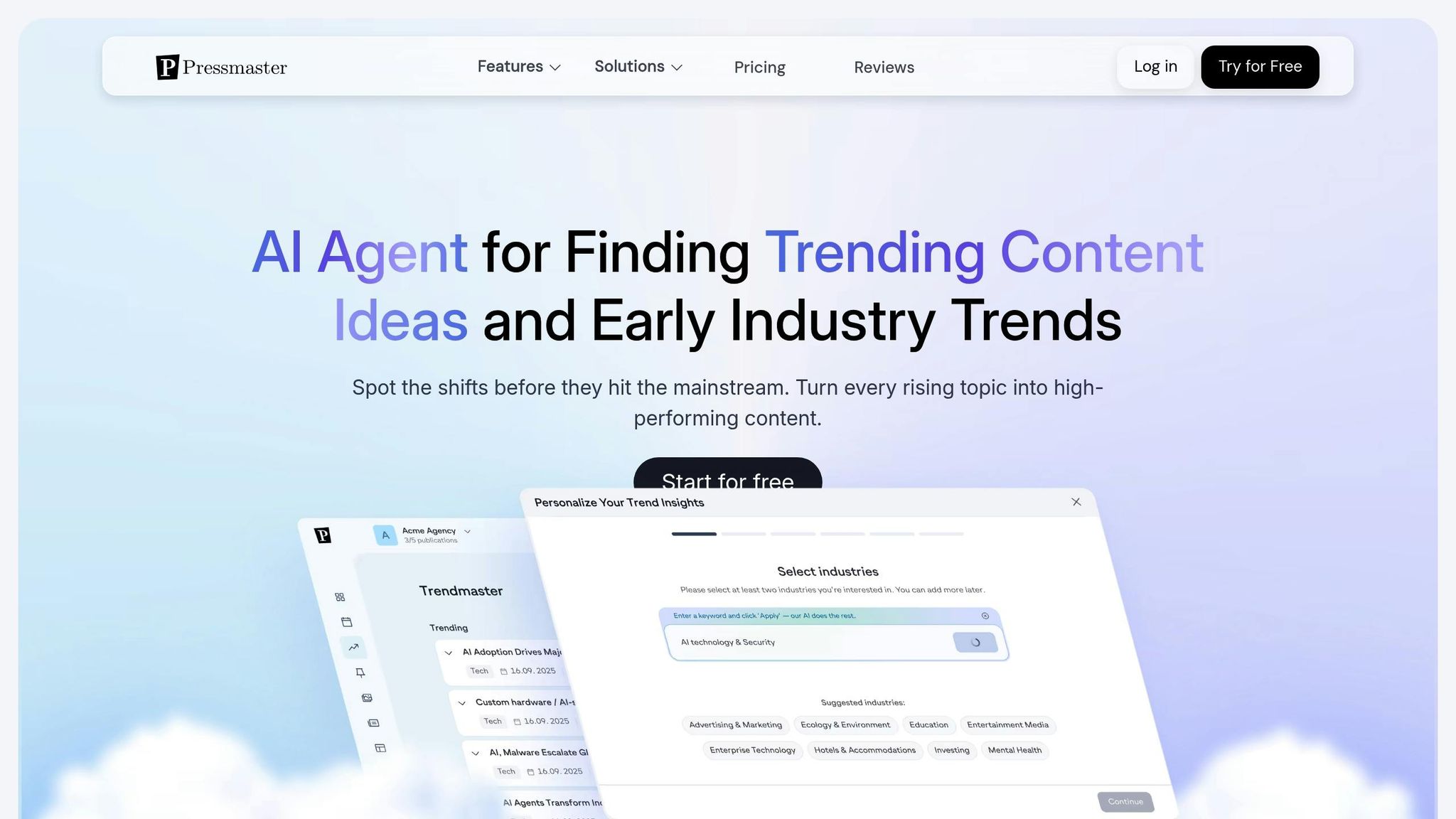
Coming up with fresh content ideas can be draining. That’s where Trendmaster steps in. This platform scans over 500,000 sources nonstop, identifying emerging topics weeks before they gain traction. It’s like having a crystal ball for spotting industry shifts 3–4 weeks ahead of the curve, giving you a chance to join conversations before they hit the mainstream.
Each trend alert includes two key metrics: a Trend Score to gauge momentum and a Relevance Rating to see how well the topic fits your brand and audience. You can even filter these alerts by region, industry, or demographic to keep them laser-focused on your needs.
One standout feature is its ability to uncover content gaps. By analyzing top-performing articles on a trend, Trendmaster highlights areas your competitors might be overlooking. It even suggests headlines and hooks tailored to those gaps, helping you craft content that stands out.
This forward-thinking approach to trend analysis ensures you’re not just reacting to what’s popular - you’re shaping conversations that matter to your audience.
Aligning Content with Audience Interests
Once you’ve identified trends, the next step is making sure they connect with your audience. AI can analyze thousands of online discussions - like those on Reddit - to uncover what your audience cares about most. From desires and frustrations to frequently asked questions, AI helps you get inside the minds of your target community.
But here’s the trick: start with your own understanding of your audience, then use AI to fill in the blanks. For example, by feeding top-performing posts into AI, you can spot recurring themes, unaddressed concerns, and overlooked perspectives. This lets you zero in on a unique angle that cuts through the noise and resonates with your audience [6].
Creating Quality Content Faster with AI
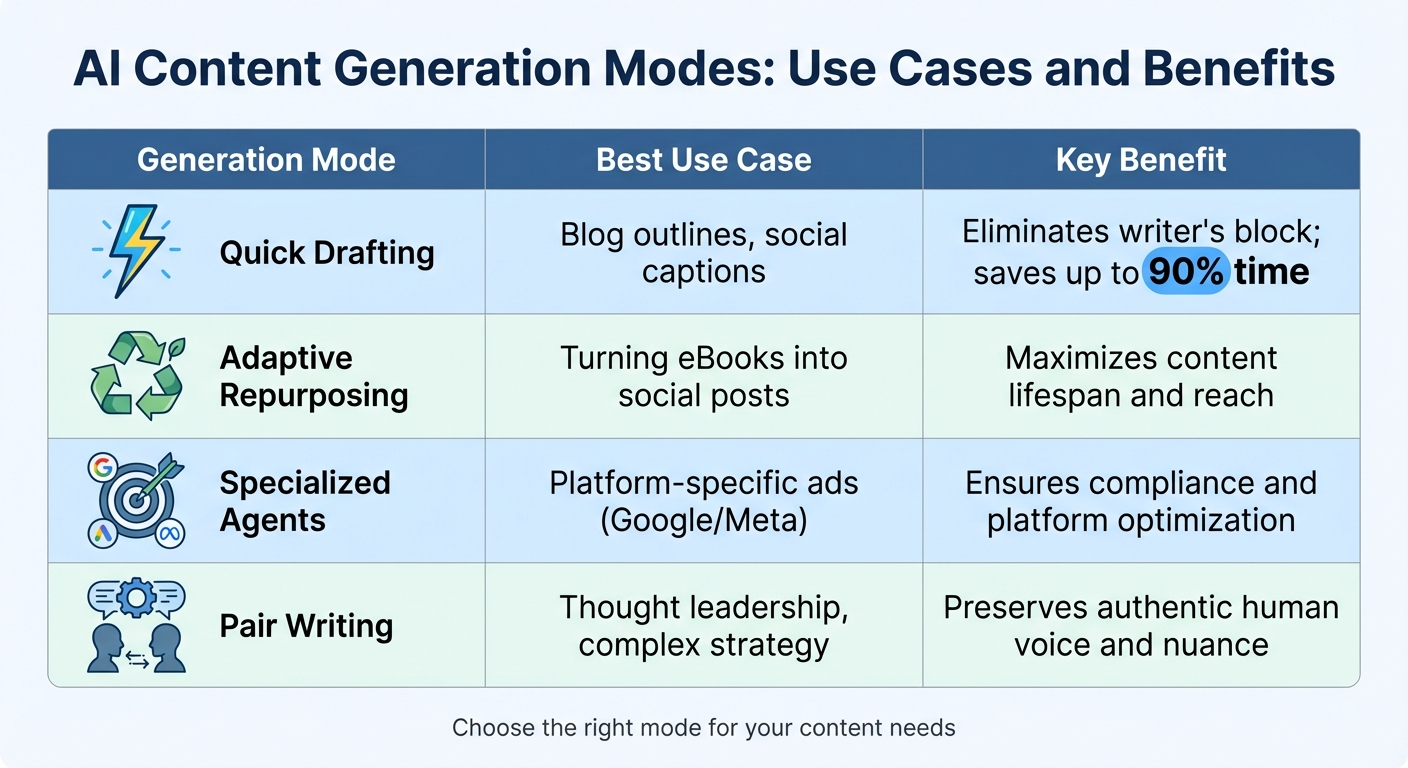
AI Content Generation Modes: Use Cases and Benefits Comparison
Once you’ve chosen your topics, the next challenge is producing content quickly enough to keep pace with your marketing goals. This is where AI steps in, transforming what used to be a time-consuming task into an efficient process. Whether it’s blogs, social media posts, or press releases, AI helps you create professional content while staying true to your brand’s voice and keeping it relevant to your audience. It’s a tool that adapts to different formats and speeds up production without compromising quality.
Different Content Generation Modes
Modern AI tools offer various modes to suit specific content needs, making the process both flexible and efficient.
Quick drafting is perfect for overcoming writer’s block and getting your ideas down fast. Provide a short prompt or even a voice recording, and the AI will generate a rough draft, outline, or first version within minutes. This mode is ideal for tasks like creating social media captions, meta descriptions, or blog outlines [2].
Adaptive repurposing works differently. Instead of starting from scratch, it takes a single high-value piece of content - like an eBook or whitepaper - and transforms it into multiple variations tailored for different platforms. This approach saves time and extends the lifespan of your content [2].
Specialized agent modes are designed for specific tasks and platforms. For example, Ad Agents create copy optimized for Google or Meta ads, Email Agents craft personalized email sequences, and Web Agents produce SEO-friendly blog posts. These tools ensure your content meets platform-specific guidelines and best practices [2].
The pair writing mode treats AI as a collaborative partner. It’s like brainstorming with a colleague - you bounce ideas back and forth, refine headlines, tweak transitions, and iterate until you’re satisfied.
"AI takes me from zero to an 80% first draft. But the final 20%, the careful, thoughtful editing, that's still entirely human." - Kyle Coleman, CMO of copy.ai [3]
| Generation Mode | Best Use Case | Key Benefit |
|---|---|---|
| Quick Drafting | Blog outlines, social captions | Eliminates writer's block; saves up to 90% time [2] |
| Adaptive Repurposing | Turning eBooks into social posts | Maximizes content lifespan and reach [2] |
| Specialized Agents | Platform-specific ads (Google/Meta) | Ensures compliance and platform optimization [2] |
| Pair Writing | Thought leadership, complex strategy | Preserves authentic human voice and nuance [3] |
Once the content is drafted, the next step is ensuring it meets high standards through built-in editing tools.
Built-in Editing and Quality Control
Speed means little if the content lacks accuracy or polish. That’s why modern AI platforms come equipped with features to maintain quality.
SEO optimization is handled automatically. The AI analyzes keyword usage, suggests meta titles and descriptions, and even recommends internal links to boost your search engine rankings [4]. It’s not just about creating content - it’s about creating content that gets noticed.
Fact-checking and accuracy verification tackle one of AI’s known challenges: the risk of generating incorrect information, or "hallucinations." Advanced tools now cross-check data against reliable sources to ensure accuracy [4] [14].
"AI only augments what you can already do, which means many marketing efforts will still require human input." - Florian Fuehren, Senior Writer at Brafton [4]
Readability and style refinement tools help fine-tune the content. They offer real-time suggestions to simplify sentence structure, remove fluff, and adjust the tone - whether you need to sound more casual or more formal [15].
"As long as I can write out the ideas on the page, Grammarly's AI can help me clean up those sentences and add a bit of sparkle to the ideas." - Tina Donati, Content and Partner Marketing Lead at Grammarly [5]
Here’s a practical tip: after completing a draft, ask the AI to summarize it in three or four lines. If the summary misses the main point or feels generic, it’s a sign the content needs more work [15]. This quick check helps catch issues before publication.
With these tools, you’re not forced to choose between speed and quality. AI enables you to achieve both, producing content that’s polished, accurate, and aligned with your brand’s standards.
Automating Content Distribution Across Channels
Once you've streamlined your content creation process, the next logical step is automating its distribution. Creating the content is just part of the equation; getting it in front of your audience across multiple platforms can be a time-consuming task. This is where AI steps in, simplifying the process and ensuring your content reaches the right places with minimal effort.
Publishing to Multiple Platforms at Once
AI tools make distributing content across platforms much easier by handling the tedious tasks of reformatting and posting. Instead of manually adjusting content for each platform, you can use a centralized dashboard to manage everything. These tools automatically adapt your content - shortening posts for Twitter, optimizing images for Instagram, and formatting articles for WordPress or Medium.
What used to take hours or even days can now be done in minutes. With AI, scaling your efforts from a few posts a week to dozens per day doesn’t require hiring additional staff. Plus, centralized dashboards bring all your analytics into one place, so you can track performance without juggling multiple accounts. Automated scheduling also ensures that your posts go live at the most effective times, based on real-time data insights.
How automation transforms content distribution:
| Feature | Manual Distribution | AI-Automated Distribution |
|---|---|---|
| Speed | Hours to days per piece | Minutes to hours per piece |
| Formatting | Manual per platform | Automated and optimized |
| Scheduling | Fragmented/Manual | Centralized and data-driven |
| Analytics | Multiple logins required | Unified dashboard |
| Scalability | Limited by staff hours | Easily scalable |
AI also ensures your branding remains consistent across all platforms. Manual processes often lead to mistakes, like broken links or missed channels, but AI minimizes these risks. This seamless approach not only amplifies your reach but also strengthens your brand’s digital presence.
Setting Up a Custom Newsroom
To take your content strategy even further, consider creating a custom newsroom. A newsroom centralizes your messaging, providing a dedicated space on your website for press releases, announcements, and thought leadership content. This goes beyond a simple blog - it's a branded hub designed to enhance your visibility and credibility.
In the past, setting up a newsroom required a team of developers and designers, along with ongoing maintenance. Now, AI-driven platforms like Pressmaster.ai make it possible to launch a newsroom in under an hour. With pre-designed templates and drag-and-drop tools, you can skip the technical headaches. Plus, automated SEO ensures that your content is indexed by search engines right away, improving its chances of ranking well. Each piece is tagged, formatted, and structured to help Google understand and prioritize it.
Owning a custom newsroom gives you full control over your narrative. Instead of relying only on external platforms - where algorithm changes can impact your reach - you can manage your own space for key content. Integrated with your main website, the newsroom becomes a go-to resource for journalists, customers, and stakeholders. It also boosts your domain authority and reinforces your branding with consistent fonts, colors, and tone. This unified approach strengthens your professional image across all digital touchpoints.
Measuring Content Performance with AI
Creating and sharing content is just the beginning. The real challenge lies in figuring out what’s working and what isn’t. Without clear insights, you’re left guessing which efforts drive results. That’s where AI steps in, transforming scattered analytics into a single, actionable view.
Viewing All Metrics in One Dashboard
In the past, tracking content performance meant juggling multiple platforms, downloading spreadsheets, and manually piecing together data from tools like Google Analytics, social media accounts, and email marketing software. It was time-consuming and prone to errors. AI changes the game by pulling all of this data into one streamlined dashboard. Instead of spending hours compiling reports, you get real-time insights that reveal how your content performs across all channels.
"AI can analyze engagement metrics across platforms as they happen, giving you a clearer picture of how your content is performing." - Grammarly [5]
Modern AI dashboards don’t just display data - they interpret it. They turn raw metrics into plain-language summaries, highlighting which content engages your audience and drives conversions. Tools like Optimizely Opal can break down complex analytics into easy-to-understand insights with just a click [10]. For example, you’ll quickly see which blog posts are driving traffic, which social media updates are generating leads, and which platforms are delivering the best return on investment.
Take Pressmaster.ai’s unified analytics hub as an example. It consolidates metrics from platforms like WordPress, Medium, social media, or even custom newsrooms into one clear dashboard. This eliminates the need for constant platform-switching or manual data entry, saving time and reducing errors.
And the impact? It’s substantial. Companies that use marketing automation report a 29% greater revenue impact from their content marketing efforts compared to those that don’t [17].
| AI Capability | Benefit for Performance Tracking |
|---|---|
| Real-time Insights | Tracks engagement metrics as they happen across platforms [5] |
| Automated Reporting | Creates easy-to-read dashboards, eliminating manual reporting [5] |
| Predictive Analytics | Identifies patterns to anticipate future content performance [5] |
| Dynamic Recommendations | Suggests actionable changes like better headlines or optimal posting times [5] |
Using Data to Improve Content Strategy
Having consolidated metrics is just the first step. The real value comes from using those insights to refine your content strategy. Raw data doesn’t mean much unless it leads to action. AI-powered analytics shine here by not only showing what worked in the past but also predicting what’s likely to work in the future.
AI-driven dashboards provide tailored recommendations based on your audience’s behavior. For instance, if your Tuesday morning posts consistently outperform Friday afternoon ones, the system will suggest shifting your posting schedule. If a particular headline style generates more clicks, it will recommend using similar phrasing in future content. These insights are specific to your audience and their engagement trends [5].
This proactive approach is already delivering results. 66% of marketing and sales teams using generative AI reported revenue growth within a year [1]. A great example comes from December 2024, when Andres SEO Expert LLC optimized an article using AI-driven insights. The result? The article received 1,817 views in just 24 hours, with an average time on page of 1 minute and 6 seconds - well above typical performance metrics [16].
"The key to AI content strategy success isn't replacing human creativity. It's amplifying strategic thinking through intelligent systems that can process data and identify patterns at unprecedented scales." - Single Grain [18]
Conclusion
Content marketing doesn’t have to feel like a daunting task anymore. Gone are the days of juggling countless tools, manually tweaking posts for different platforms, and relying on guesswork to figure out what will connect with your audience. Thanks to AI, marketing teams can now focus on what truly matters - creativity and strategy - while leaving the repetitive, time-consuming tasks to technology.
The results speak for themselves. Companies are slashing blog writing time by as much as 50–90% [2], and generative AI is enabling content creation up to 50 times faster than traditional methods [1]. These aren’t just productivity boosts - they’re game-changing advantages that allow teams to shift their focus to high-impact storytelling and strategic planning.
Pressmaster.ai offers an all-in-one solution, combining AI-driven content creation, automated distribution, and real-time analytics. Whether you’re a startup looking to establish your voice or an agency juggling multiple clients, this platform adapts to your needs and helps you scale effortlessly.
FAQs
How does AI help maintain a consistent brand voice across different types of content?
AI can help maintain a consistent brand voice across all your content - whether it's blog posts, social media updates, emails, or ads. How? By learning your brand's unique style and applying it across everything it creates. To get started, provide the AI with a detailed style guide that outlines your tone, preferred vocabulary, sentence structure, and examples of content that reflect your brand’s personality. This gives the AI a clear blueprint to work from.
Once trained, the AI can adjust your messaging to suit different platforms while staying true to your brand's tone. For instance, it can craft a casual, engaging tweet or a polished, professional article - all without losing your distinctive voice. By integrating AI into your workflow, you can streamline content creation and minimize inconsistencies. Plus, with regular feedback, the system gets even better at mirroring your style, ensuring your brand voice stays sharp and unified across every channel.
What are the main advantages of using AI for identifying trends in content creation?
AI streamlines trend analysis by processing massive datasets - such as search queries, social media chatter, news, and competitor content - at lightning speed. What used to take hours or even days can now be done in moments. This allows marketers to produce timely, relevant content that aligns with audience interests, driving higher engagement and expanding organic reach.
Beyond speed, AI uncovers valuable patterns like seasonal shifts, regional preferences, and content gaps. These insights empower marketers to focus on topics with the most impact, allocate resources wisely, and make decisions rooted in data rather than guesswork. It’s like having a crystal ball for smarter content strategies.
AI also makes personalized content at scale a reality. By aligning trends with specific audience segments, marketers can fine-tune their messaging - adjusting tone, format, or even headlines - to connect with different groups. This blend of speed, insight, and customization transforms content creation workflows into something far more efficient and effective.
How can AI enhance content distribution and track performance effectively?
AI takes the guesswork out of content distribution by analyzing audience behavior, platform algorithms, and past performance. It pinpoints the best time, platform, and format for publishing, then automates the entire process - whether it’s scheduling posts for social media, sending email campaigns, updating blogs, or managing paid ads. This not only saves marketers a ton of time but also ensures the content lands in front of the right audience. Plus, AI makes A/B testing a breeze, quickly experimenting with headlines, formats, and posting schedules to fine-tune results without requiring manual input.
When it comes to performance tracking, AI steps in with real-time metrics like clicks, shares, and conversions, all neatly organized into intuitive dashboards. Using predictive analytics, it doesn’t just show what’s happening - it also spots trends, suggests tweaks, and reveals which topics and channels are delivering the best return on investment. This allows marketers to make smarter, data-backed decisions and continuously refine their campaigns for even better outcomes.
Related Blog Posts






Sign Up for our Pressmaster Newsletter
Sign up for our Pressmaster.ai newsletter to get instant alerts on trending topics, ensuring you stay ahead in your field with the latest insights and updates.


.avif)
.png)

.avif)


7 Viral Patterns That Drove 10,643% Growth
Turn natural conversations into content gold, make every insight count, and drive real conversations.

Please fill out the form to get our Viral Cheat Sheet


How to Become a Thought Leader in 6 Easy Steps
Increase your visibility, establish authority, and conquer your market with minimal effort.

Please fill out the form to get our PDF Checklist
