
How to Use AI for Writing Content That Sounds Human and Builds Trust

Want your AI-generated content to sound human and relatable? Here's how you can scale content creation while keeping it natural and trustworthy. AI tools like Pressmaster.ai help brands maintain a consistent tone, write in a conversational style, and meet the expectations of modern audiences.
Key takeaways:
- Trust is essential: 68% of U.S. consumers prefer brands using a conversational tone.
- AI can match your voice: Tools analyze your content to replicate your style across platforms.
- Human oversight matters: AI drafts save time, but editing ensures accuracy and relatability.
- Measure and refine: Use analytics to track performance and improve future content.
How to make ChatGPT write like a human (a power prompt to humanise it)
Setting Up Your Brand Voice with AI
Your brand voice is what sets you apart from the competition, making your content instantly recognizable. By using AI, you can scale your content production while maintaining the personal touch that makes your brand unique.
The secret to success is configuring your AI with purpose. Instead of letting the AI decide how your brand should sound, you guide it to amplify your voice in a consistent way across all content.
Defining Your Brand Voice
Before you can train AI to replicate your voice, you need to clearly define what that voice is. It’s not just about choosing to sound “friendly” or “professional.” It’s about pinpointing the specific characteristics that make your communication style stand out.
Start by reviewing your most engaging content - blog posts, social media updates, press releases, or anything that resonated with your audience. Ask yourself: What tone did you use? Was the language formal or casual? Did you lean on industry-specific terms or keep it conversational? These patterns will help you identify the core elements of your voice.
Once you've analyzed your content, document the key traits. For example, a tech startup might define its voice as “knowledgeable but approachable - we simplify complex ideas, use active voice, and avoid jargon.” Meanwhile, a PR agency might outline, “professional yet personable - we’re authoritative but write like we’re chatting with a colleague.” Including examples of preferred words and phrases - along with ones to avoid - can help maintain consistency. Don’t forget to consider your audience. For example, U.S. audiences often prefer direct, honest communication that feels personal rather than overly formal.
With a clear understanding of your voice, you’re ready to teach the AI to mirror it.
Training AI to Match Your Writing Style
Once your brand voice is clearly defined, the next step is teaching Pressmaster.ai to replicate it. The platform’s customization tools learn directly from your content, so the quality of your training material is critical.
To start, upload 10–20 of your best content pieces, whether they’re blog posts, press releases, or social media updates. These samples help the AI learn your tone, style, and how your voice adapts to different contexts without losing its core identity.
Thomas Preiss, a Sales Development Coach, shared his experience with this process:
"Once your brand voice is in there, it's amazing how close each article gets to the way I would write. It's like a real person is grilling me in my points”[1].
Pressmaster.ai also offers tools like "Expertise Interviews", where conversational sessions capture your unique communication style. The "Pin Your Thoughts" feature allows you to upload insights from articles, videos, or podcasts, ensuring the AI fully understands your voice and expertise.
Keeping Your Voice Consistent Across Platforms
After training the AI, it’s important to ensure your voice stays consistent across all platforms. While each platform has its own style and requirements, AI can adapt your tone for these nuances without losing your brand identity.
You can create templates that adjust your voice for specific platforms. The AI learns these adjustments, tweaking tone and format while preserving your core style. Plus, Pressmaster.ai's multi-channel publishing ensures your content is tailored to each platform’s format and algorithm:
"Content is automatically optimized for each platform's specific format and algorithm”[1].
To keep everything on track, set up a workflow where team members review AI-generated content before it’s published. This feedback loop helps refine the AI’s output over time. Pressmaster.ai’s collaborative editing tools make this process simple.
Emmy W., a Fractional CMO & Agency Owner, highlighted how efficient this approach can be:
"Pressmaster drastically cuts my content time. It captures my voice, finds trending topics, and publishes everywhere, blog, socials, all done in under 30 minutes. Total game-changer”[1].
Finally, monitor how your voice performs across platforms. Use analytics to see which aspects of your brand voice resonate most with your audience, then refine your templates as needed. The goal isn’t to sound identical everywhere - it’s to maintain a consistent brand identity while adapting to each platform’s context. When done right, your audience will recognize your voice instantly, building trust and familiarity no matter where they encounter your content.
Step-by-Step Guide to Creating Human-Like AI Content
Creating content that feels human isn’t as simple as hitting "generate" and waiting for magic to happen. To truly connect with your audience, you need to guide the AI, treating it as a collaborative tool rather than a one-click solution. The process involves three key steps that transform your raw ideas into polished, engaging content. By combining your unique perspective with AI's efficiency, you can produce work that resonates with readers and reflects your authentic voice.
Step 1: Input Your Ideas and Insights
The foundation of human-like content lies in grounding it with your personal experiences and knowledge. Start by sharing your genuine ideas, stories, and insights. This ensures the content reflects your expertise, rather than feeling generic or detached.
Tools like Pressmaster.ai's Expertise Interview make this step feel natural. Instead of staring at a blank screen, you engage in a conversation where the AI asks focused questions to draw out your knowledge. For example, if you're writing about crisis management, it might ask about challenges you've faced, strategies that worked, or common pitfalls in the field.
Another helpful feature is Pin Your Thoughts, which lets you share links to videos, articles, or podcasts that align with your perspective. The AI analyzes this material to better understand your viewpoint, making it easier to build on existing ideas or reference current discussions in your industry.
Mike Irving, Founder, shared how this approach revolutionized his workflow:
"It nails my voice and lets me talk instead of type" [1].
When providing your input, be as specific as possible about your audience and desired tone. For instance, instead of saying, "write about social media marketing", try something like, "explain how small businesses can use Instagram Stories to connect with local customers through behind-the-scenes content." This clarity helps the AI generate content with a clear purpose that speaks directly to your readers.
Step 2: Choose the Right AI Content Mode
The mode you choose determines how the AI processes your input and shapes the final output. Each mode serves a different purpose, so selecting the right one is key to getting the results you want.
- Quick Mode: Perfect for generating content quickly, like social media posts, email drafts, or brainstorming ideas. It prioritizes speed over nuance, making it great for high-volume tasks or testing multiple angles.
- Adaptive Mode: Ideal for creating more refined and cohesive content. This mode takes into account your audience, brand voice, and goals, producing content with smoother transitions and a more polished feel. Use it for blog posts, press releases, or anything where quality and consistency are important.
- Conversational Mode: This mode is designed to highlight your expertise and position you as a thought leader. It helps craft narratives that showcase your authority on a topic, making it perfect for cornerstone content, in-depth articles, or thought leadership pieces.
Think about your content's purpose when choosing a mode. For something time-sensitive like breaking news, Quick Mode might be your best bet. But for detailed guides or industry analyses, Adaptive or Conversational modes will deliver a more professional result.
Step 3: Edit and Polish AI-Generated Content
Once you’ve selected the right mode and generated content, the final step is to refine it. This is where you ensure the output truly reflects your voice and expertise.
Start by reviewing the tone and flow. Reading the content aloud can help you catch phrases that sound robotic or overly formal. Replace stiff language with conversational alternatives - swap "utilize" for "use" or "in order to" for "to." These small tweaks can make a big difference in how natural the content feels.
It’s also crucial to verify facts and ensure accuracy. While AI can produce compelling content, it’s not immune to errors or outdated information. Add current examples and relatable scenarios to make the content more engaging and relevant.
To enhance credibility, weave in personal anecdotes or industry-specific examples. These details create a stronger connection with your audience and demonstrate your expertise.
Don’t forget to consider cultural relevance during editing. For example, U.S. readers often prefer direct, straightforward communication, so avoid overly formal or verbose language. Acknowledge their time constraints by getting to the point while still delivering value.
Finally, include real customer stories or testimonials where possible. These elements add authenticity and provide social proof, showing that your ideas aren’t just theoretical. Even a brief mention of a successful strategy applied to a client can boost credibility and trust.
Building Trust Through Quality Content
Earning trust takes effort, and it starts with delivering quality and being transparent. When AI is part of your content creation process, trust becomes even more crucial. Your audience needs to feel confident in the insights, product details, or advice you share. The good news? Modern AI tools are designed to help you maintain credibility while boosting your content output. By applying strategies that prioritize authenticity, you can ensure your content connects with readers and reinforces trust.
Using AI Quality Checks for Accuracy
Today's AI tools can streamline fact-checking and proofreading, making it easier to produce accurate content. For instance, Pressmaster.ai’s triple-check system combines plagiarism detection, automated fact-checking, and robotic language detection into one powerful quality control process.
- Plagiarism detection safeguards originality, which is critical in fields like PR and marketing where credibility hinges on unique content.
- Automated fact-checking cross-references claims against trusted sources, reducing the risk of errors that could erode trust.
- AI content detection flags overly artificial or robotic sections, giving you the opportunity to refine them for a more natural tone.
According to the 2023 Edelman Trust Barometer, 61% of U.S. consumers are more likely to trust brands that disclose their use of AI in communications. This statistic highlights why these quality checks are essential - not just to catch errors but to show a commitment to responsible AI use.
To implement these checks effectively, configure your AI tools to run them automatically and make reviewing the results a standard part of your editing routine. This consistent process helps ensure your content remains polished and reliable.
Being Transparent About AI Content Creation
Honesty about AI usage is another key to building trust. Instead of hiding your reliance on AI tools, show how they enhance your expertise and allow you to deliver greater value.
Consider adding a simple disclaimer like, "This article was created with the assistance of AI technology," either in the byline or at the end of your content. This small note acknowledges the role of AI while emphasizing the human oversight involved in shaping the final product.
Organizations such as the Public Relations Society of America (PRSA) and the Content Marketing Institute recommend clear disclosures, regular accuracy audits, and maintaining human involvement throughout the content creation process. These practices not only strengthen trust but also position you as a responsible and forward-thinking adopter of AI.
To ensure consistency, establish internal guidelines for when and how your team discloses AI usage. A unified approach builds credibility over time and helps your organization stand out as a leader in ethical AI practices.
Adding Real Customer Stories and Testimonials
Nothing builds trust quite like real customer experiences. While AI can craft polished narratives, genuine testimonials from your customers provide the human connection that no algorithm can replicate.
In fact, Nielsen research shows that content featuring real testimonials is seen as 2.4 times more trustworthy than generic marketing copy. This highlights the power of incorporating authentic customer voices into your AI-generated content.
Here’s how you can do it: collect quotes, case studies, or feedback from your customers and weave them into your content. You can either prompt the AI to include these stories during the drafting process or manually add them during editing.
For example, a U.S.-based SaaS company used Pressmaster.ai to create product launch articles while integrating real customer testimonials gathered through surveys. By pairing AI-generated drafts with authentic user stories and clearly disclosing AI involvement, the company achieved a 30% increase in reader engagement.
When selecting testimonials, focus on specific results - such as improved timelines, cost savings, or challenges resolved. Detailed stories resonate more with readers than generic praise like "great product." And always get permission before using customer quotes. This not only protects you legally but also demonstrates respect for your customers, further strengthening trust.
Measuring Results and Improving Your Content
Once your content is crafted, the next step is just as critical: measuring its performance and refining it based on what works. Creating great AI-driven content is only the beginning - tracking how it resonates and making data-driven adjustments is what ensures long-term success. Without this, you risk missing opportunities to connect with your audience and strengthen trust.
Tracking Performance with Analytics
The success of AI-generated content hinges on understanding how your audience interacts with it. Modern AI platforms make this easier by consolidating all your performance data into one place, so you don’t have to juggle multiple dashboards or spreadsheets.
For example, Pressmaster.ai offers a unified analytics dashboard that integrates data from social media, websites, email campaigns, and press coverage into a single, streamlined view. This allows you to track key metrics like click-through rates, time spent on a page, return visits, comment sentiment, and conversion rates - all in one place. Metrics like return visitor rates and comment sentiment are especially important for gauging trust and engagement, while conversion rates reveal how effectively your content drives leads or sales.
Take Wesley Pitts, Founder of KnoxBots and TerraSYNC, as an example. After adopting Pressmaster.ai’s analytics tools, he saw a staggering 10,643% increase in post impressions and a 24% boost in followers within a week [1]. By identifying which elements of his content sparked the most engagement, he was able to replicate those patterns in future posts, driving even better results.
Using Data to Improve Your Content Strategy
Analytics are only useful if you turn them into actionable insights. Instead of just collecting numbers, focus on what they reveal about your audience’s preferences and behaviors. This is how you refine your content strategy.
Start by analyzing your top-performing content. Which topics consistently draw the most engagement? What tone seems to resonate most with your audience? Are there specific keywords or formats that drive higher traffic? Tools like Pressmaster.ai’s Hook Engineering & Performance Simulation feature can even predict audience responses before you publish, helping you test different approaches and choose the most effective one.
Adrian Zaldivar, Founder of Z&S Consulting, used performance data to overhaul his content strategy. By analyzing which content generated the best leads, he adjusted his AI prompts and content focus. Over three months, his agency’s cold email lead close rate jumped from 8% to 21% [1].
When content doesn’t perform as expected, don’t rush to blame the AI tool. Instead, compare it with your best-performing pieces to identify differences in tone, structure, or topic. Sometimes, even well-crafted content underperforms simply because of poor timing or distribution.
A/B testing is another valuable tactic. Experiment with different headlines, opening paragraphs, or calls-to-action while keeping other variables constant. This method helps pinpoint which elements resonate most with your audience.
Finally, create a feedback loop between your analytics and AI settings. For instance, if your data shows that conversational tones outperform formal ones, adjust your AI tool’s tone settings. If certain content structures consistently yield better results, tweak your prompts to highlight those formats.
Regular Content Performance Reviews
Consistency in reviewing your content’s performance ensures steady improvement. Set a review schedule that matches how often you publish content and aligns with your business goals.
- Weekly reviews: Focus on short-term insights. Which posts performed best this week? What made them successful? Are there any new engagement trends emerging?
- Monthly reviews: Take a broader look at patterns. Which themes or formats consistently drive engagement? Is your brand voice consistent across platforms? Are audience preferences shifting?
- Quarterly reviews: Tie content performance to your business objectives. Are you achieving your trust-building goals? Is your content driving meaningful engagement or conversions? Use these insights to guide your overall content strategy.
Document your findings systematically. Use templates to track key metrics, insights, and action steps. Performance scorecards that highlight engagement rates, return visits, sentiment, and business outcomes can be especially helpful. Visual dashboards make it easier to spot trends and communicate results effectively.
With tools like Pressmaster.ai, these reviews become even more efficient. The platform not only tracks performance across all connected platforms but also enables you to scale content creation and optimization efforts - delivering up to 21x more content output without increasing headcount [1]. By combining robust analytics with regular performance reviews, you can ensure your content consistently delivers results.
Conclusion: Creating Better AI Content for PR Success
By shaping a clear voice, ensuring high-quality output, and keeping a close eye on results, you've laid the groundwork for PR success. Tools like Pressmaster.ai empower PR professionals to produce content efficiently while staying true to the quality standards that build audience trust.
AI content creation isn't about replacing human creativity. Instead, it's about using automation to amplify your unique perspective and expertise. The most effective PR professionals combine the speed and precision of AI with the depth and nuance of human insight to create content that truly connects with their audience.
Key Takeaways for PR Professionals
The strategies we've discussed rest on three essential pillars: authenticity, consistency, and measurement. AI tools shine when it comes to learning and replicating your brand voice across various platforms and content types.
Your journey with AI content begins with training your brand voice. By providing sample content, defining tone preferences, and fine-tuning outputs over time, you create a system that mirrors your communication style. This consistency helps your audience recognize and trust your brand, no matter the format or platform.
The editing and quality assurance process is equally critical. While AI can generate strong first drafts, the human role in refining, fact-checking, and adding personal touches is what elevates content from good to exceptional. It’s this human oversight that ensures your content remains accurate and meaningful.
Transparency about AI usage has become a best practice that enhances, rather than diminishes, trust. When you acknowledge AI as a tool while emphasizing the human expertise guiding it, audiences appreciate your openness. This positions you as forward-thinking without sacrificing credibility.
To tie it all together, measurement is key. By analyzing engagement rates, sentiment, and conversions, you create a feedback loop that sharpens your content strategy. The best PR professionals use these insights to refine AI prompts, tweak brand voice settings, and focus on content that delivers real results.
These pillars pave the way for leveraging tools like Pressmaster.ai to bring your strategy to life.
Getting Started with Pressmaster.ai
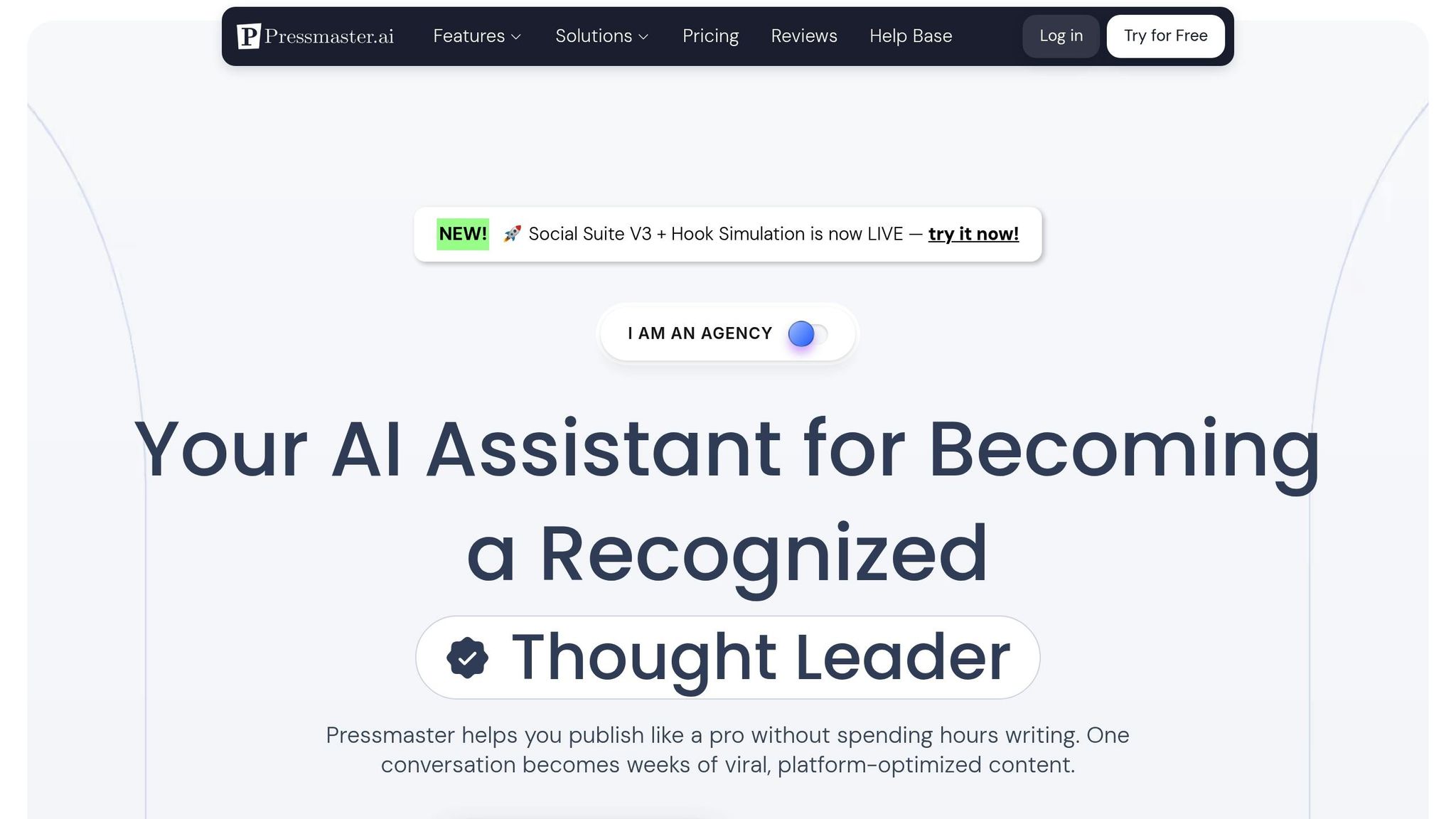
With a clear strategy and quality checks in place, Pressmaster.ai can amplify your PR efforts. This all-in-one platform is designed to scale high-quality content creation for professionals.
Start by defining your brand voice and content objectives. Pressmaster.ai’s voice replication tools learn from your existing content, ensuring every piece reflects your organization’s authentic tone. Additionally, the AI Strategizer, trained on over 1 million viral articles, helps identify content angles that resonate with your audience.
The Trendmaster feature scans over 500,000 sources daily, spotting emerging industry trends weeks before they hit the mainstream. This gives you a competitive edge, allowing you to craft timely, relevant content that positions your brand as a leader.
Use the conversational interview mode to transform your insights into polished articles and social media posts. The External Interview feature extends this capability, enabling you to collect expert input from team members or clients with minimal effort.
Pressmaster.ai’s unified analytics dashboard consolidates performance data from all your platforms, saving you the hassle of juggling multiple tools. This streamlined approach makes it easier to identify what’s working and fine-tune your strategy.
Whether you’re a startup aiming to establish thought leadership, a business scaling its content efforts, or an agency managing diverse clients, Pressmaster.ai offers the tools and insights to create content that feels genuine and builds trust. Its white-label capabilities and multi-workspace features make it especially valuable for agencies catering to clients with varied needs and voices.
The future of PR belongs to those who can seamlessly combine AI’s efficiency with the authenticity and insight only humans can provide. Pressmaster.ai serves as the foundation for this balance, taking care of execution so you can focus on the strategy, relationships, and expertise that drive real results.
FAQs
How can I make sure AI-generated content matches my brand's voice and style?
Pressmaster leverages advanced AI to capture your brand's tone, values, and style, ensuring the content aligns perfectly with your messaging. By analyzing your existing materials and preferences, it produces content that not only reflects your unique voice but also connects with your audience on a deeper level.
This method strengthens trust and fosters a sense of connection, delivering a consistent experience that genuinely reflects your brand.
How can I ensure AI-generated content feels authentic and builds trust with my audience?
To craft content that feels genuine and reliable while using AI, focus on keeping a human touch and aligning your message with what matters to your audience. Think of AI as a tool to enhance your writing, not as a replacement for your personal style. Always take the time to refine and customize the AI-generated output so it reflects your unique voice and perspective.
Being open about your use of AI, when appropriate, can go a long way in building trust with your readers. On top of that, leverage AI's ability to analyze what your audience values and create content that speaks directly to them. When you combine the precision of AI with your own creativity, you can create content that not only engages but also earns the trust of your audience.
How can I measure the success of AI-generated content and improve it effectively?
To gauge how well your AI-generated content is performing, focus on key performance indicators (KPIs) that match your objectives. These could include metrics like engagement rates (likes, shares, comments), conversion rates, time spent on page, and bounce rates. Tools like Google Analytics or similar platforms can help you monitor these numbers and spot trends.
To fine-tune your content, dig into the data to uncover areas where it could be more engaging or relevant. Experiment with A/B testing to compare different tones, styles, or formats and find out what clicks with your audience. Don’t overlook the value of feedback - ask your audience or team for their thoughts to make sure your content feels relatable and credible. By blending data-driven insights with real-world input, you can make smarter adjustments that boost both performance and trust.
Related Blog Posts








Sign Up for our Pressmaster Newsletter
Sign up for our Pressmaster.ai newsletter to get instant alerts on trending topics, ensuring you stay ahead in your field with the latest insights and updates.


.avif)
.png)

.avif)


7 Viral Patterns That Drove 10,643% Growth
Turn natural conversations into content gold, make every insight count, and drive real conversations.

Please fill out the form to get our Viral Cheat Sheet


How to Become a Thought Leader in 6 Easy Steps
Increase your visibility, establish authority, and conquer your market with minimal effort.

Please fill out the form to get our PDF Checklist
