
How to Use AI for Writing Content That Speaks Your Brand Language

AI tools can help you write faster and more consistently while keeping your brand’s tone and style intact. By analyzing your existing content, these tools learn your brand voice - your unique tone, vocabulary, and messaging - and use it to create tailored content for blogs, social media, and more. This ensures every piece feels like it comes from your brand, saving time and reducing errors.
Key Takeaways:
- AI learns your brand voice by analyzing 3–5 high-quality samples.
- It can produce content 10x faster while maintaining consistency.
- Inconsistent branding can cost companies up to $1.5 million annually.
- Tools like Pressmaster.ai simplify the process by training on your existing content and creating platform-specific posts.
Steps to Get Started:
- Define your brand voice: Review your content for tone, style, and recurring themes.
- Train the AI: Upload writing samples and style guidelines.
- Create a brand profile: Include your audience details, tone preferences, and messaging points.
- Use AI to generate and adapt content for multiple platforms.
- Review and refine: Edit AI drafts to ensure accuracy and emotional connection.
AI doesn’t replace your voice but amplifies it, helping you scale content creation while staying aligned with your brand identity.
How to Define Your Brand Voice
What Is a Brand Voice?
Your brand voice is how your business expresses itself through tone, style, and values - it’s essentially your brand’s personality in written and spoken form. It’s what makes your content distinct and instantly recognizable, even without a logo or branding.
A well-defined brand voice sets you apart from generic messaging. It’s the difference between blending in with the crowd and standing out in a way that your audience connects with on a deeper level.
"The irony is powerful: In an age of artificial intelligence, human authenticity becomes MORE valuable, not less." - Pressmaster.ai
This idea of authenticity is more critical than ever. Audiences today are highly discerning; they can quickly spot the difference between genuine, thoughtful content and something that feels mass-produced or insincere. A strong, consistent brand voice gives you an edge in a noisy marketplace.
Consider examples like Nike’s inspiring and motivational tone, Mailchimp’s quirky and approachable style, or Apple’s sleek and minimalist messaging. These brands have carefully shaped their voices to resonate with their audiences while staying true to their core values. Once you understand what makes your voice unique, you can focus on defining it and using it consistently.
Steps to Define Your Brand Voice
Defining your brand voice takes a thoughtful approach rooted in your existing content and values. Start by reviewing your current content. Look for patterns in tone, style, and recurring themes. Pay attention to the language you use - whether it’s formal or casual, concise or detailed, direct or reflective - and note the emotions it conveys.
Ask yourself: Does your content feel conversational or professional? Is it more playful or serious? These observations can help you uncover your natural voice, even if you haven’t formally defined it yet.
Next, think about your target audience. Who are they, and what do they care about? Understanding their demographics, interests, and challenges will help you shape a voice that connects with them. For instance, a younger audience might respond well to an upbeat, casual tone, while a more corporate audience might prefer clear, straightforward language. By aligning your voice with your audience’s preferences, you create a foundation for all your future content.
Once you’ve identified your voice, document it in a brand voice guide. This guide should include:
- Tone characteristics: Is your tone professional, friendly, authoritative, or playful?
- Style preferences: Guidelines for sentence length, vocabulary, and formatting.
- Core messaging points: Key themes and values that define your brand.
- Practical tips: How to handle humor, address sensitive topics, and avoid specific words or phrases.
It’s also important to involve people from different teams - marketing, sales, customer service, and beyond. Your brand voice should work across every touchpoint, from ads to customer interactions. A voice that feels polished in marketing but awkward in customer service won’t serve your brand well.
Above all, your brand voice should reflect who you truly are as a company. If you try to adopt a tone that doesn’t match your culture or values, it will feel forced and inauthentic to your audience.
"The distinctive qualities of your thinking and expression are what will help you stand out in a world of abundant content." - Pressmaster.ai
Once your voice guide is complete, test it with sample content and gather feedback from your audience. Adjust as needed to ensure it resonates. A clear, well-documented brand voice not only unifies your messaging but also helps AI tools produce content that genuinely reflects your identity.
How to Use AI Without Losing Your Brand Voice
How to Train AI Tools to Match Your Brand
Training AI to reflect your brand's voice involves teaching the platform your unique communication style, core messaging, and preferences. When done effectively, the AI can generate content that feels like it was written by your team.
The process revolves around providing examples, clear guidelines, and interactive feedback. This combination helps the AI grasp not just what you say, but how you say it. The result? Content that embodies your brand's personality and expertise.
Upload Writing Samples and Style Guidelines
Your existing content is the starting point for training AI to match your brand's voice. Gather a collection of high-quality examples - blog posts, email newsletters, social media updates, marketing copy, and anything else that showcases your brand's style. Be selective: avoid pieces that stray from your voice or were created during transitional periods. Include a variety of formats to demonstrate how your tone adapts while staying consistent.
Platforms like Pressmaster.ai simplify this process. By analyzing your website, these tools can automatically detect your brand's patterns and preferences, eliminating the need to manually upload individual files.
"In this video, I'll show you how to set your brand guidelines and train Pressmaster AI to understand your unique brand voice by analyzing your website and using sample content." - Feisworld Media, Business Strategist [1]
Alongside writing samples, provide detailed style guidelines. These should include your preferred tone, formatting, and language. Highlight specific phrases or terminology you use frequently, your audience approach (formal or casual), and how you structure sentences and paragraphs.
Equally important is specifying what not to do. If certain buzzwords, jargon, or phrases don't align with your brand, make that clear. These "negative" guidelines are just as essential as the positive ones for keeping AI-generated content on-brand.
By combining writing samples with clear instructions, AI platforms can better replicate your voice across different types of content. Next, refine the process by defining your key messaging points.
Set Up Your Key Messaging Points
Key messaging points are the themes, values, and insights that should consistently appear in your content, no matter the format or topic. These aren’t just catchy slogans - they’re the core ideas that define your brand and make it stand out.
Start by identifying your unique expertise. This could be industry insights, frameworks you've developed, or perspectives that challenge conventional thinking. These elements become the intellectual backbone of your content, setting it apart from generic AI output.
"The distinctive qualities of your thinking and expression are what will help you stand out in a world of abundant content." - Pressmaster.ai [1]
To develop these points, dig into what makes your brand different. What connections do you see that others might miss? What experiences have shaped your perspective? These insights form the foundation of your messaging strategy.
When inputting these themes into AI platforms, be specific. Don’t just list broad topics like "customer service." Instead, explain your unique take, such as: "Customer service should focus on proactive problem-solving rather than reactive support."
Some platforms, like Pressmaster.ai, offer tools like "Expertise Interviews" to extract insights directly from you. The AI asks targeted questions to uncover your perspective and translates those ideas into actionable messaging points.
Document your messaging in a way that’s easy for the AI to follow. Include examples of how these themes should come across, supporting evidence, and ways to connect with your audience. This ensures every piece of content reinforces your brand’s identity. Once your messaging is set, the next step is creating a full brand profile.
Create Your Brand Profile in AI Platforms
A comprehensive brand profile ties everything together, serving as a central guide for AI-generated content. It ensures your voice remains consistent across all channels, regardless of who’s creating the content or where it’s being published.
Start by detailing your target audience. Include demographics, interests, challenges, and communication preferences. The more specific you are, the better the AI can tailor content to resonate with your audience. Consider factors like their expertise level in your field, common concerns, and the type of language they connect with.
Platforms like Pressmaster.ai excel in building brand profiles through interactive processes. For example, they can conduct AI-led interviews where you speak your thoughts instead of writing them. This conversational method often captures nuances that formal writing might miss.
"Pressmaster learns your unique voice and beliefs, creating content that sounds like you wrote it." - Pressmaster.ai [1]
These interviews are valuable because they reveal how you naturally structure arguments, connect ideas, and use examples. The AI uses this information to replicate not just your voice, but your thought process.
Configure your platform settings to align with your tone, language, and structure. This includes sentence length, paragraph style, humor usage, and how you handle sensitive topics or incorporate data.
Once your brand profile is set, many users find the results surprisingly accurate. Thomas Preiss, a Sales Development Coach, shared his experience: "Once your brand voice is in there it's amazing how close each article gets to the way I would write." [1]
Don’t forget practical details like your publishing schedule, preferred content lengths, and any legal or compliance requirements. Regularly update your brand profile to reflect changes in your voice or strategy. Periodic reviews ensure the AI stays aligned with your current goals and priorities, keeping your content relevant and engaging.
Create Content for Multiple Platforms with AI
Once your AI gets a solid grasp of your brand voice, its real power shines when creating content for different platforms. With a trained AI that aligns with your messaging, you can expand its use across various channels. While each platform has its own audience preferences and formatting requirements, your core message should stay consistent. AI can adjust your voice to fit these unique needs without losing the essence of what makes your brand stand out. This ability to seamlessly shift tone and style lays the groundwork for successful multichannel strategies.
The tricky part? Tailoring content for each platform while staying true to your voice. AI tools don’t just learn your voice - they also understand how to adapt it across different contexts. Your core message can take the form of a blog case study, a quick Twitter tip, or a professional insight on LinkedIn, all while sounding unmistakably like you.
Adapt Content for Different Platforms
Adapting content isn’t just about tweaking word counts or throwing in a few hashtags. Each platform has its own algorithms, audience behaviors, and engagement trends that shape how content should be structured. AI tools trained on your brand voice can fine-tune these elements while keeping your messaging intact.
Think of it this way: social media platforms have distinct personalities. LinkedIn leans toward professional insights, Twitter thrives on punchy observations, and Instagram rewards visual storytelling paired with engaging captions. AI tools analyze these nuances and reformat your content to match.
When it comes to press releases, for example, the tone needs to be formal, the structure precise, and elements like datelines and boilerplate information must be included. AI can take your conversational insights and transform them into press-ready material that reflects your perspective on industry updates.
Platforms like Pressmaster.ai's Social Suite showcase this adaptability. It can take a single article and rework it into over 15 platform-specific posts, optimizing each one based on engagement data from more than 50,000 viral posts. This isn’t just adaptation - it’s leveraging data to craft content that works.
The secret lies in training your AI to not only understand what you say but also how you’d naturally adjust your tone for different audiences. For instance, a marketing agency used AI tools to create distinct brand voices for each client. They generated blog posts, social updates, and email campaigns that perfectly captured each client’s unique style across all platforms [5]. With this tailored approach, AI also speeds up production through rapid content versioning.
Generate Multiple Content Versions Quickly
Once your brand voice is established, AI turns the old trade-off between speed and consistency on its head. It can produce multiple versions of content from a single idea, cutting down on the time spent manually adapting content for different platforms.
This approach is a massive time-saver. Imagine generating 30 days’ worth of content in just one hour - all from a single brainstorming session. AI takes care of the repetitive adjustments, leaving you free to focus on strategy and creativity.
"Pressmaster drastically cuts my content time. It captures my voice, finds trending topics, and publishes everywhere - blog, socials - all done in under 30 minutes. Total game-changer." - Emmy W., Fractional CMO & Agency Owner [1]
These variations go beyond simple format changes. AI can take one business insight and spin it into a how-to guide, a case study, an industry prediction, or even a personal reflection. Each version stays true to your brand voice while appealing to different audience preferences.
Of course, quality control remains critical. The best AI platforms come with built-in tools for checking plagiarism, verifying facts, and ensuring content authenticity. This guarantees that speed doesn’t come at the expense of accuracy or originality - qualities your audience values.
To measure the success of this multi-platform approach, businesses should monitor metrics like engagement rates (likes, shares, comments), click-through rates, conversion rates, and brand sentiment across platforms [4][6]. These numbers will show whether your AI-generated content is resonating with your audience while scaling production.
The ultimate goal isn’t just creating more content - it’s creating better content that stays true to your brand while meeting the demands of each platform. Done right, this strategy enables thought leaders to increase their content output tenfold without compromising the quality or authenticity that built their reputation [1].
Check and Improve AI-Generated Content
AI tools are powerful allies in content creation, but they still need a human touch to truly shine. Think of AI as your co-writer - it handles the heavy lifting, while you refine its output to match your brand's voice, ensure accuracy, and connect emotionally with your audience. This partnership can turn decent content into something that resonates on a deeper level.
The goal isn't just to fix errors; it's to elevate the content so it feels like a genuine reflection of your brand. That means ensuring your tone is consistent, your facts are solid, and your message strikes the right emotional chords. The end result? Content that builds trust and authenticity with your readers. Before finalizing any draft, take a step back to confirm it aligns with your brand’s personality and values.
Edit and Review AI Content
When reviewing AI-generated content, start by checking for consistency in voice and tone. Does the content sound like it came from your brand? Is it conversational and engaging, or does it feel too stiff and generic? AI can sometimes default to overly formal language, so adjust phrasing to better reflect your unique style.
Fact-checking is another critical step. Cross-reference claims with reliable sources, especially when the content includes statistics or time-sensitive information. This ensures your audience gets accurate, up-to-date insights.
For U.S.-based audiences, cultural relevance matters. Make sure the content uses American English, formats currency as USD (e.g., $1,234.56), follows the MM/DD/YYYY date format, and employs imperial measurements where appropriate.
While grammar and readability are important, don’t overdo it. Polishing too much can strip away the quirks and personality that make your brand stand out. As Pressmaster.ai aptly puts it:
"The goal isn't to sound like everyone else with a polished, perfect voice. The goal is to sound unmistakably like yourself, with all the quirks, imperfections, and distinctive patterns that make your thinking unique."
Use AI Tools for Plagiarism and Fact-Checking
Ensuring originality is a cornerstone of maintaining your brand’s credibility. Many AI platforms now include tools to detect plagiarism and verify facts, giving you an added layer of protection before publishing. These tools scan massive databases to flag potential overlaps or inconsistencies in your content.
For fact-checking, AI can highlight claims that might not align with current data. While these automated systems are a great starting point, they aren’t foolproof. For sensitive topics or niche industry insights, a human review is essential to guarantee accuracy and context.
Some AI tools even offer citation management, suggesting sources for statistics or claims. This feature is especially handy when creating in-depth content that pulls from multiple references, like thought leadership pieces or industry reports.
When to Use AI vs. When to Make Manual Changes
Once you've refined the content, it’s time to decide what needs further human input. Striking the right balance between AI-generated text and manual edits is key to maintaining quality and authenticity. For routine content - like social media posts, product descriptions, or straightforward blog articles - AI can often handle the bulk of the work with just a light human review.
However, for high-stakes messaging - such as crisis communications, major product launches, or commentary on sensitive issues - human involvement is non-negotiable. These situations demand the nuance and emotional intelligence that only people can provide.
AI is great at generating drafts, brainstorming ideas, and offering multiple perspectives on a topic. It can even suggest headlines and angles to explore. But when it comes to content that requires personal stories, deep insights, or strategic messaging, manual intervention is crucial.
Consider your audience’s expectations when deciding how much human input is needed. Content aimed at building thought leadership or personal branding often benefits from a more hands-on approach. As Pressmaster.ai wisely notes:
"AI can help you say things better. But only you can decide what's worth saying."
Finally, track performance metrics like engagement and click-through rates to refine your approach over time. You might find that some topics thrive with more human involvement, while others perform well with AI-driven efficiency and minimal editing. This data can help you fine-tune your content strategy for maximum impact.
Track Your Content Performance
Once you've fine-tuned your AI-generated content, the next step is to evaluate its impact. AI-generated content is just the starting point; tracking its performance ensures your messaging aligns with your brand identity and resonates with your audience.
Performance tracking isn’t just about basic metrics like page views. It’s about digging deeper to see if your content truly reflects your brand voice and achieves its intended goals. The insights you gather form the basis for refining your strategy and creating content that connects on a meaningful level.
Think of it as a feedback loop: you publish content, your audience reacts, and their responses help you determine what’s working and where adjustments are needed.
Monitor Engagement and Key Metrics
To assess how well your content represents your brand, focus on metrics that reveal engagement and effectiveness.
- Time on page: This metric shows how long readers stay with your content. If you see high traffic but low time on page, it might mean the content isn’t meeting audience expectations or aligning with your brand’s tone.
- Conversion rates: These are critical for evaluating how effectively your content turns visitors into subscribers, customers, or leads. A low conversion rate could indicate a mismatch between your brand’s message and the content’s delivery.
- Social media engagement: Look beyond likes to see which posts spark meaningful conversations. Comments, especially thoughtful ones, indicate that your brand voice is resonating and sparking genuine interest.
- Sentiment analysis: Tools that track the emotional tone of audience feedback - categorizing it as positive, neutral, or negative - can provide valuable insights. Monitoring sentiment trends over time can help you determine whether your AI-generated content is strengthening your brand perception or missing the mark [2][3].
Don’t overlook email click-through rates and organic search performance. A sudden drop in email engagement or a decline in search rankings might signal that your content isn’t hitting the right notes. For instance, a spike in email unsubscribes could mean your AI-generated emails feel off-brand.
Use Data to Improve AI Content
Performance data isn’t just numbers - it’s a guide for fine-tuning your AI content. By identifying patterns and trends, you can make adjustments that bring your content closer to your brand’s voice.
- Analyze top-performing content: Look at the tone, structure, and language of your best-performing pieces. These examples can serve as templates for future AI-generated content.
- Segment your data: Break down performance by content type, platform, and audience. You might find that a professional tone works well on LinkedIn, while a more relaxed style performs better on Instagram.
- Test variations with A/B testing: Experiment with different tones or approaches - formal versus conversational, for example - and let the data guide your decisions. Tools like Pressmaster.ai can make tracking these tests seamless.
- Conduct regular audits: Set up monthly or quarterly reviews to evaluate trends and update your AI’s training materials. This helps ensure your brand voice stays consistent and effective over time.
- Assess cross-platform performance: If your blog content excels but social media posts fall flat, it might be time to adapt your tone for different platforms.
You can also gather direct audience feedback through surveys or polls. Asking questions like, “Does this content feel like our brand?” can reveal gaps between your intended voice and how your audience perceives it.
The aim isn’t to achieve perfection but to keep improving. Every piece of data is a chance to refine your AI-generated content and make it more aligned with your brand.
How Pressmaster.ai Helps You Track and Improve Your Content Performance
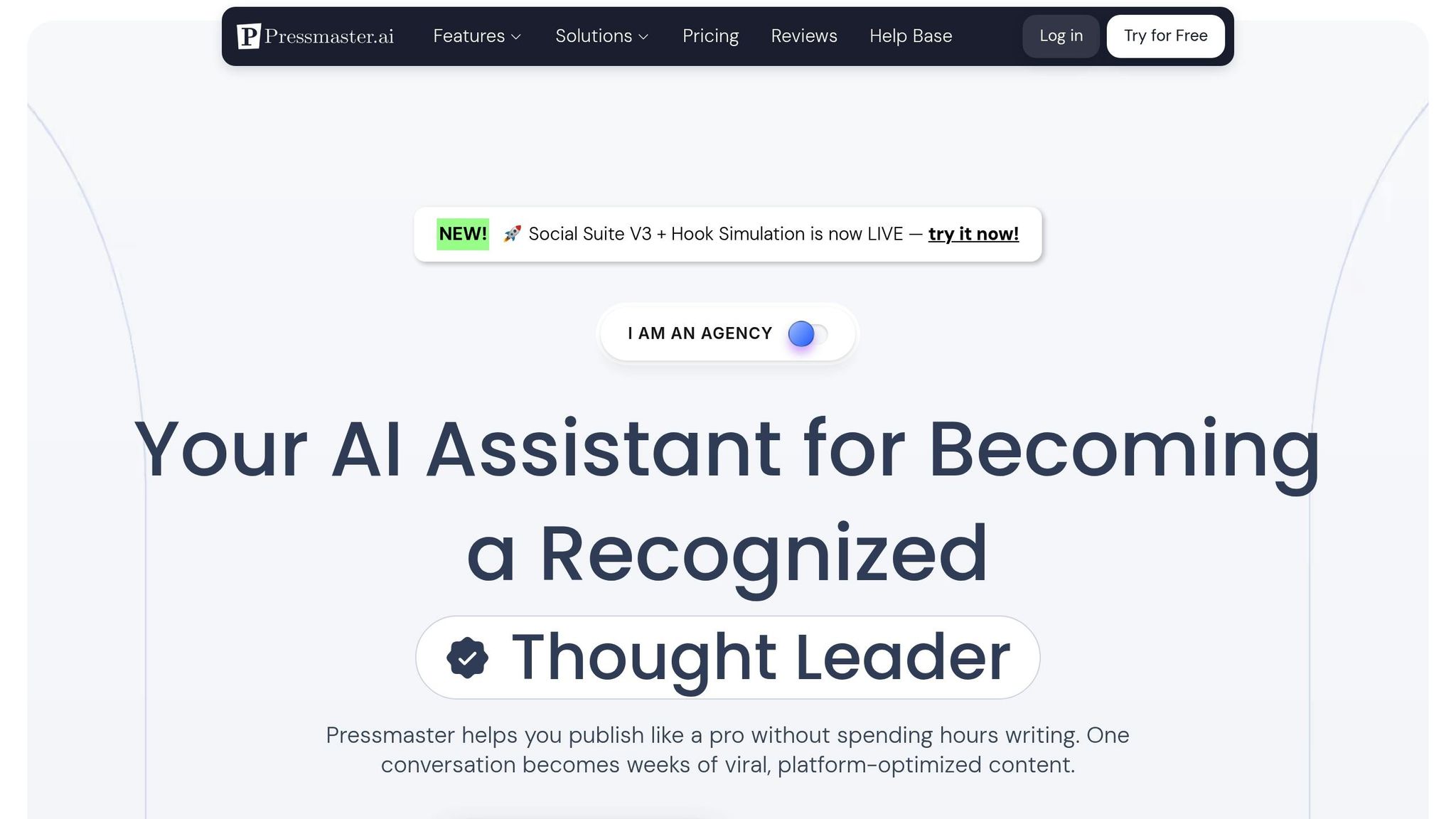
Pressmaster.ai simplifies performance tracking by offering a unified analytics dashboard that pulls metrics from all your connected platforms into one easy-to-read view. This allows you to monitor your AI-generated content’s performance in real time, across all channels.
The platform’s AI Strategizer uses data from over 1 million viral articles to provide actionable recommendations tailored to your audience. Instead of just tracking results, you’ll know exactly what content strategies and angles are likely to work best.
With Trendmaster, which scans 500,000+ data sources daily, you can anticipate emerging trends and adjust your content strategy weeks before they gain traction. This gives your brand a proactive edge, keeping your messaging relevant and authoritative.
For brands managing multiple campaigns, the multiple workspace feature allows you to track performance separately for each brand or audience segment. Plus, white-label reporting ensures you can present polished, professional reports while maintaining your brand’s identity throughout the process.
Conclusion: Get Started with AI for Brand-Focused Content
Creating content that reflects your brand’s unique voice isn’t about letting AI take over - it’s about using AI to amplify what sets you apart. Smart businesses understand that while AI can handle repetitive tasks like content creation and distribution, it’s your authentic perspective and expertise that truly resonate.
Start by clearly defining your insights, rooted in your experience and knowledge. Then, train your AI using your writing samples, style guidelines, and key messaging. This ensures the AI reflects your voice rather than replacing it.
"AI serves as an amplifier. It helps us create more. It helps us share more. It helps us connect more. But it will never replace the fundamental aspects of human interaction." – Pressmaster.ai
Take it a step further by setting up multiple brand voice profiles within your AI platform. Tailor these profiles for different audience segments or platforms to ensure your message stays consistent and relevant[2][5].
As AI handles routine tasks, your focus on originality and creative thinking becomes even more critical. Use AI to help refine and expand your ideas, keeping your content authentic while reaching a wider audience. This collaborative process allows you to maintain your brand’s unique identity while leveraging AI’s capabilities.
Platforms like Pressmaster.ai make this easier by capturing your communication style and identifying emerging trends before they become mainstream. This enables you to scale your content efforts without losing the genuine voice that defines your brand.
Choose a topic where your expertise shines, define your approach, and let AI help you refine and expand that perspective. With the right tools, you can amplify your voice and create content that sparks meaningful engagement across platforms.
The future belongs to brands that combine human insight with AI’s efficiency. By embracing this partnership, you can create content that not only stands out but also builds lasting connections.
FAQs
How can I make sure AI-generated content matches my brand's voice and values?
To make sure AI-generated content matches your brand's voice and values, start by sharing examples of your current content. This might include blog articles, website copy, or marketing materials that showcase your tone and messaging style. These samples allow the AI to understand and reflect your brand's personality.
You can also refine the output by providing detailed guidelines. Specify things like preferred terminology, tone, or stylistic preferences. This way, the AI can deliver messaging that's consistent and connects well with your audience.
How can I train AI tools to match my brand voice for social media, blogs, and other platforms?
To make sure AI tools reflect your brand voice consistently across various platforms, start by sharing examples of your current content. This could include website copy, blog posts, or social media updates. These samples give the AI a clear sense of your tone, style, and messaging.
You can also fine-tune the AI’s output by providing feedback on the content it creates. Point out areas that need tweaking or adjustments. Over time, this back-and-forth helps the AI produce messaging that feels more tailored and aligns seamlessly with your brand across all platforms.
How can I measure the success of AI-generated content in improving my brand’s engagement and conversions?
To gauge how well AI-generated content is working for your brand, keep an eye on key performance indicators (KPIs) that reflect your goals. If engagement is your focus, look at metrics like post interactions, comments, shares, and the time users spend on your pages. For conversions, track things like click-through rates, leads generated, and sales tied to specific pieces of content.
Leverage analytics tools to collect data and compare results before and after introducing AI-generated content. On top of that, consider running surveys or gathering customer feedback to see how your audience feels about the content. Regularly reviewing these metrics helps you fine-tune your approach, ensuring your content delivers real, measurable results.
Related Blog Posts








Sign Up for our Pressmaster Newsletter
Sign up for our Pressmaster.ai newsletter to get instant alerts on trending topics, ensuring you stay ahead in your field with the latest insights and updates.


.avif)
.png)

.avif)


7 Viral Patterns That Drove 10,643% Growth
Turn natural conversations into content gold, make every insight count, and drive real conversations.

Please fill out the form to get our Viral Cheat Sheet


How to Become a Thought Leader in 6 Easy Steps
Increase your visibility, establish authority, and conquer your market with minimal effort.

Please fill out the form to get our PDF Checklist
