Founder Attention Is the New Oil: How to Turn It Into 25–35 Inbound Leads a Month on LinkedIn
Most founders post, collect likes and wait for messages that never come. This is the system that turns LinkedIn attention into 25–35 qualified conversations a month, from zero.
Alex from Pressmaster.ai
October 27, 2026
11 min read
You open LinkedIn and see the same few names from your market, every single day. Their posts pull hundreds of reactions. Your last one got eleven.
You know you're better at the work. Buyers have no way of knowing that. All they see is the feed.
Meanwhile your pipeline runs on referrals. A strong quarter, then a quiet one, and no way to switch it back on.
That's why founder attention is the new oil. The founders who have it get the first call when a buyer starts looking. Everyone else waits for the next referral.
This guide shows you how to build the refinery: borrow attention you don't have yet, get buyers to show themselves, and turn that into 25–35 qualified conversations a month. From zero, without becoming an influencer, and mostly on autopilot.
It starts with where the leads actually are, which is probably not where you've been looking.
Where the leads actually are
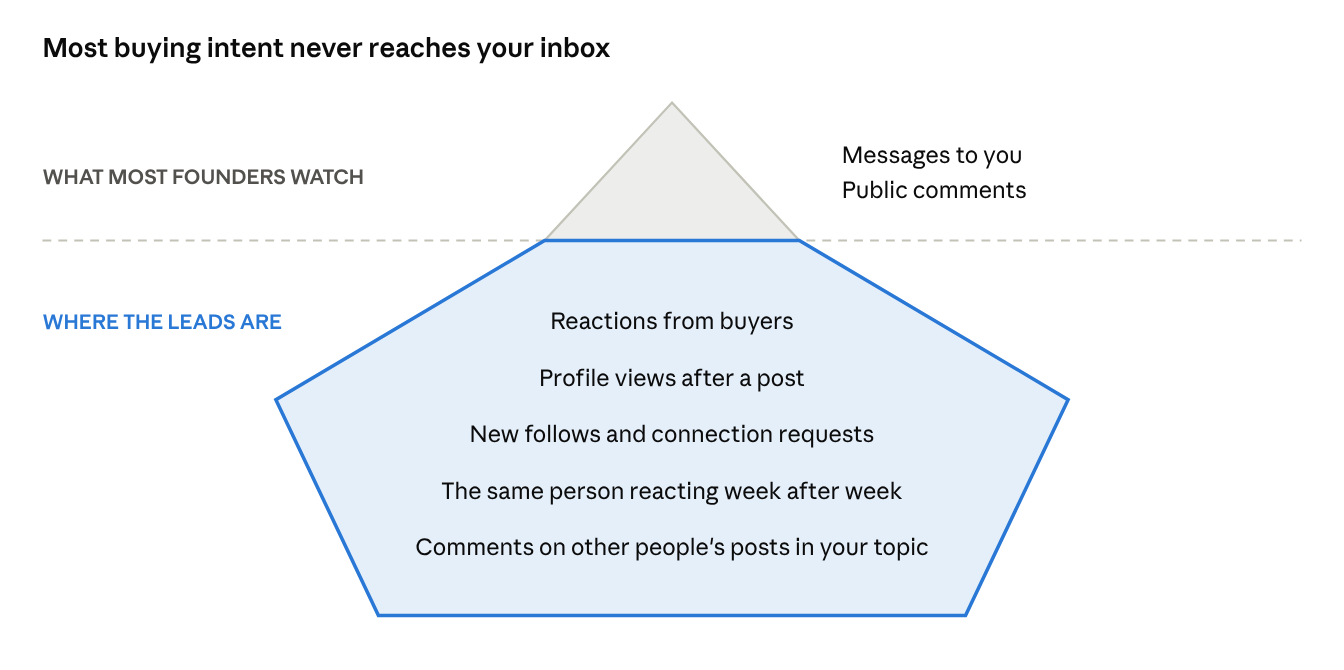
Most founders judge LinkedIn by their inbox. If nobody writes, it isn't working.
Interested buyers rarely write first. A first message means admitting a problem to a stranger, and senior people put that off as long as they can.
So they do quieter things. They react to a post, open your profile, follow you, and come back next week to read the next one.
Each of those moves is a buyer raising a hand a few centimetres. Alone it looks like nothing. Collected over a month, it's your pipeline.
The founders pulling 25–35 leads a month read everything below the waterline and start the conversation themselves, usually days before the buyer would have reached out to anyone.
Whoever reaches that buyer first tends to become the favourite on the list.
The attention refinery
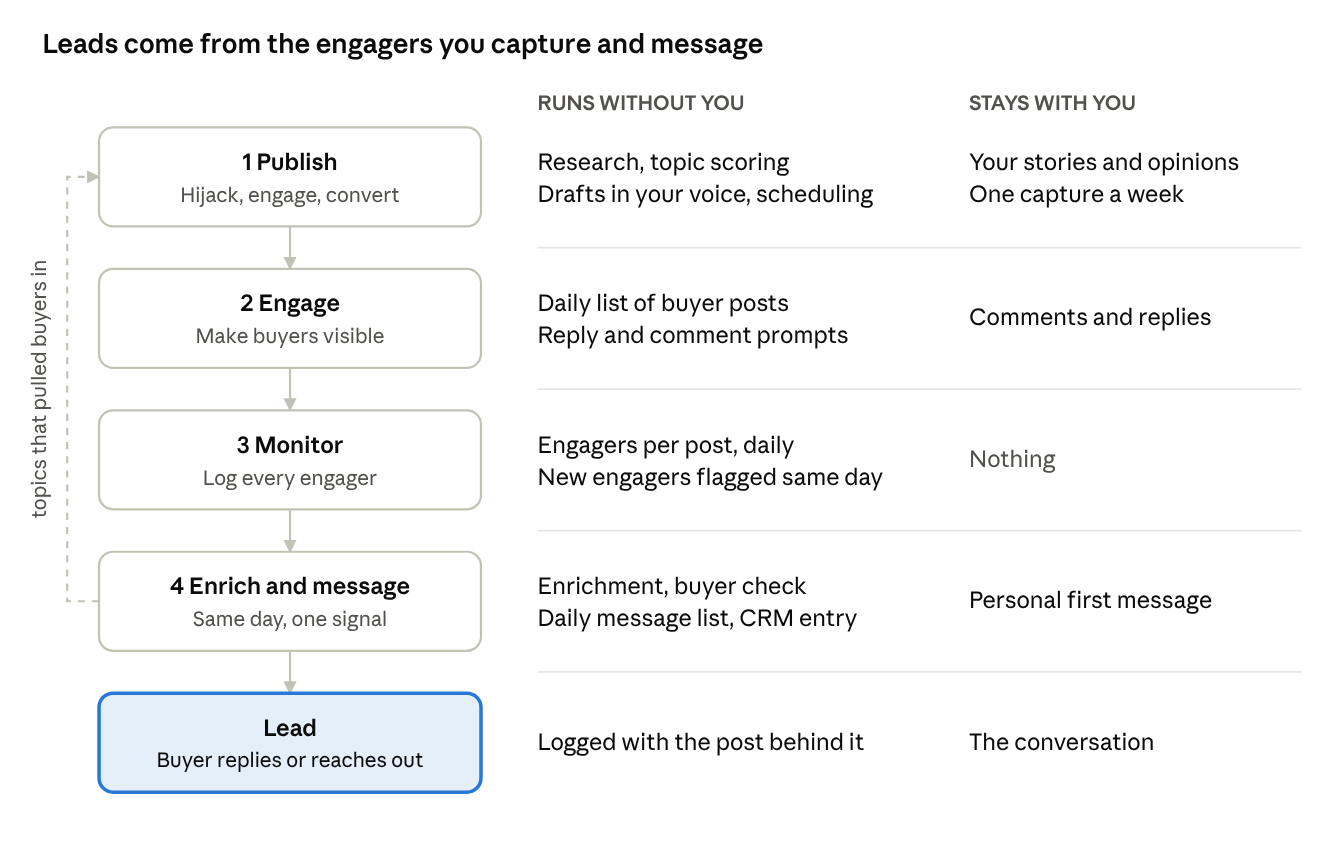
Crude attention is worth little until you refine it. The system has four stages, and each one turns the output of the last into something closer to a deal.
The middle column runs on a schedule. The right column is the part buyers can tell is you, so it stays with you.
Watch the dashed line on the left. Every month the list shows which topics pulled buyers in, and next month's content leans into them. That loop is why the system gets better the longer it runs, and why starting three months after a competitor puts you three months behind.
No audience yet? Then don't try to build reach the slow way. Borrow it.
Every week your buyers are already paying attention to something. Your content strategy is mostly about showing up there with something worth reading.
Hijack reach (50% of posts)
A hijack attaches your expertise to something your buyers are already watching, while it's still moving.
Timing decides whether a hijack works.
Get in while attention is still rising. The topic carries the reach, readers arrive already caring, and you skip the warm-up. After the peak, you're talking to a room that's emptying.
Set up your trend watch
You can't scroll your way to the first take. Speed needs a system.
Give a research agent three jobs:
Watch the 10–20 accounts your buyers actually read
Pull what's going viral in your niche in the last 48 hours
Flag which takes people are arguing with in the replies
The arguments are your opening. Where people push back, there's room for an expert to settle it.
Then read the comments under top creators' posts. That's where your buyers write down what they care about in their own words: the problem, the worry, the question nobody has answered for them. Each of those is your next Engage post.
The hijack test. Before you publish, you need four yeses:
Is the topic still moving, with new posts and comments in the last 48 hours?
Do your buyers care about it, beyond your peers?
Do you have an angle nobody has posted yet?
Does it lead back to the problem you solve?
One no and you skip it. A hijack that reaches the wrong people fills your list with noise.
Engage (30% of posts)
These posts describe your buyers' problems so precisely that they comment "this is us."
The best source for them is your sales calls. Mine them:
Pull 90 days of call transcripts or notes.
Write down every objection, question and complaint, word for word.
Count how often each one comes up.
Turn the top ten into posts, with the buyer's own words in the first line.
The difference shows in the first line. "Pricing strategy matters for consultancies" gets scrolled past. "Three proposals out this month, one signed, and two went quiet after 'let me run it by the team'" gets the comment.
Convert (20% of posts)
These posts make the next step obvious: client results with numbers, how you work, who it's for and who it isn't for, and how to start.
Skip them and buyers will like you, trust you, and still not know what to do next.
Make every post felt
Most expert posts are useful, and useful gets scrolled past. The ones that spread make the reader feel something before they learn anything.
The test before you publish: if a post can be described as useful but not felt, rewrite it.
Stack them. One trigger gets a glance. Two or three together keep people reading, commenting and sharing. Use at least two per post, aim for three, and put T5 in every hook.
The stacks that fit each part of the mix:
Hijack: Open a loop + Expose the gap — Shows a problem they didn't know they had
Engage: Expose the gap + Feel seen — Warms up cold or sceptical buyers
Convert: Open a loop + Achievable — Makes the result feel within reach
A weak hook names a topic: "How to get more engagement." A strong one names an outcome they want and holds back how: "The post structure that booked 47 calls in 72 hours."
Runs without you: trend watch, hijack scoring, transcript mining, drafts in your voice, scheduling.
Stays with you: your angle on each hijack, and one voice note a week with your stories.
Most buyers who read you will never comment. They read, nod and scroll on, and you never learn they exist.
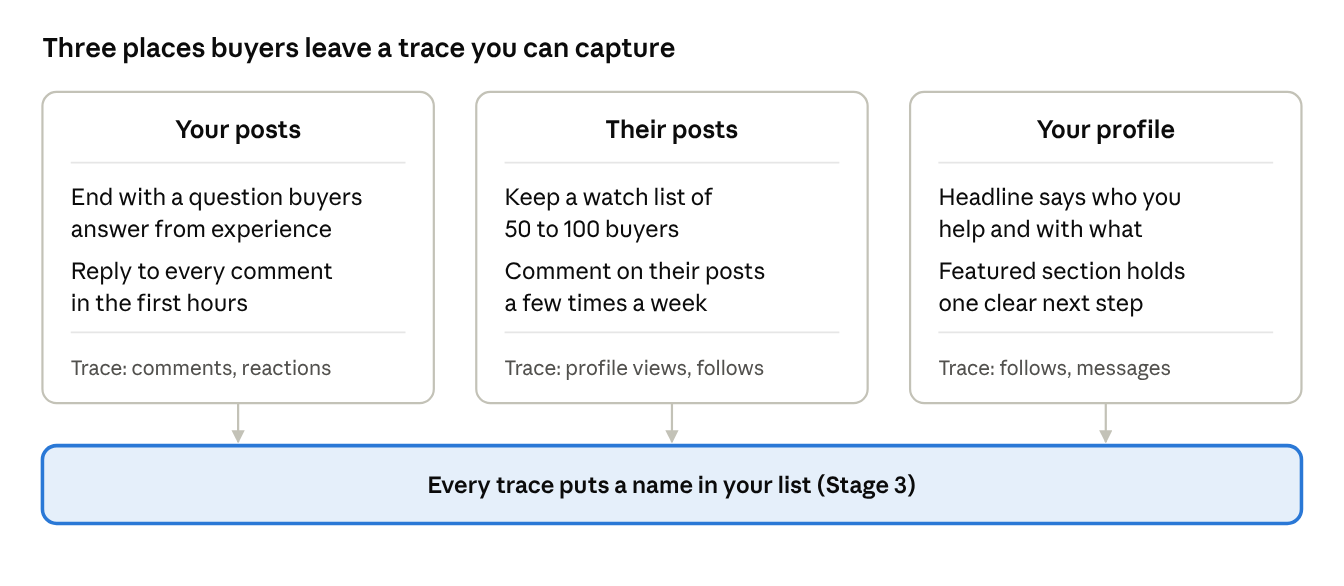
This stage makes leaving a trace easy, in three places.
Ask questions only buyers can answer
"Thoughts?" pulls in peers. A question about their situation pulls in buyers.
"What do you think about AI in finance?" gets opinions. "How many days does your team lose to month-end close?" gets a CFO telling you about her problem in public.
Reply to every comment in the first hours, and end each reply with a question. Every reply brings them back into the thread.
Aim for conversations
A like tells you someone saw the post. A conversation puts a buyer in a thread with you, in public, talking about their problem. That's the signal Stage 3 catches, and the one that starts most leads.
Build a watch list of 100 buyers
You don't need followers to get noticed. You need to show up where your buyers already are.
Start the list with:
Prospects who went quiet
Deals you lost in the last 12 months
Peers of your best clients: same role, similar company
People who already comment on posts in your topic
Comment on their posts a few times a week with something they'd want to answer. Many will check your profile, some will follow, and everyone who engages back lands in your list.
Turn your profile into a landing page
Every buyer who notices you checks your profile before deciding anything. Most founders' profiles are written for recruiters.
Headline: who you help and the result, in plain words
Banner: one line of proof
Featured: one post or page that shows the next step
About: the first three lines answer "can this person fix my problem?"
Runs without you: the daily list of buyer posts worth a comment, reply prompts, watch-list updates.
Stays with you: the comments. Automated comments read as automated, and they put your account at risk.
Stage 3: Catch every raised hand
Most founders skip this stage, and it's where the leads are.
A buyer who viewed your profile on Tuesday is buried under new notifications by Friday. Unless someone writes it down, that signal is gone.
Capture every new engager, every day: everyone who reacts, comments, views your profile after a post, follows or sends a connection request.
Don't wait for a second or third signal. One is enough to start a conversation, and every day you wait, the moment cools.
Keep one list
One row per person, with every signal attached.
Name, profile, headline: Who they are
The signal and its date: What they did and when
The post behind it: Which topics pull buyers in
Trigger stack of that post: Which stacks pull buyers, and which only pull likes
Score every post by buyers
Once a month, rank your posts by how many buyers they brought into the list, and ignore the reaction counts.
Keep the stacks and topics that pull buyers. Drop the ones that only pull peers. After three months you'll have a playbook built on your own market.
Keep your account safe
LinkedIn's terms ban scrapers, bots and tools that act on your account, and LinkedIn has taken scrapers to court.
Use tools that read your own post data at human volumes
Never hand your login to a tool that runs actions from another server
Never automate comments, messages or connection requests
Lose the account and you lose the whole refinery.
Runs without you: collecting every new engager daily, with the post that brought them in.
Speed wins here. A buyer who engaged today is thinking about your topic today. Tomorrow they're thinking about something else, and next week someone else may have written to them first.
So skip the scoring. Every new engager goes through the same five steps, the same day.
1. Enrich
Add role, seniority, company, company size, industry and website. Then answer one question: could this person buy from you, or bring you to someone who does?
Yes, and you message them today. No, and you move on.
2. Open the conversation
Refer to the exact thing they engaged with
Add one thought that continues it
Ask one question about their situation
Leave out the offer, the link and the calendar
Something like: "Saw your comment on the month-end post, the part about approvals stuck with the CEO. Is that a sign-off problem or a tooling one on your side?"
3. Add to CRM
Every conversation goes in with the post that started it. When they reply, you have a lead, and you know exactly which content produced it.
4. Continue
Keep showing up. Comment on their posts, answer in their threads, and pick the conversation back up when they engage again. The next post often does what the first message started.
Runs without you: spotting new engagers, enrichment, the daily message list, CRM entries.
Stays with you: the message. One that reads like a sequence undoes everything the content built.
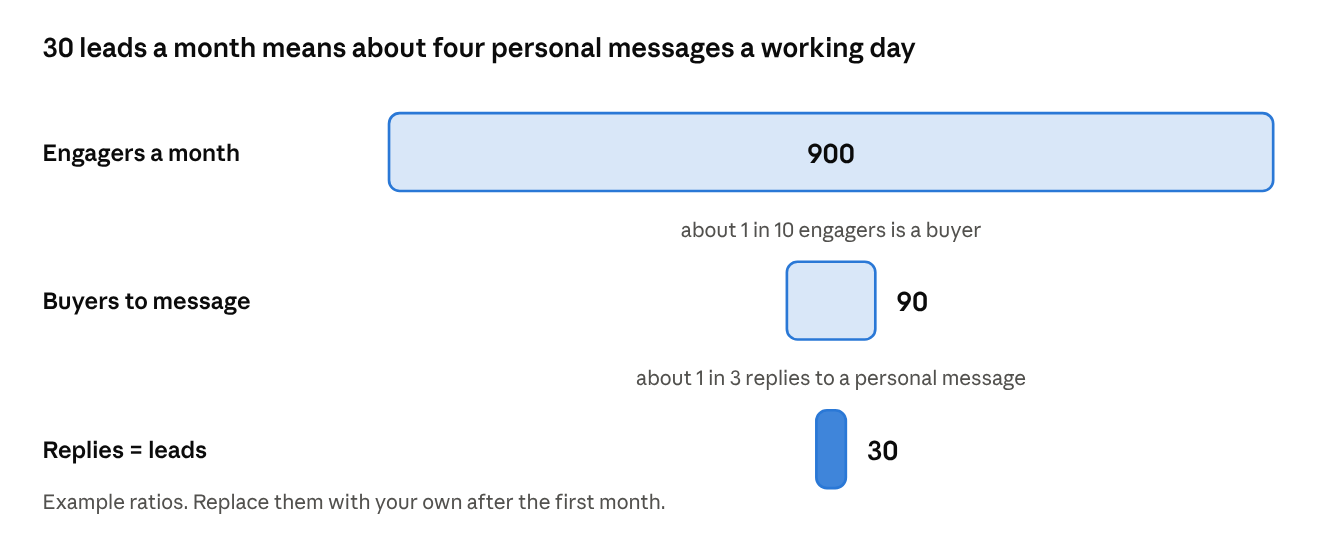
Work backwards from 30 leads
25–35 leads a month sounds like a lot until you run it backwards.
That's about four personal messages a working day, sent to people who already know your name. Most founders can do that between meetings.
If the numbers come up short, two levers move them: more engagers (Stages 1 and 2) or a bigger share of the right ones (sharper topics). Sending more messages to cold names won't.
Engagers, but few buyers: Pull topics from sales calls, not industry news
Buyers, but no replies: Cut the pitch from the first message
Too few engagers: More hijacks, faster; comment on watch-list buyers daily
Replies, but no calls: Add Convert posts so the next step is obvious
Account warnings: Remove any tool that acts on your account
The first month is mostly calibration. You'll learn which topics pull buyers and which pull peers, and that's what makes month three work.
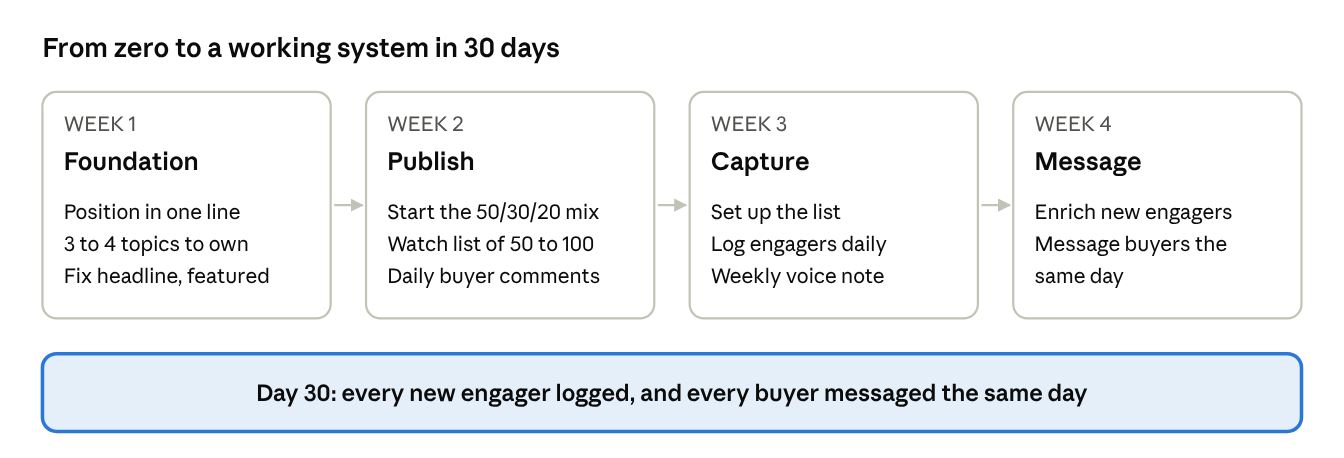
Your first 30 days
Every week you wait, the names already in your buyers' feed get a week more familiar.
Hit the day-30 check and the lead count follows as your reach grows.
Run the refinery without running it
You can build all of this with a spreadsheet and discipline.
Or let Pressmaster run it. Every post that goes out gets monitored, and every person who engages with it, on LinkedIn, X, Instagram or wherever you publish, lands in one list.
Most tools stop at likes. Pressmaster keeps going until they're leads.
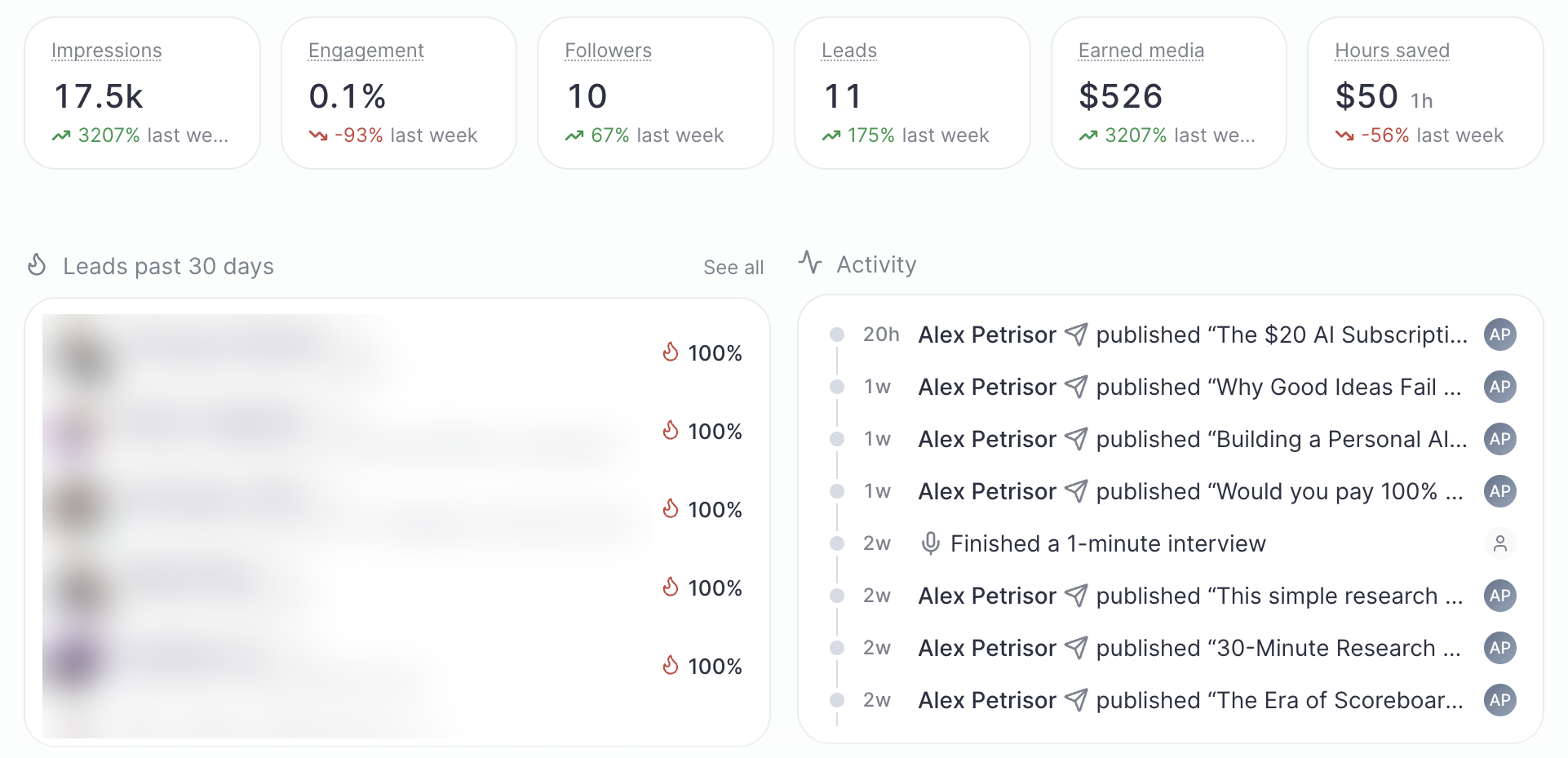
The dashboard tracks the numbers that build pipeline: impressions, followers, leads and earned media. Each lead shows how many times they engaged, next to the posts that pulled them in.
One or two posts a month that reach 200 reactions can put 30 warm leads in that list: people who know your name and are already in the conversation.
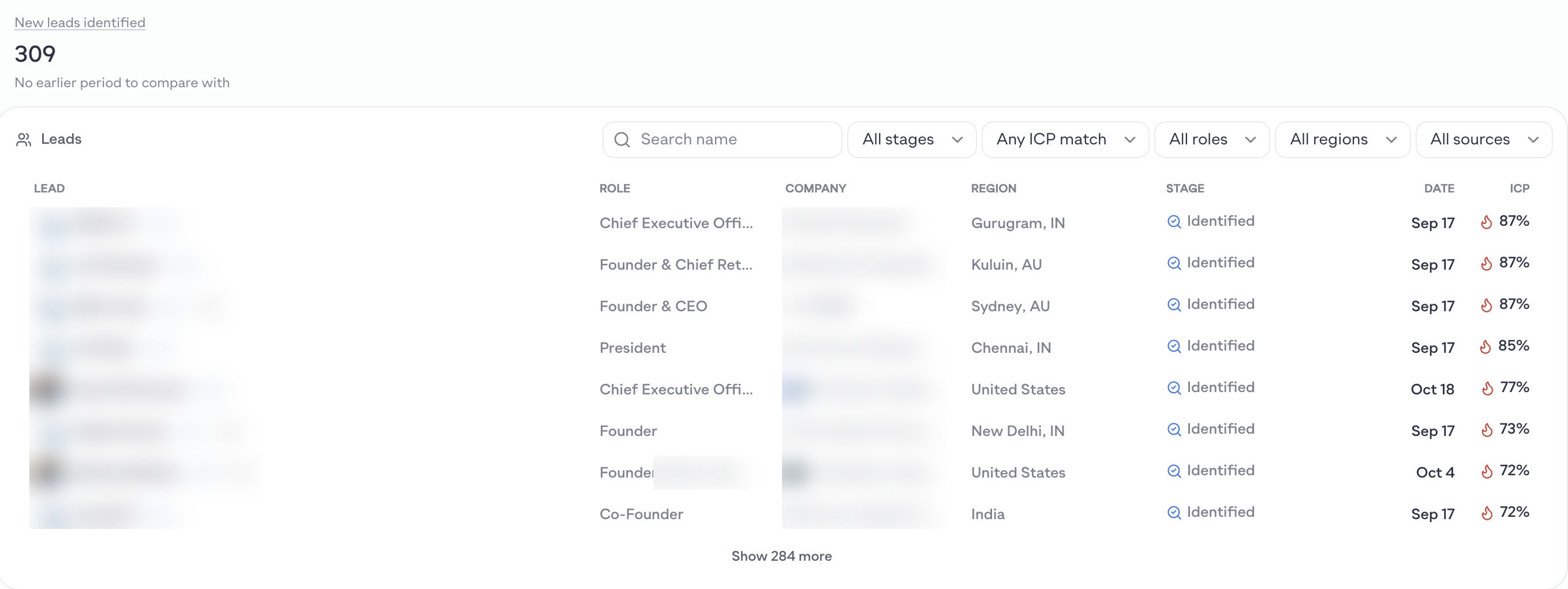
Here's what that looks like for one Pressmaster user: 309 new leads identified in three months, each with role, company, region and how closely they match the buyer profile.
You bring your stories. Pressmaster finds the hijacks, writes in your voice, publishes, and tells you who to talk to.