Before the laws, one thing has to land.
Going viral has nothing to do with how well you write.
The goal of a post is to trigger an impulse. One that makes someone stop, react and act.
Platforms reward exactly that. Read time, likes, comments and shares.
Five or six years ago, information was scarce. It lived in books and in long, painfully written articles. Useful content won because useful was rare.
That era is over.
AI made useful information the most abundant thing in the world. Any answer, any time, within seconds.
When information is everywhere, nobody stops scrolling for it.
The feed isn't run by useful information anymore. It's run by impulses. Reactions, emotion, triggers.
Every law in this guide exists to produce them.
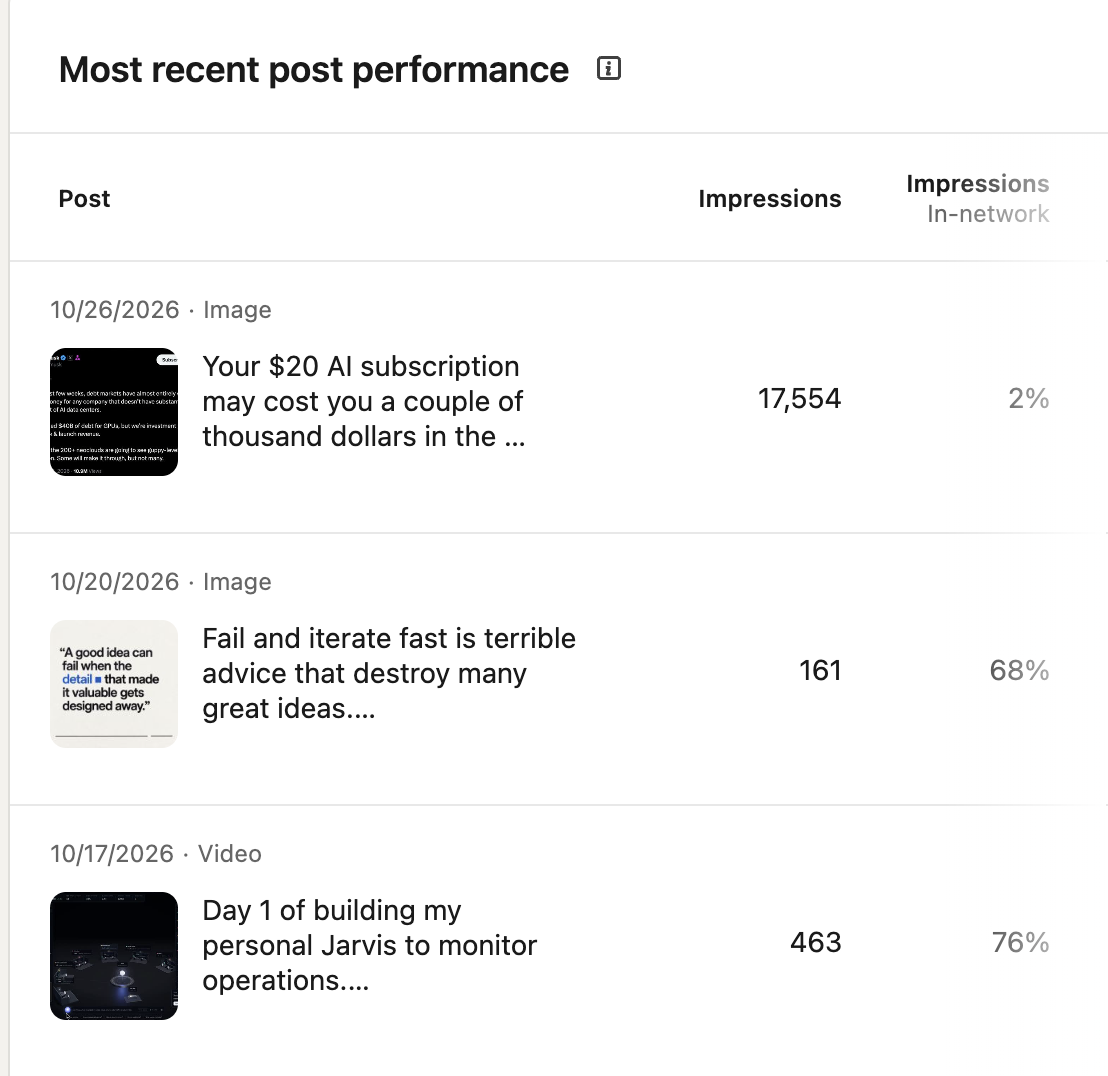
What this looks like on my own feed Here are my last three LinkedIn posts.
The two at the bottom were useful and thought through. A contrarian take on "fail fast" and a build log of an AI agent. 161 and 463 impressions.
The top one hijacked a news story that was already moving, about AI companies borrowing billions to build data centers. I wrapped it in an impulse aimed at the reader's own wallet.
It reached 17,554 people within hours.
Look at the last column. 98% of them were outside my network.
Same founder, same month. The only thing that changed was the impulse.
You've probably felt it already.
Something breaks in your industry on Monday. By Tuesday a competitor's founder has posted his take, and two of your prospects are in his comments.
You knew more about it than he did. You posted something useful instead and it got 10 likes.
He doesn't write better than you. He triggers impulses, and he does it with a system.
That system mines the trends, finds the angle, builds the post and learns from every result, on autopilot. It runs on eight laws.
Law 1 · Every post has one job The first law is the one almost everyone breaks.
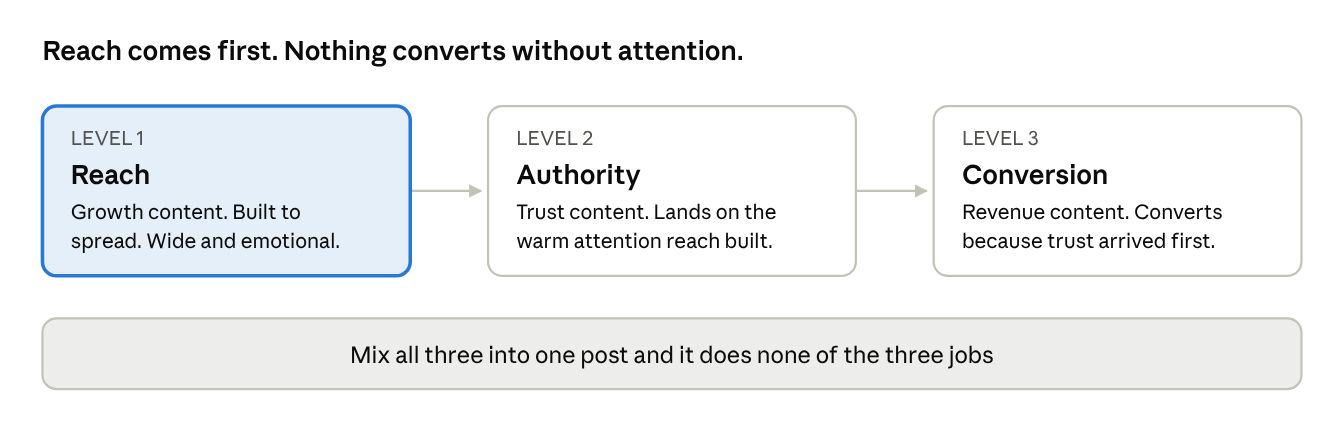
A post has exactly one job. Most founders give it three.
Reach gets you seen by strangers.
Authority makes those strangers believe you.
Conversion makes the believers raise a hand.
Blend all three and the post is too careful to spread, too thin to trust and too vague to sell.
The order is the method. Reach first. Trust lands on the warm attention that reach created. Offers convert because trust arrived before them.
The next laws are about Level 1, reach you engineer on purpose. The final chapters show how that reach descends to buyers.
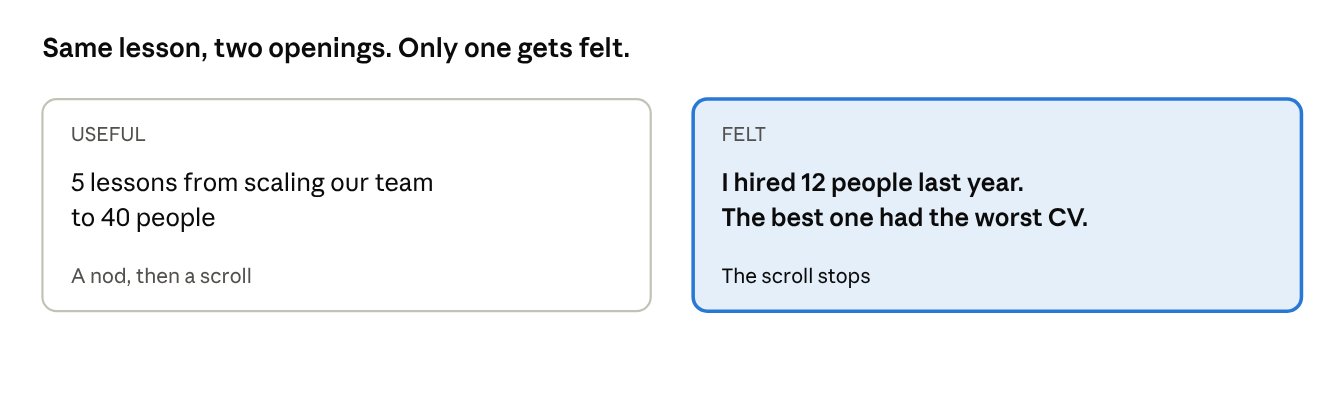
Law 2 · Felt beats useful Founders are trained to be useful. The feed only rewards what people feel.
A post that teaches earns a nod and a scroll.
A post that makes someone feel seen, called out or ambitious earns a reaction.
The felt test. If a draft can be described as useful but not as felt, it isn't ready. Rewrite it.
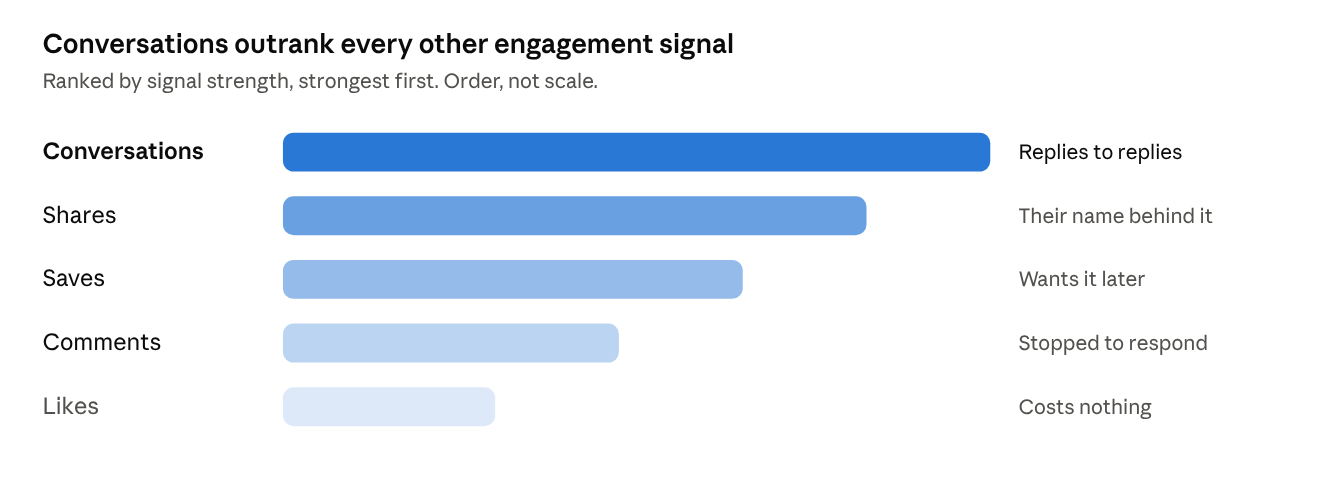
And the feed doesn't count every reaction the same. It ranks them on a hidden ladder.
A like costs nothing. A comment means they stopped. A save means they want it later. A share means they put their name behind you.
Conversations sit at the top. When readers start replying to each other, the feed carries your post to strangers.
Emotional intensity lifts readers up the ladder. The six triggers are how you produce it on command.
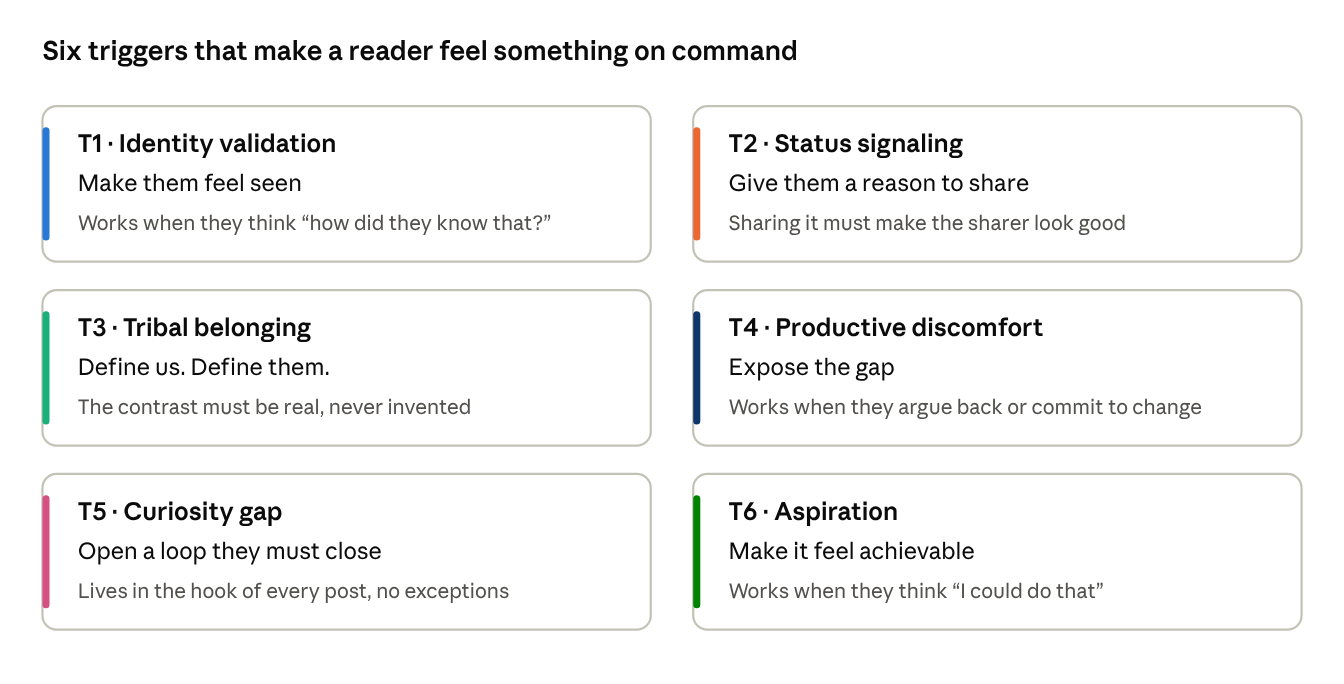
Law 3 · Six triggers move every reader Every post that travels makes the reader feel one of six things. Learn them once and you'll see them in every viral post you scroll past.
Each example below shows one founder making the same point twice. Once flat, once with the trigger.
T1 · Identity validation Say the thing your buyer has thought but never said out loud.
Use it when a frustration is shared by everyone in the role and admitted by no one.
T2 · Status signaling People share what makes them look good. Give them an insight that makes the person reposting it look informed, early or sharp.
If sharing it says nothing about the sharer, it won't spread.
T3 · Tribal belonging Draw a line between the group your reader wants to join and the one they want to leave.
The contrast has to be true. Your buyers know their own industry, and an invented divide costs you their trust.
T4 · Productive discomfort Show the gap between where they are and where they could be, then imply it can be closed.
The strongest version gives the reader something to check. Once they've seen the gap with their own eyes, they can't unsee it.
T5 · Curiosity gap Open a loop the reader has to close. This one goes in the hook of every post.
Only use outcome numbers you can stand behind. A curiosity gap built on a made-up result costs you the trust you're trying to earn.
T6 · Aspiration Show a specific outcome with enough context that it feels reachable.
"I wish I could do that" breeds skepticism. "I could do that" breeds saves and follows. The difference is proof. Same niche, same effort, one change.
A client went from 400 to 40,000 impressions in 28 days. Same niche, same effort, different structure. Here's what changed.
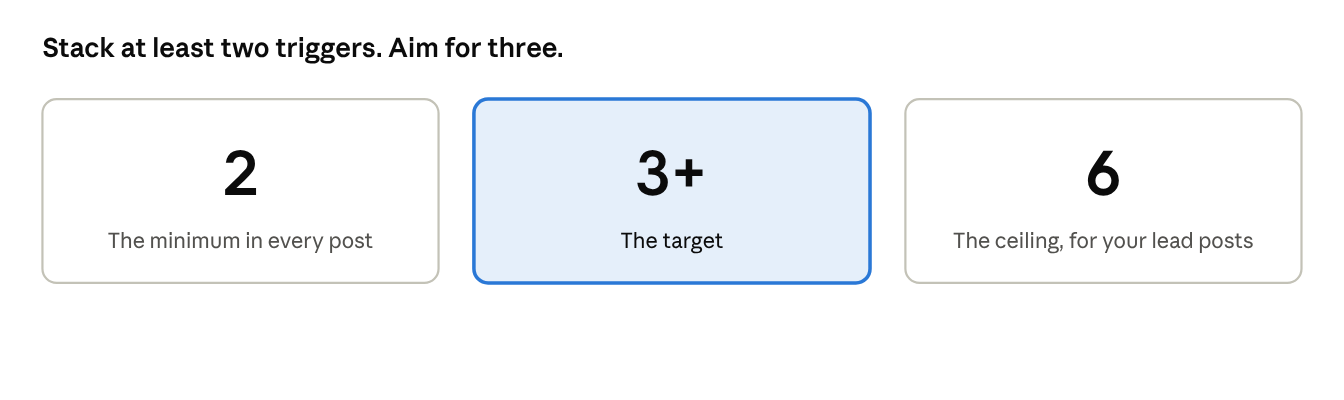
Law 4 · Stacked triggers compound One trigger gets a post noticed. Stacked triggers make it travel.
Treat triggers as a recipe, not a checklist. Pick the ones the idea can carry, then sequence them.
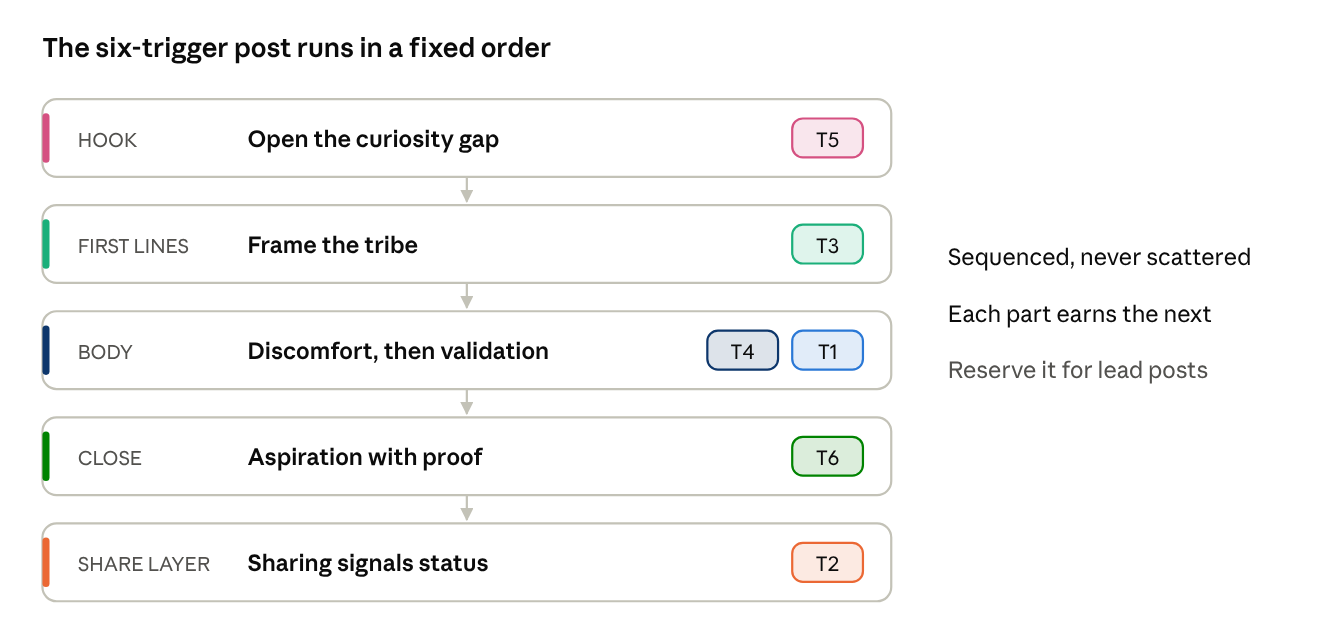
Five stacks that keep working Curiosity + Discomfort (T5 + T4). You want to expose a problem they didn't know they had.Discomfort + Validation (T4 + T1). The audience is cold or skeptical.Curiosity + Aspiration (T5 + T6). You want saves and shares from people who want the result.Tribal + Discomfort (T3 + T4). Passive readers need a push to act.Validation + Aspiration (T1 + T6). The audience feels stuck or discouraged.The six-trigger post For the posts that matter most, run the full stack in this order.
Scatter the same triggers at random and the effect disappears. The order is what makes each line pull the reader into the next.
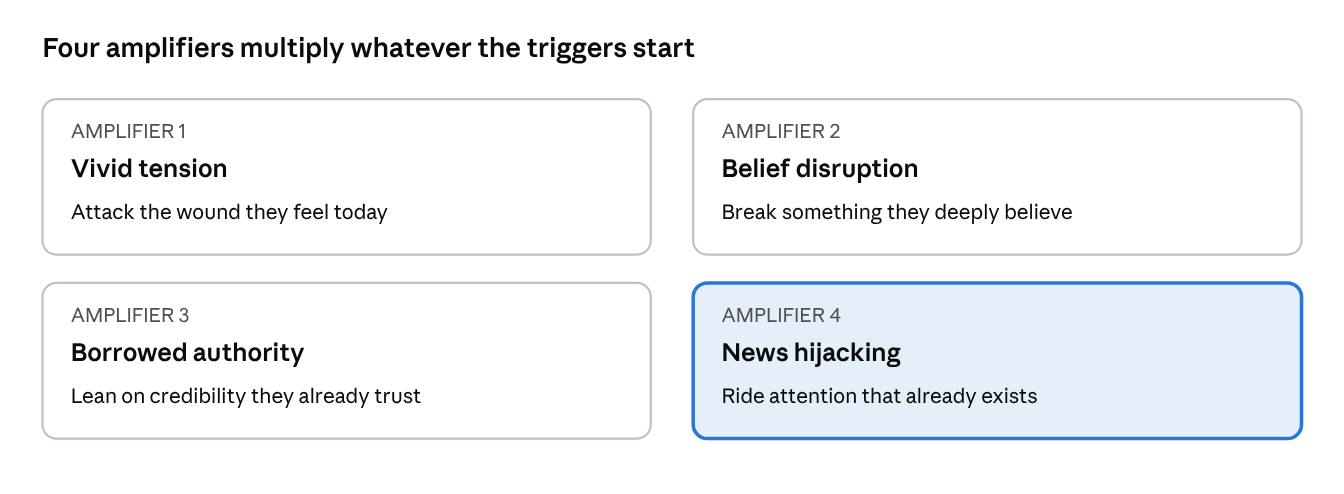
Law 5 · Amplifiers multiply the stack The triggers are the fuel. The amplifiers are the accelerant you pour on top.
Vivid tension Write the wound in present tense. A scene, a number, the reader's own screen.
Discomfort only works on a wound that is open today.
It's Monday. Your competitor's post has 400 comments. Yours has 6.
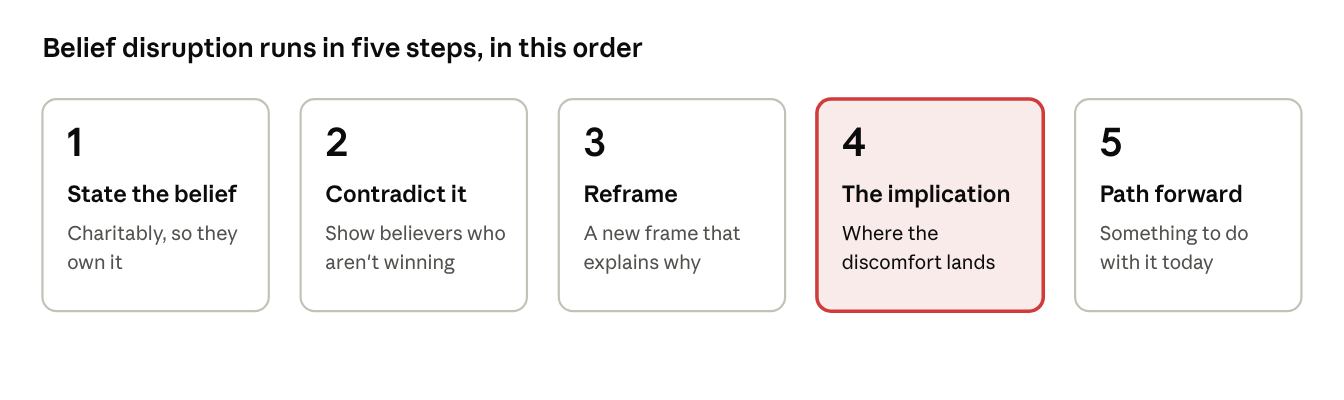
Belief disruption Made for cold audiences who don't know they have a problem yet. You break a belief they hold, in five steps.
The advice was post daily. So you did. 6 months, 180 posts, zero pipeline. Volume was never the mechanism.
Its default stack is T5, T4, T1 and T3.
Borrowed authority Attach your claim to a name, a study or platform data your buyers already trust.
Their credibility carries your point before you've built your own.
News hijacking Ride attention that already exists. The news brings the reach, you bring the angle.
This is the most powerful amplifier a founder has, and the next law is built entirely on it.
Law 6 · Enter the wave before it crests Every news story draws the same curve. Attention climbs, peaks and falls away.
Post on the way up and the story carries you. The feed favours fresh topics, and readers arrive already feeling something.
Post after the peak and you're one more voice in a crowd that has moved on.
That's why you can't hijack news by hand. By the time you've noticed it, thought about it and written it, the window has closed.
The trend radar The method is five moves, run every day.
The three gates A trend only gets through the filter if it passes all three.
Rising. The topic is still climbing, not already everywhere.Felt by buyers. Your buyers care about it, not just your peers.Ownable. You have a real take that someone without your experience couldn't write.The angle is where most trend posts fail. Repeating the news earns nothing. The win is connecting it to the problem your buyer pays to solve.
Law 7 · Reach descends to buyers Reach without trust is entertainment. Reach with trust becomes revenue.
The law of the one hit You can't predict which post will hit. You can guarantee that one will.
The formula is two or more stacked triggers in every post, three to five posts a week.
Volume without engineering is noise. Engineering without rhythm is a one-hit wonder.
What one hit buys you The crowd at the top is wide and cold. The core at the bottom is small, and it's where your revenue comes from.
Treat every new engager on a hit as a lead. Look them up and open a conversation the same day, while your post is still fresh in their mind.
The weekly mix About half your posts hijack reach with trends and viral topics.
About a third speak straight to your buyers' problems.
The reach posts fill the top of the funnel. The buyer posts decide who makes it to the bottom.
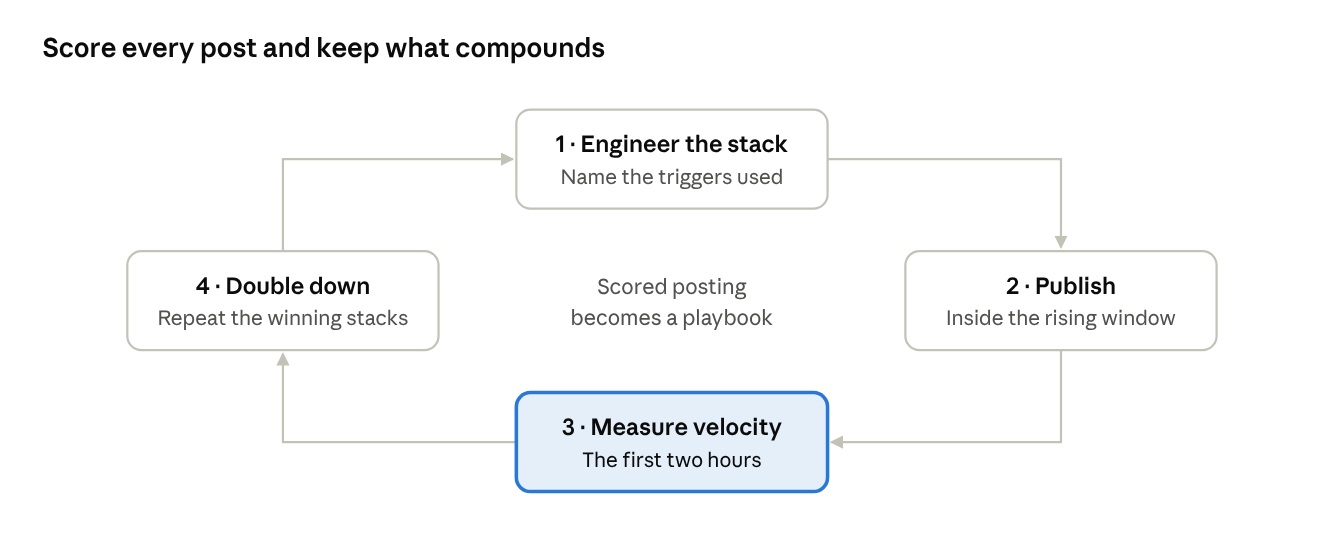
Law 8 · Score every post Random posting gives random results. Scored posting turns into your own playbook.
Track three things on every post.
Comments, saves and shares in the first two hours New followers after it goes out The trigger stack it used After a month the pattern shows itself. Some stacks travel with your audience and some never do. Keep the ones that compound and drop the rest.
Stop posting. Start engineering. Virality was never luck. It follows laws, and now you know them.
Start with one post this week.
Find one topic rising in your market right now. Run it through the three gates. Open with a curiosity gap and stack two more triggers. Publish before the peak. Then check who showed up in the comments. If people who could buy from you are in there, the method works in your market.
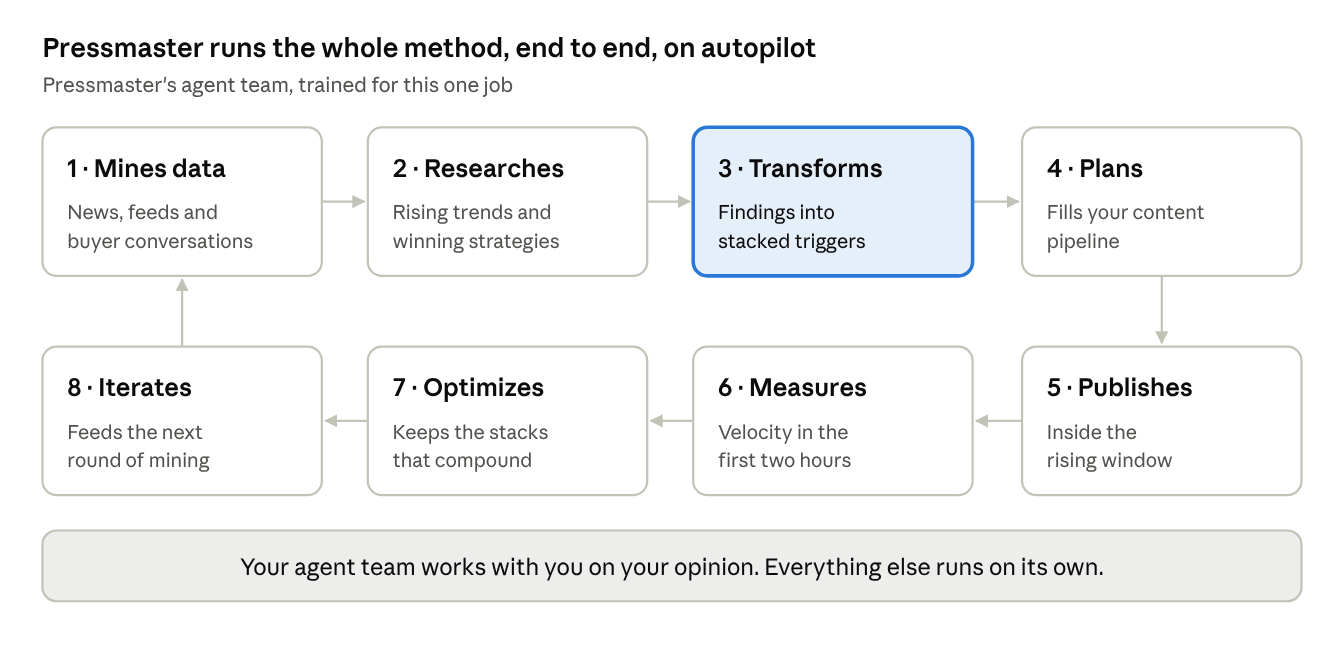
Or let Pressmaster run it on autopilot Doing this by hand every day is a second job. So we built it into Pressmaster as an agent team, structured and trained for exactly this work.
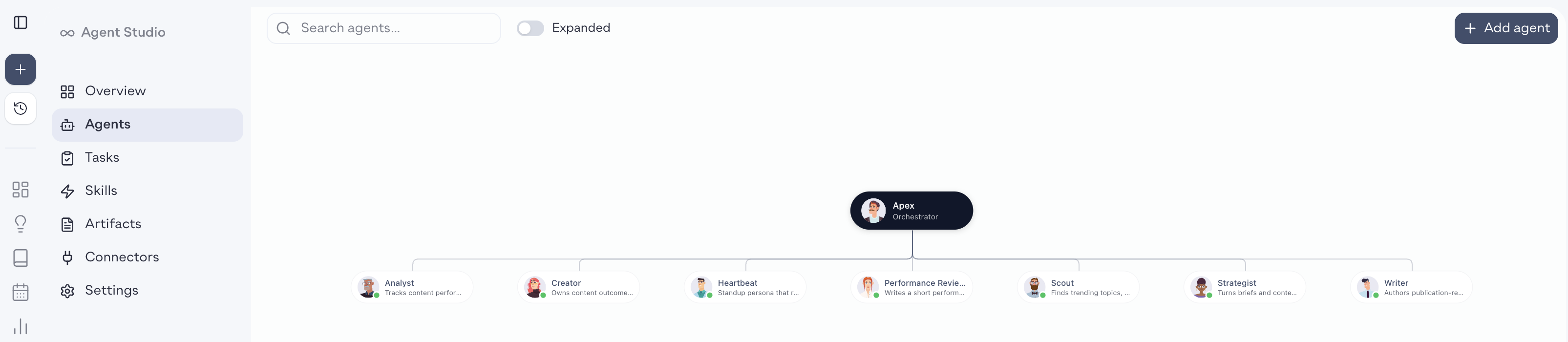
This is my Agent Studio.
Apex orchestrates the team. Each agent below it owns one part of the method.
Scout does nothing else but find what's rising. He mines the data, researches trends and strategies, and hands the findings on.
The Strategist and the Writer turn them into stacked triggers and publication-ready posts, and work with you to fill your content pipeline.
The Analyst and the Performance Reviewer track every post and report what worked.
It runs end to end, completely on autopilot. From mining the data to publishing, measuring, optimizing and iterating.
You stay a founder. Your agent team does the content work, and your feed starts filling your pipeline.